Heat Damage on Curly Hair: Signs, Repair Limits, What's Next
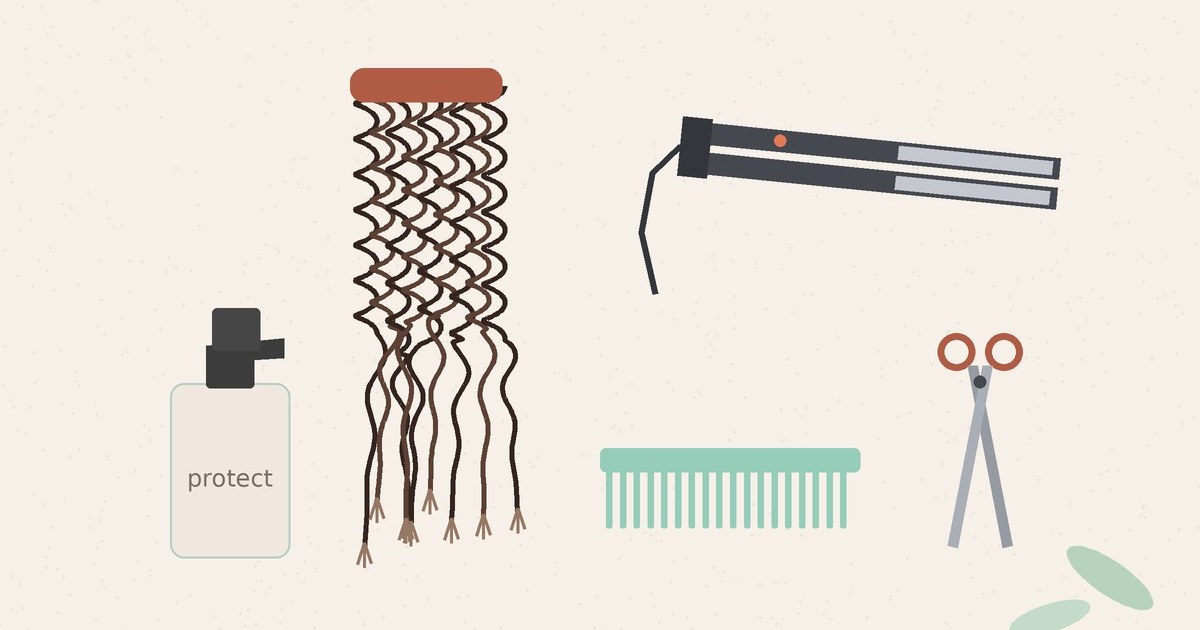
Heat damage on curly hair shows up as sections that stay straight or loose after you wash and air-dry, plus ends that feel rough, tangle easily, and snap when stretched. Once heat has changed the proteins inside a strand, that curl pattern won't fully come back, so trimming is the real fix and products can only improve how the hair looks and feels while it grows out.
That sounds harsh. But it also means you can stop buying "miracle" masks and start a plan that works.
In this guide, you'll learn:
- The signs that point to heat damage
- A three-check strand test you can do on wash day
- What heat actually does inside a curl, from lab studies
- What products can and can't repair
- How to decide: trim now, trim slowly, or treat
- A recovery routine, and safer heat from here on
The rest of this guide covers it in order.
Quick answer
- Signs: curls that won't revert after washing, a straw-like feel, split or frayed ends, more tangles, and strands that snap instead of stretching when wet. (Davines, SELF)
- Can it be repaired? Not fully. The hair shaft is non-living keratin and can't heal itself. When heat has altered the inner cortex, dermatologists say cutting is the only real fix. (SELF)
- What helps meanwhile: conditioner every wash, a moisture and protein balance, gentle detangling, and very little heat. Bond-repair products may help strength, but there isn't enough evidence they permanently reverse damage. (AAD, SELF)
- Going forward: heat protectant first, dry hair only, the lowest setting that works, and heat about once a week or less. (AAD)
Start with a Curltine hair scan
Signs of heat damage
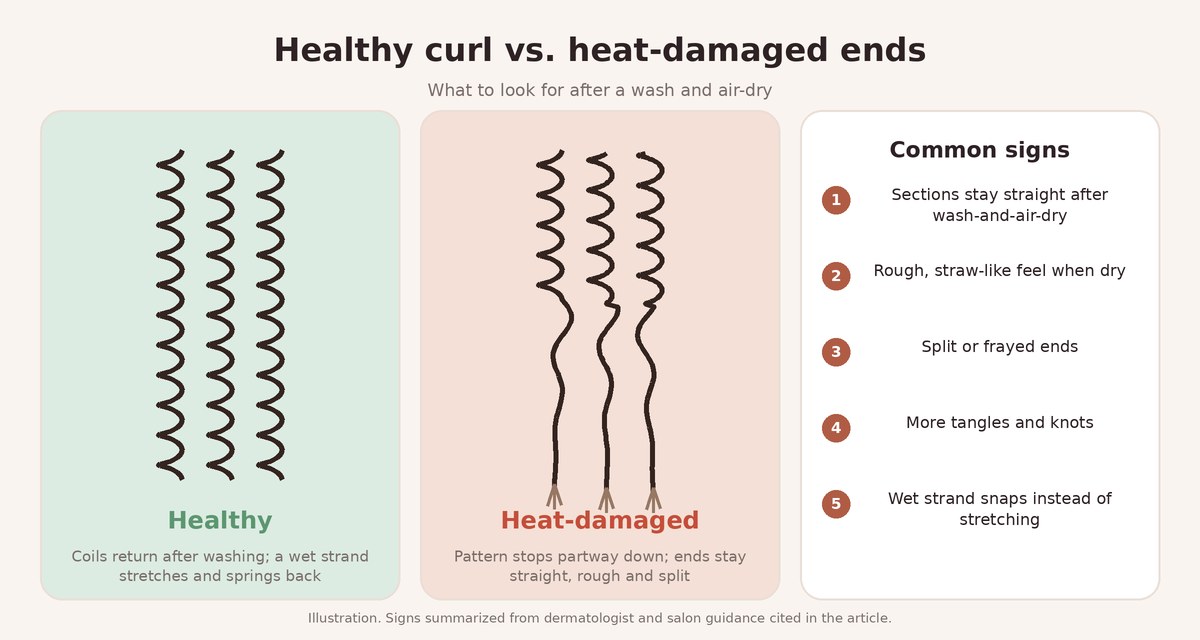
Heat damage rarely hits the whole head evenly. It usually shows up where the iron or wand went most often: the front, the crown, and the last few inches of length.
Look for these:
- The pattern won't come back. After a full wash and air-dry, some sections stay straight, limp, or much looser than the rest. This is the clearest curly-specific sign.
- Rough, straw-like texture, especially when dry, and a dullness that conditioner doesn't fix.
- Split or frayed ends, sometimes splitting further up the strand.
- More tangles and knots than you used to get, especially where straight ends wrap around curly lengths.
- Snapping. A wet strand that breaks when gently pulled, instead of giving a little and springing back. (Davines)
Not every one of these means heat. Frizz alone can come from humidity, and limp curls can come from heavy products or too much moisture. See how to fix frizzy curly hair and protein overload vs. moisture overload before you blame your flat iron.
Three-check strand test
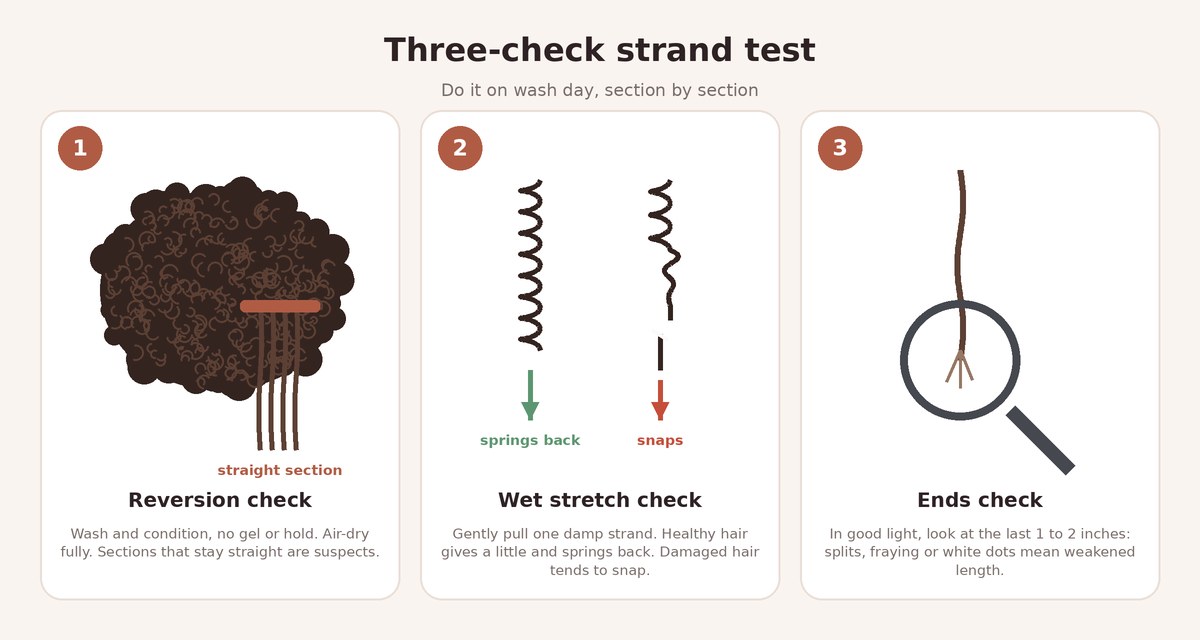
Run this on your next wash day. It tells you which sections are damaged and how far up the damage goes. That's what you need to decide between trimming and treating.
1. The reversion check
Wash with your usual shampoo and conditioner. Skip gel, mousse, and anything with hold. Let your hair air-dry fully. Now look section by section. Sections that dry into their normal pattern are fine. Sections that stay straight or noticeably looser are your suspects. Note roughly how many inches from the end the pattern stops.
2. The wet stretch check
On damp hair, take one strand from a suspect section and one from a healthy section. Hold each near the root and gently pull. Healthy hair gives a little and springs back. Heat-damaged hair tends to snap. (Davines) Don't yank. You are testing, not breaking.
3. The ends check
Under good light, look at the last inch or two of a suspect section. White dots, frayed tips, or splits that run up the strand mean that length is weakened, whatever the curl pattern looks like.
What heat does inside a curl
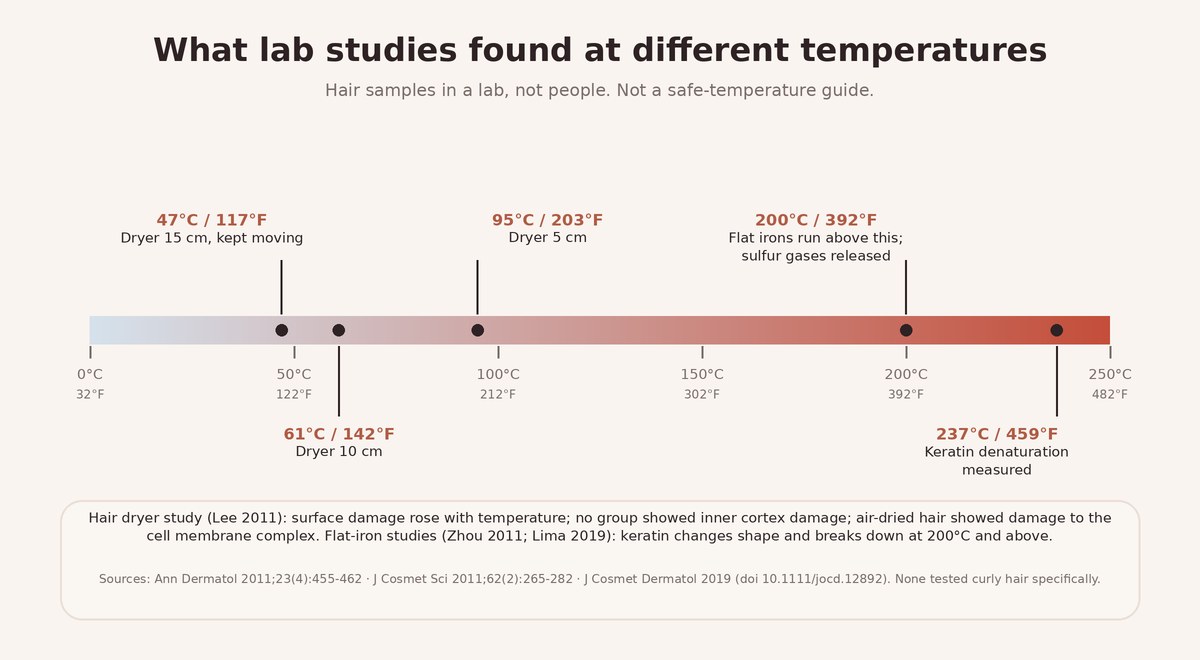
A curl holds its shape because of the structure of keratin proteins inside the strand. The outer cuticle protects that structure. Heat attacks both, and lab studies show roughly where:
- Hair dryer heat mostly roughs up the surface. In a study that shampooed and dried hair samples 30 times, surface damage increased as dryer temperature rose (47°C / 117°F at 15 cm, 61°C / 142°F at 10 cm, 95°C / 203°F at 5 cm). No group showed damage to the inner cortex. (Lee et al., 2011)
- Air-drying wasn't damage-free either. In the same study, only the naturally dried group showed damage to the cell membrane complex, the "glue" between hair cells, which the authors linked to long contact with water. They concluded that a dryer held 15 cm away and kept moving caused less damage than natural drying. (Lee et al., 2011) The AAD still advises air-drying when possible, so think of this as permission to diffuse gently, not a reason to blast heat.
- Flat irons are a different level. Flat irons operate above 200°C (392°F). At those temperatures, keratin changes shape (α-helix to β-sheet) and degrades. Heated hair also absorbed and held less water afterward, and it broke significantly more when combed. (Zhou et al., 2011)
- The breakdown point. In virgin hair heated for analysis, sulfur gases (a sign of protein breakdown) were released from 200°C (392°F), and keratin's denaturation temperature was measured at 237°C (about 459°F). (Lima et al., 2019)
- Wet hair plus a hot tool is worse. "Bubble hair" is a condition in which air-filled cavities form inside the hair shaft, usually from heat. In a review of published cases, most patients had used a heated tool to dry or style wet hair. Treatment was to stop the heated tool. (Li et al., 2023)
Two honest limits: these studies used hair samples, not people, and none tested curly hair specifically. They don't give a "safe" temperature for your curls. What they do show is the direction. More heat, more passes, and wet hair all add damage.
What can and can't be repaired
| Damage | Can it be fixed? | What actually helps |
|---|---|---|
| Dryness, frizz, mild roughness (cuticle surface) | Mostly, yes | Deep conditioning; ingredients like glycerin and dimethicone restore moisture and shine for several washes (SELF) |
| Dull, rough ends | Looks better, not healed | Silicones and emollients temporarily seal the cuticle; the effect washes out (SELF) |
| Split ends | No | Trim them; splits can travel further up the strand (SELF) |
| Straightened sections that won't revert (cortex damage) | No | Trim over time; protein and bond-repair care can make what remains stronger and easier to handle |
The big question everyone asks is whether bond builders can bring curls back. Dermatologists quoted by SELF say these treatments show some promise for strength. They also say there isn't enough evidence that over-the-counter formulas can permanently restore damaged hair to its healthy state. (SELF) Use them to keep weakened lengths from snapping while you grow them out. Don't expect them to rebuild a spiral. More on timing in bond repair for curly hair, and if your hair is also lightened, read bleached curly hair care.
Trim or treat
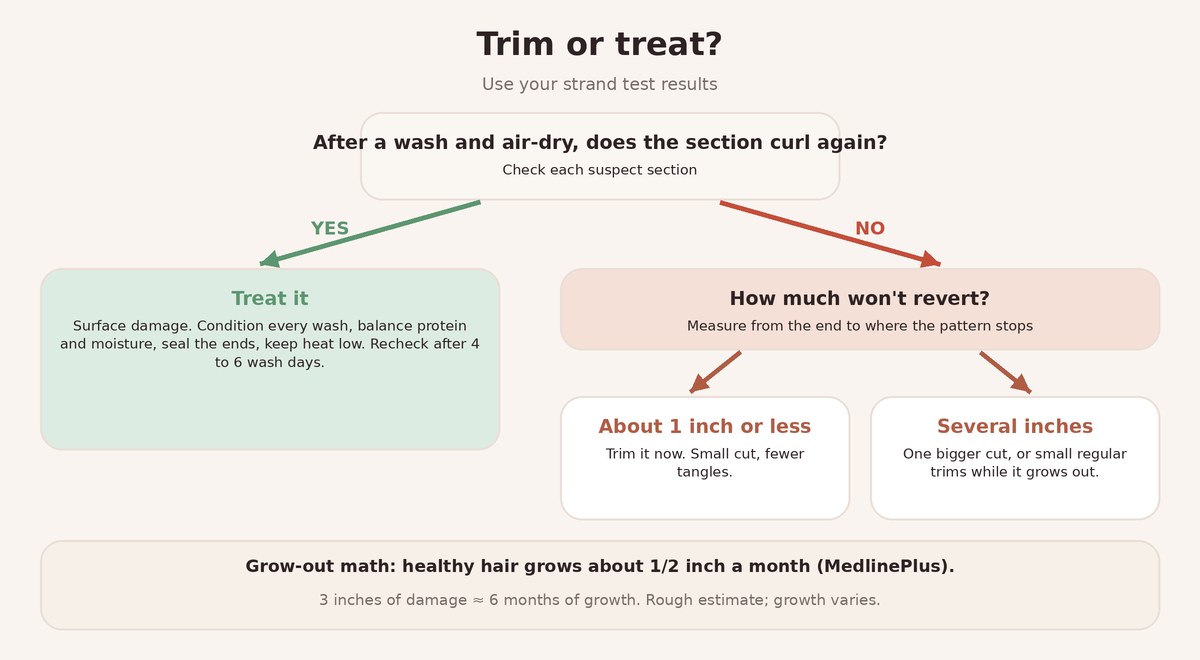
Use your strand test results:
- The section reverts but feels rough or frizzy: treat it. This is surface damage. Follow the routine below for 4 to 6 wash days and recheck.
- Only the last inch or so is straight or split: trim it now. It's a small cut and it stops the tangling.
- Several inches won't revert: choose between one bigger cut and a gradual grow-out with regular small trims. Neither is wrong. The big cut gets you one consistent pattern fast. The gradual route keeps length, but you'll be styling two textures for a while.
Grow-out math. Healthy hair grows about half an inch a month. (MedlinePlus) So if 3 inches are straight, expect roughly 6 months of growth before you can trim it all away without losing overall length. Growth varies from person to person, so treat this as a rough planning number.
While you grow it out, styles that blend two textures help. Twist-outs, braid-outs, flexi-rod sets, and wash-and-go styles with a little more hold can disguise straight ends without heat. If you'd rather not style daily, protective styles for curly hair can keep fragile ends tucked away.
Recovery routine
Heat-damaged hair tends to act like higher porosity hair. In the flat-iron study, heated hair took up and held less water than unheated hair. (Zhou et al., 2011) In practice that means it dries out faster, frizzes sooner, and needs more sealing than the healthy hair above it.
A simple recovery wash day:
- Shampoo the scalp, not the lengths. Let the rinse run through the ends. (AAD)
- Condition every time and coat the ends well. The AAD notes the ends are the oldest and most fragile part of your hair. (AAD)
- Detangle only with conditioner in, using a wide-tooth comb, from the ends up. Damaged ends catch on everything. Full method: how to detangle curly hair without breakage.
- Balance protein and moisture. If hair feels mushy and over-stretchy, it may need protein. If it feels stiff and crunchy, it needs moisture. See when to use a protein treatment and protein vs. moisture balance.
- Seal the ends. A leave-in followed by a cream or a little oil helps damaged lengths hold water longer. The high porosity routine works well for the damaged sections even if your roots are lower porosity.
- Blot, don't rub. Wrap hair in a towel or T-shirt instead of rubbing it dry. (AAD)
- Protect at night with a satin pillowcase or bonnet so fragile ends don't snag. See how to sleep with curly hair.
Not sure where your porosity sits now? Damage can change it. Retake the hair porosity test or read the porosity guide. Then build your wash day with Curltine routines or the free wash day routine guide.
Heat without more damage
You don't have to give up heat forever. But if your curls already show damage, use the strictest version of the advice:
- Dry hair only for irons. The AAD says flat irons belong on dry hair. Wet hair plus a hot tool is how bubble hair happens. (AAD styling, Li et al., 2023)
- Lowest setting that works. Use a tool with a temperature dial and pick the lowest temperature that gives you the style. Thicker, coarser hair may need more heat. (AAD)
- Less often. AAD advice ranges from no more than every other day for flat irons to about once a week, or even less, for hot combs and curling irons. For damaged curls, aim for once a week or less. (AAD habits, AAD styling)
- Shorter contact. Limit how long the tool touches your hair. With a curling iron, a second or two is enough. (AAD styling)
- Protectant first, every time. (AAD)
- Diffuse low and keep moving. If you diffuse, use low heat, keep some distance, and keep the dryer moving. That matches the dryer study's least-damaging setup. (Lee et al., 2011) Compare methods in diffusing vs. air drying.
Reading heat protectant and bond-repair labels
Labels make big promises. A few checks keep you honest:
- Look for film-forming polymers in heat protectants. In the flat-iron study, pretreating hair with VP/acrylates/lauryl methacrylate copolymer, polyquaternium-55, or a complex of PVM/MA copolymer and polyquaternium-28 significantly reduced breakage and helped protect keratin. (Zhou et al., 2011) Those were lab pretreatments, not finished products. A bottle with these names isn't guaranteed to work the same, but it's a better sign than marketing claims alone.
- Know what silicones do. Dimethicone and similar ingredients smooth and shine by coating the cuticle. The effect is cosmetic and washes out. (SELF) If you avoid buildup, read silicones in curly hair products.
- Read "repair" as "improves feel." No over-the-counter product has strong evidence for reversing heat damage. (SELF)
- Watch protein load. Many bond and "repair" products are protein-heavy. Stacked with a protein mask, they can leave curls stiff. See protein ingredients in curly hair products.
Curltine's ingredient checker checks a product's ingredients against your hair profile before you buy or apply it. That makes it quicker to see what you're actually putting on damaged ends. For more on decoding a bottle, see how to read curly hair product labels.
Frequently asked questions
Can heat-damaged curly hair go back to normal? Not fully. Once heat has changed the protein structure inside the strand, the curl pattern in that length won't come back. Your new growth will have your natural pattern, so the fix is trimming the damaged length over time while you care for what's left.
How do I know if my curls are heat damaged or just dry? Wash and air-dry without styling products. Dry hair still curls once it's moisturized. Heat-damaged sections stay straight or loose, feel rough, and often snap when you stretch a wet strand.
Do bond-repair treatments fix heat damage? They may make weakened hair stronger and less likely to snap, but there isn't enough evidence that over-the-counter formulas permanently restore damaged hair. They won't recreate a lost curl pattern.
Is diffusing bad for heat-damaged curls? Not if you're gentle. In a lab study, a dryer held about 15 cm away and kept moving caused less overall damage than natural drying. Use low heat, keep it moving, and stop before your hair is bone dry.
How long does it take to grow out heat damage? Hair grows about half an inch a month on average, so 3 inches of damage takes roughly 6 months to replace. Regular small trims let you remove it gradually.
Next step
Do the three-check strand test on your next wash day and write down how many inches won't revert. That number tells you whether to trim now or plan a grow-out. If you want your routine tuned to how your hair is behaving now, start a Curltine scan. It estimates your curl pattern, porosity, and density from a photo, and the free plan includes one hair scan and one product scan (terms). Curltine is for ages 13 and up (16 and up in the EEA), and its results are cosmetic guidance, not a diagnosis. If you notice thinning or hair loss, see a board-certified dermatologist.
Curltine
Obtenez votre routine boucles personnalisée
Faites un scan IA de 60 secondes et recevez un plan wash day adapté à votre type de boucles, porosité et densité.
Commencer mon plan