Curly Hair Care for Kids: Gentle Wash Day Without Tears
Curly hair care for kids comes down to three habits: shampoo less often than you think (dermatologists suggest every 7 to 10 days for dry, curly hair in kids ages 8 to 12), detangle only when hair is wet and full of conditioner, and pick styles that don't pull. Most tears on wash day come from dry detangling and sections that are too big, not from the products.
If your child's curls are a different texture from yours, the usual advice can feel like it was written for someone else. This guide keeps it short and practical.
In this guide, you'll learn:
- How often to wash a child's curly hair, by age
- A six-step wash day that keeps tugging to a minimum
- How to section by density so detangling goes faster
- Which styles are gentle on the hairline, and the warning signs
- Night care, swimming, and day-2 refreshes
- How to match product weight to your child's hair
Use it as your wash-day plan, and adjust as your child grows.
Quick answer
- Shampoo rarely. For dry, curly hair in kids ages 8 to 12, the American Academy of Dermatology (AAD) suggests shampooing every 7 to 10 days, including hair in braids. Rinse and condition after swimming or heavy sweating. (AAD)
- Condition every time. The AAD says children with dry or curly hair should use a conditioner. (AAD)
- Never detangle dry. Work on wet, conditioned hair, in sections, from the ends up.
- Keep styles loose. Pain, stinging, crusts, or "tenting" of the scalp mean a style is too tight. (AAD)
Start with a Curltine hair scan
How often to wash
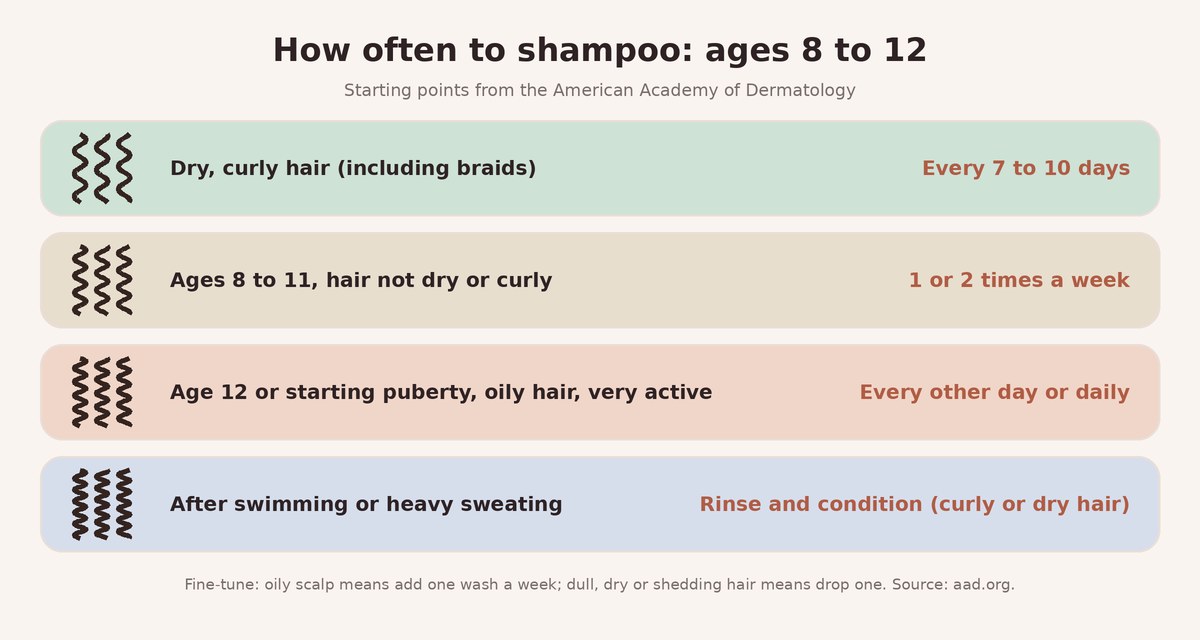
The AAD's guidance for ages 8 to 12 is the clearest starting point we found:
| Child's hair and situation | Starting shampoo frequency |
|---|---|
| Dry, curly hair (including braids or weaves) | Every 7 to 10 days |
| Ages 8 to 11, hair not dry or curly | 1 or 2 times a week |
| Age 12 or starting puberty, oily straight hair, or very active | Every other day or daily |
| After swimming or heavy sweating (dry or curly hair) | Rinse and condition |
Source: AAD, "How often do children need to wash their hair?"
Then fine-tune by looking at the hair and scalp between washes. If the scalp looks oily, add one shampoo a week. If the hair looks dull, dry, or is shedding, drop one. If it still seems off, the AAD suggests seeing a dermatologist.
For younger kids, there is no single rule. Many parents of curly toddlers rinse with water and use conditioner between occasional gentle shampoos. Watch the scalp: flakes, itch, or a smell mean it needs a real wash. More on cleansing choices in co-wash vs. shampoo and curly hair scalp care. For adult cadence, see how often to wash curly hair.
Six-step gentle wash day
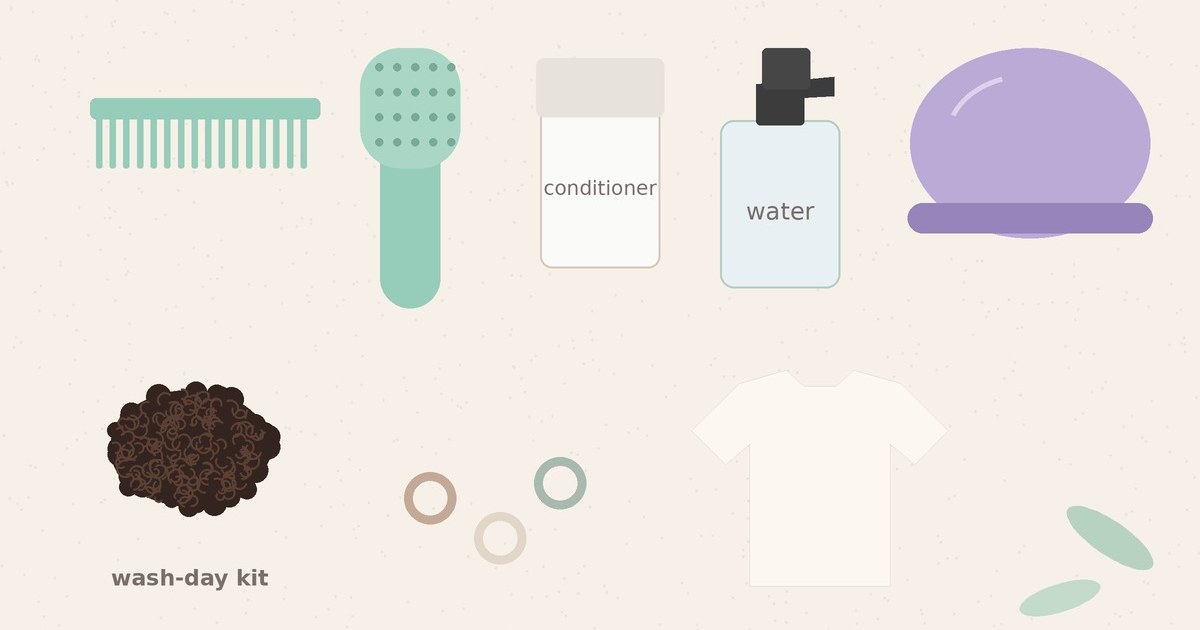
Set up everything before your child gets in the tub: conditioner, a spray bottle of water, a wide-tooth comb, clips or hair ties, and a cotton T-shirt. Short sessions beat marathons.
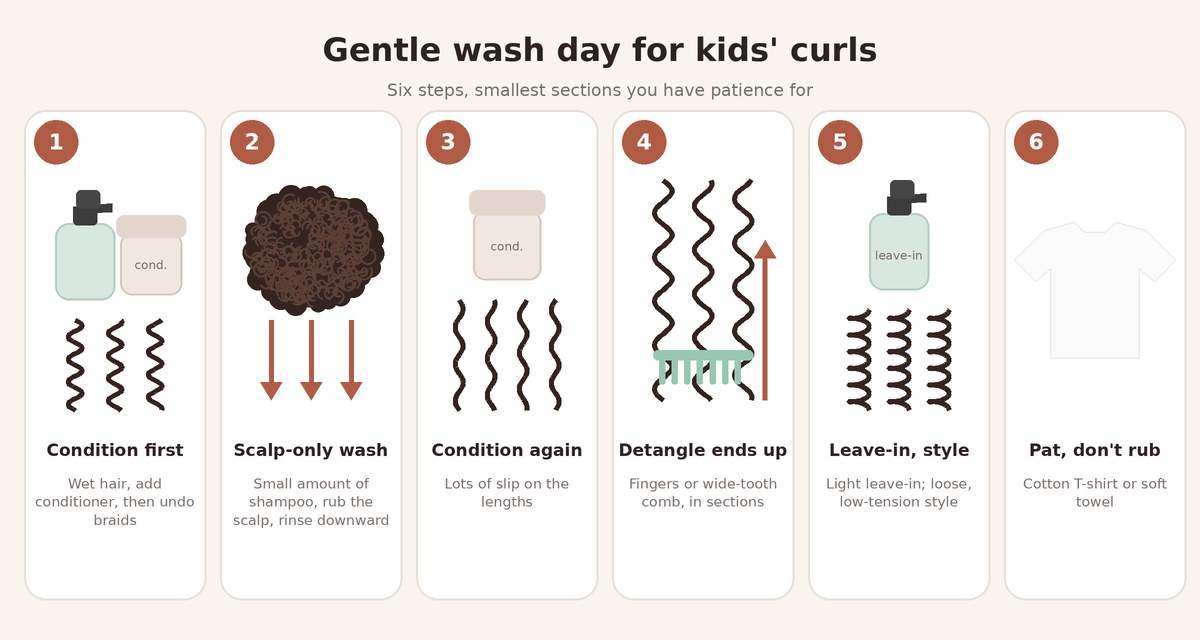
1. Wet the hair and condition first
Soak the hair, then work conditioner through the lengths before shampoo. If your child is wearing braids or twists, take them down after the conditioner is in, so you are not pulling dry knots apart. Undo braids gently; don't tug from the end.
2. Shampoo the scalp only
Put a small amount of shampoo in your palm (the AAD suggests about a quarter-size amount when teaching kids) and rub it gently into the scalp, not the lengths. Rinse in a downward direction. Piling hair on top of the head while washing creates tangles.
3. Condition again
Add plenty of conditioner to the lengths. You want the hair to feel slippery before any tool touches it.
4. Detangle from the ends up, in sections
Use your fingers or a wide-tooth comb. Hold each section above the tangle so the pull lands on your hand, not your child's scalp. Start at the ends and work toward the roots. Re-wet and add more conditioner whenever a section starts to feel dry. Full technique: how to detangle curly hair without breakage.
5. Leave-in and a loose style
Rinse, then smooth a little leave-in through damp hair. Finish with a loose, low-tension style or simply leave the curls out.
6. Pat dry, don't rub
Wrap the hair in a cotton T-shirt or soft towel and press. The AAD notes that rubbing wet hair with a towel can cause breakage. Air dry when you can; if you use a dryer, keep the heat low.
Keep it tear-free
- Give them a job. Let your child hold the spray bottle or the comb they'll use next.
- Time-box it. Detangle a few sections, take a break, and finish the rest later or tomorrow if hair stays twisted or clipped.
- Tell them to speak up. Pediatric dermatology guidance encourages kids to say when styling hurts, because ongoing pain is a sign a style needs to come out. (Afifi et al., 2021)
Section by density
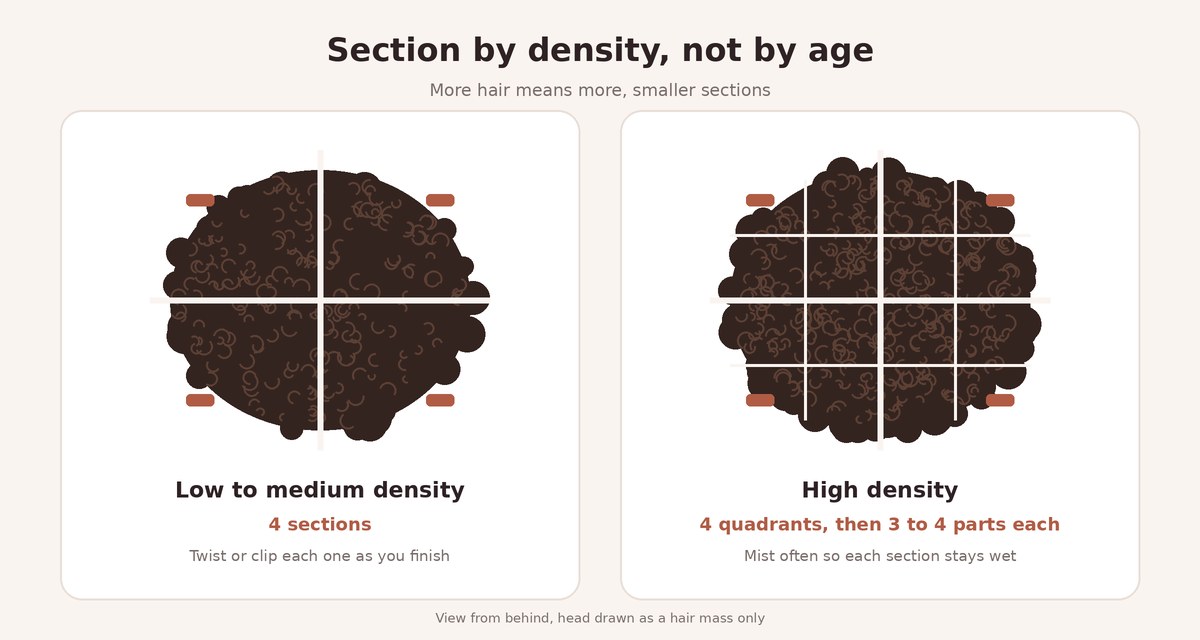
Age doesn't tell you how long detangling will take. Density (how many strands are on the head) does.
- Low to medium density: four sections are usually enough. Clip or loosely twist each one when it's done.
- High density: split into four quadrants, then divide each into 3 or 4 smaller parts. Mist often so every section stays wet.
Smaller sections mean less pulling per pass, which is what actually reduces tears. Not sure where your child's hair falls? Use the at-home checks in hair density.
Low-tension styles
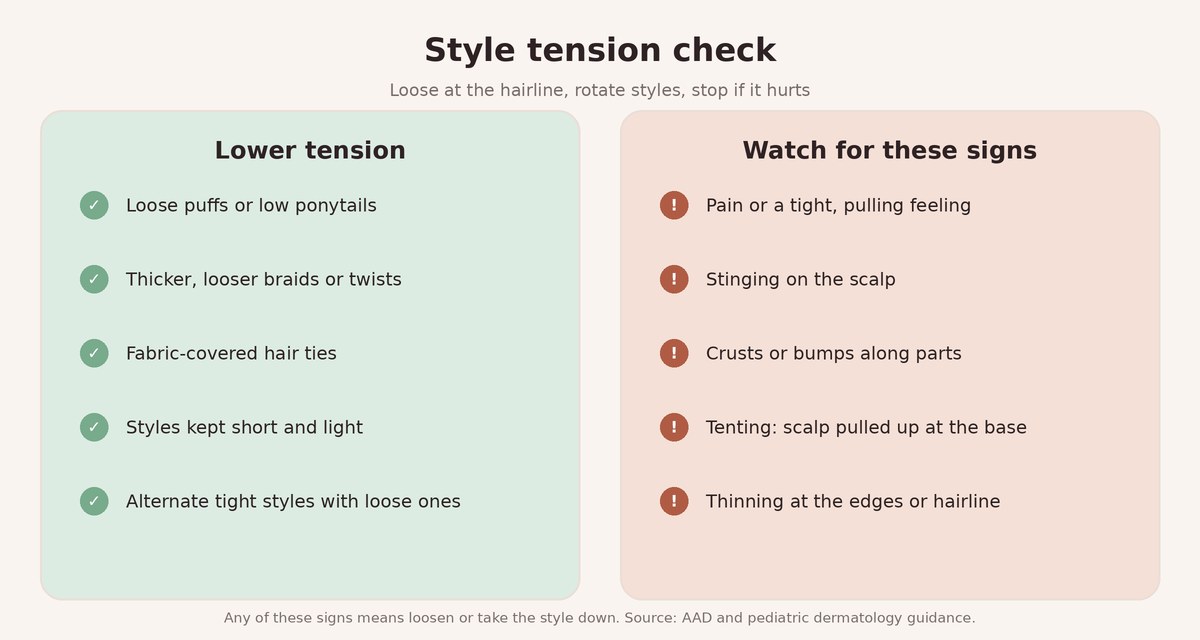
Traction alopecia is hair loss from repeated pulling, and the AAD notes that children can get it too. Habits that lead to it often start young. (AAD)
Gentler choices:
- Loose puffs, low ponytails, or curls left out
- Thicker, looser braids or twists, especially around the hairline
- Fabric-covered hair ties instead of bare elastics (AAD)
- Rotating tight styles with loose ones, for example tighter styles during the day and a looser style at night (Afifi et al., 2021)
Take the style down or loosen it if you see: pain, stinging, crusts on the scalp, or "tenting" (the scalp pulled up at the base of a braid). (AAD) Thinning at the edges is a reason to see a dermatologist.
The AAD also advises styles that don't need heat or chemical treatments for kids, and lower heat when heat is used. (AAD)
Night, swim, and day 2
Night: a satin or silk pillowcase, or a satin bonnet for kids who keep it on, cuts friction. Longer curls can go into a loose, high pineapple or a couple of big loose twists. More options in how to sleep with curly hair.
Swimming: wash pool chemicals out the same day. The AAD says kids with normal to oily hair do best with a shampoo after swimming, while kids with very dry hair should rinse well and condition. (AAD)
Day 2 and beyond: mist with water, add a little leave-in, and scrunch or finger-shape. Don't comb dry curls. See refresh curls between wash days.
Product weight by porosity
Kids don't need a shelf of products. Usually a gentle shampoo, a conditioner with lots of slip, and one leave-in or cream are enough. What changes is weight:
| What usually helps | |
|---|---|
| Low porosity (water beads up, products sit on top) | Lighter leave-ins and creams, warm water, thin layers |
| Medium porosity | Leave-in plus a light cream |
| High porosity (soaks up water, dries fast, frizzes) | Richer cream; seal with a little oil if hair dries out quickly |
These are starting points, not rules. Learn the signs in hair porosity and the hair porosity test, and match pattern names with the curl type chart. Unsure what's in a kids' bottle? Paste the label into the ingredient checker.
Frequently asked questions
How often should I wash my child's curly hair? For kids ages 8 to 12 with dry, curly hair, the AAD suggests every 7 to 10 days, then adjusting: add a wash if the scalp is oily, drop one if hair looks dull, dry, or sheds. Rinse and condition after swimming or heavy sweating.
Should I brush my child's curly hair? Not when it's dry. Detangle wet, conditioned hair with fingers or a wide-tooth comb, from the ends up. The AAD recommends a wide-tooth comb more often than a brush.
How do I detangle without tears? Condition before and after shampoo, use small sections (smaller for dense hair), hold the hair above the knot, and take breaks. Ask your child to tell you when it hurts.
Are braids bad for kids' hair? No, but tension is. Keep braids loose, especially at the hairline, choose thicker braids, and rotate with loose styles. Pain, stinging, crusts, or tenting mean the style is too tight.
Can I use the Curltine app for my child? The Curltine app is for people 13 and older (16 and older in the EEA), per our terms. For younger kids, use the free curl type chart, porosity, and density guides. Teens 13 and up can run their own scan.
Next step
Pick one change for this week's wash day: condition before shampoo, or cut your sections in half. Then build the rest of the routine with the free wash day routine guide and Curltine routines. If your teen (13+) wants a plan matched to their own curl type, porosity, and density, they can start a Curltine scan.
Curltine
Obtenez votre routine boucles personnalisée
Faites un scan IA de 60 secondes et recevez un plan wash day adapté à votre type de boucles, porosité et densité.
Commencer mon plan