Curly Hair Analyzer: Results and Photo-Scan Limits
A curly hair analyzer can suggest a hair profile from a photo. Review the labels and their limitations before changing your routine. Curltine’s store listing describes a photo-based profile and hair score; these descriptions do not independently establish accuracy or guarantee current feature access.
Looking for a product ingredient scanner?
This page covers photo-based hair profiles. If you want to check a bottle or ingredient list, use the ingredient checker guide. A hair photo and a product-label photo answer different questions.
What a photo result can and cannot establish
A photo can show visible pattern and styling, but an app suggestion is not a laboratory porosity measurement, counted follicle density, or a scalp diagnosis. Lighting, hair arrangement, and image quality can change the estimate. Use your observations alongside the result.
For capture steps, use the scanner tutorial. To identify shape without a scan, use the at-home pattern guide.
Quick facts
- Analyzer ≠ curl-type label alone
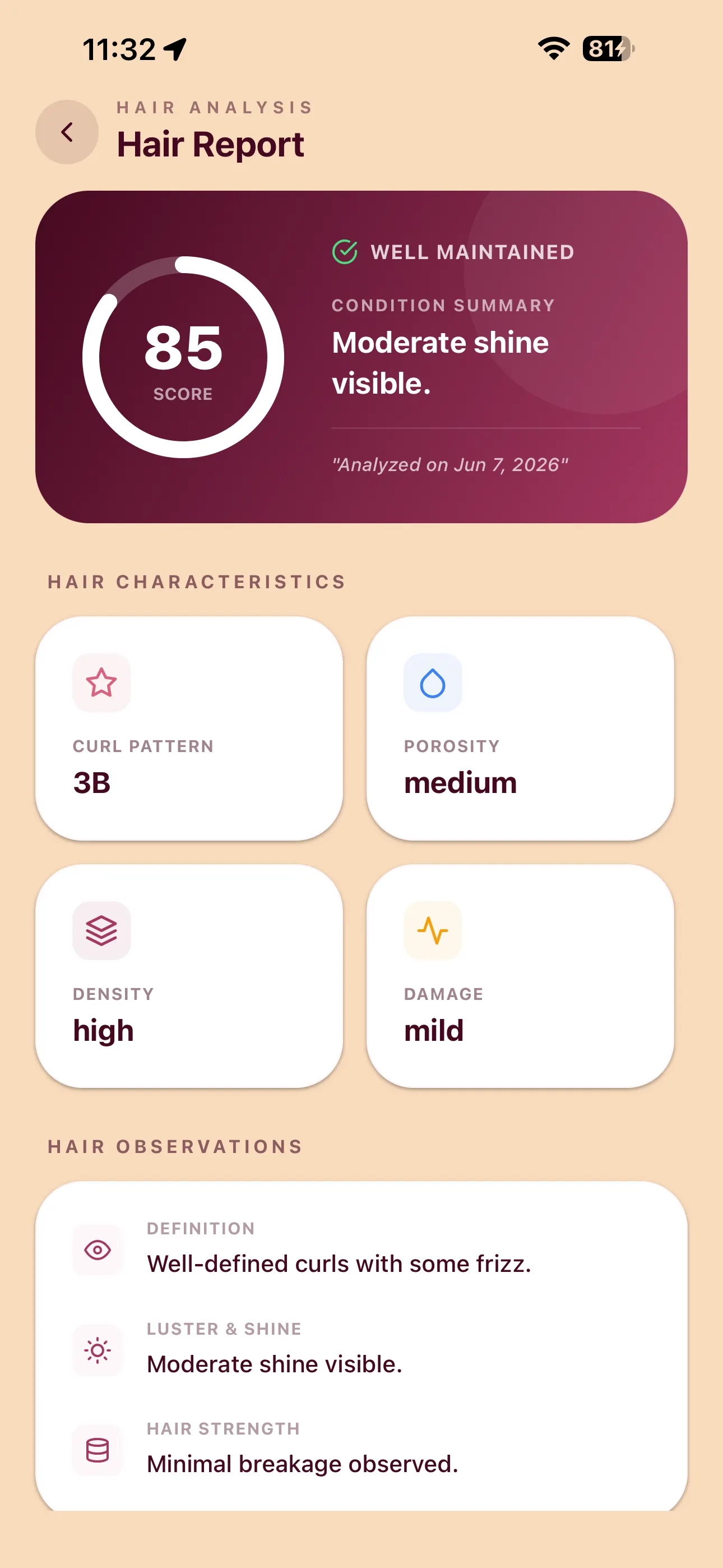
- The existing report screenshot shows pattern, porosity, density, and definition labels
- Results should drive wash-day choices, not vanity ranking
- Compare any hair score alongside similarly captured photos; a score change alone does not establish improvement
- Pair with curl type chart and 3 pillars of curly hair
- Mechanics: how Curltine AI hair scan works
What a curly hair analyzer should tell you
Curl pattern
Shape family (waves, curls, coils), clump size, and mixed zones. Pattern alone does not pick product weight. It does guide hold style, shrinkage expectations, and styling technique. Reference map: curl type chart.
Porosity
How easily moisture enters and leaves the strand. Low, medium, and high tendencies change conditioner timing, product richness, and clarifying needs. Consider observed moisture behavior rather than treating a photo estimate as confirmation; see hair porosity test.
Density
How full the hair mass looks at the part and in sections. Density changes how much product you need and whether roots weigh down. Low density often needs lighter layers; high density needs thorough sectioning.
Frizz and definition
Halo frizz, broken clumps, and soft vs crisp separation. These move fastest with weather and technique, so an analyzer should treat them as current state, not a permanent verdict.
Look for a clear explanation of which outputs are estimates and how you can check them. The 3 pillars explain why pattern without porosity and density leads to product fails.
How Curltine’s profile works (plain language)
Curltine describes a photo-based profile in its store listing. Treat the suggested traits as estimates rather than a stylist assessment. The listing also describes routine guidance and product analysis; current access should be checked in the app.
It is not a lab cuticle measurement. Repeated scans can help you compare visible results, but they do not establish accuracy or prove that the model learns from your logs. Full breakdown: how Curltine AI hair scan works. Photo how-to: curly hair scanner.
What the hair score means
The store listing describes a hair score for progress tracking. We have not verified the precise weighting or independent accuracy. Compare the number with similarly captured photos and your own notes; a change may reflect styling or image conditions.
See what Curl Score measures for the product overview, and treat suggestions as a starting point.
Review a suggested profile
- Check current access in Curltine and follow its hair-scan prompts.
- Use a clear photo with even light and visible sections.
- Read the labels as estimates and compare them with your own observations.
- Choose one routine adjustment if useful, then record the result. Repeated scans may require paid access.
The existing report screenshot illustrates displayed output. The current native scan, results and routine-access sequence has not been exercised for this guide.
Analyzer vs quiz vs DIY typing
| Method | What you get | Limit |
|---|---|---|
| Curl type quiz | Pattern label | Often skips porosity/density |
| DIY home typing | Pattern + your notes | Easy to miss mixed zones |
| Curltine analyzer | Store-described photo profile and hair score | Current access may differ; compare estimates with your observations |
DIY still helps. Combine find curl type at home with analyzer results when you want both intuition and structure.
Frequently asked questions
What is a curly hair analyzer?
A tool that suggests a hair profile from photos or answers. Review which results are estimates and what evidence supports them.
What should a curly hair analyzer tell me?
It should explain its suggested traits, their limitations, and possible next steps. A photo result does not establish measured porosity or counted follicle density.
What does the hair score in Curltine mean?
The store listing describes a hair score for progress tracking. The precise weighting and independent accuracy were not verified; compare scores alongside consistent photos and your observations.
Is a curly hair analyzer the same as a curl type quiz?
A quiz uses your answers; a photo analyzer uses image-based estimates. Both can suggest a starting point, and neither establishes every physical trait.
How do I use analyzer results?
Review the suggested profile, choose one routine adjustment, and record the result. Similar photo conditions help comparisons, but a score change alone does not prove better hair health.
Related guides
Curltine
Explore Curltine
See the app overview and check current features and access before downloading.
View Curltine