2B vs 2C Hair: Compare Your Wave Pattern
2B vs 2C hair is a comparison between two wave patterns in the common Type 2 chart. Both can form S-shaped bends; 2B is usually described with more open waves, while 2C describes deeper, more pronounced bends that may approach a loose curl. These are visual labels, not exact measurements, and a person can see both patterns in different sections.
If you are deciding between 2B or 2C hair, compare several fully dry sections under similar conditions. Do not use root volume, strand thickness, frizz, or a single product result as a shortcut to a label.
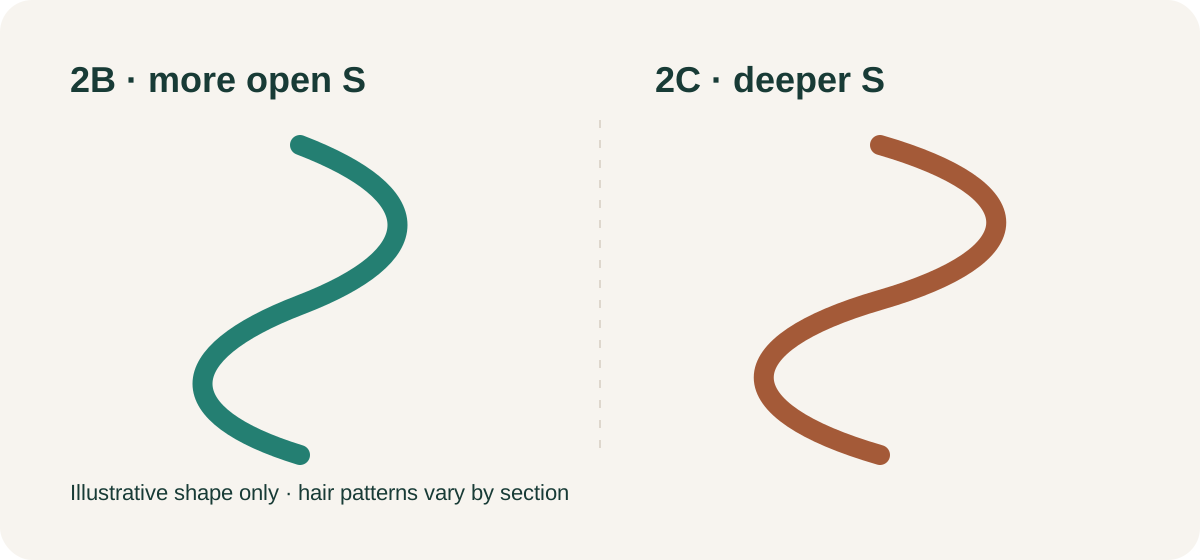
2B vs 2C: the quick difference
Both are wavy patterns. A useful first comparison is the repeated shape along the dry lengths: 2B is commonly described as a clearer, more open S; 2C as a deeper S that can turn into a loose bend or loop near the ends. Either pattern may vary from crown to nape, and styling can make the same hair look different from one wash day to another.
| What to compare | 2B (open-wave shorthand) | 2C (deep-wave shorthand) | What this does not tell you |
|---|---|---|---|
| Repeated dry shape | More open S-bends | Deeper, more pronounced S-bends; some ends may loop | An exact boundary or required routine |
| Across the head | Some areas may look looser or straighter | Some areas may look curlier than others | That every section shares one label |
| Wet-to-dry view | Bends may relax, stay similar, or be shaped by styling | Bends may look stronger or softer as sections dry | A guaranteed amount of shrinkage |
| Helpful next check | Compare the same zones after the usual routine | Compare the same zones after the usual routine | Strand thickness, density, or porosity |
The chart is a way to describe visible pattern. The American Academy of Dermatology notes that hair-care choices should account for an individual's hair and scalp; a type label alone cannot determine what products will suit you. See its curly-hair care guidance for general care advice.
How to compare your waves at home
You do not need a new product or a special test. Use a familiar wash day so you can describe the pattern you already see.
- Cleanse, condition, and style as you normally would. If something differs from your usual routine, make a note of it.
- Let your hair dry without deliberately stretching the bends. Use your ordinary air-drying or diffusing method and follow the product directions.
- In even light, compare the crown, sides, and nape once the hair is fully dry. Look for shapes that repeat across more than one section.
- Describe each zone in plain words: “open S,” “deeper S,” “loose bend,” or “mixed.” Keep product amount, handling, and drying method in separate notes.
- If you want to compare again, try to keep the conditions similar. A different result is useful context, not proof that your pattern changed.
This observation can help you choose which care guide to read. It is not a validated diagnostic method, and it cannot establish porosity, density, strand thickness, or the cause of frizz.
For the wider identification method, use how to find your curl type at home. The curl type chart shows the broader 2A–4C naming system.
Mixed 2B and 2C sections are possible
Imagine the sides show open S-bends while the nape forms deeper bends that sometimes loop at the ends. You could note “2B-like sides, 2C-like nape” rather than forcing one letter onto every zone. That description can be more useful when choosing how much product to apply in each area.
Another person may see deeper waves in most sections, with a few looser pieces around the crown. Neither example is a measured result or a rule for assigning a label. Length, cut, styling, and the section you inspect can all affect what is visible.
If your hair falls between the descriptions, “mixed Type 2” is a reasonable shorthand. You do not need a more precise label before making a small, reversible care adjustment.
What may change in your care—and what may not
A 2B or 2C label does not prescribe a particular product weight. Pay attention to the result you want and how your own hair responds. The 2B care guide and 2C care guide cover those routines in more depth; this table is only a starting point for deciding what to observe.
| What you notice | A small next check | Avoid concluding |
|---|---|---|
| Waves feel coated or look flatter after several layers | Follow label directions and compare using a smaller amount or one fewer layer next time | “I must be 2B” or “2C hair cannot use this” |
| Bends are present but do not hold the finish you want | Review how the product was applied and how the hair dried; change one step at a time | “I need a richer cream” based on the type label alone |
| Crown and nape behave differently | Note the zones separately and adjust application by section if helpful | “My hair type is inconsistent” |
| Frizz appears | Check timing, weather, handling, and product directions; use the frizz guide for troubleshooting | That frizz proves 2C, dryness, damage, or porosity |
These are practical comparisons, not guaranteed outcomes. Follow product directions and change one variable at a time so you can tell what you prefer. The wash-day routine guide covers a broader sequence without assigning it to one wave subtype.
If your pattern seems closer to 2A or 3A
If you see softer, looser bends, compare with the 2A guide. If repeated dry sections form loose spirals rather than S-bends, the 3A guide may be a more useful next read. These pages offer context; one section does not settle the label for your whole head.
Want another way to explore your pattern?
You can compare your notes with the Curltine curl type quiz, which asks you to describe your hair, or read the Curltine hair-scan guide to understand the photo-based flow and its limits. The quiz and scan provide different kinds of input; neither is presented here as a confirmed diagnosis. The Curltine links below lead to the existing quiz/get-started and app-store options.
Frequently asked questions
Can I have both 2B and 2C hair?
Yes. Different zones can show different wave definition, and a single head does not need one label. Note where each pattern appears and make care adjustments by how those sections respond.
Is 2C hair wavy or curly?
The common chart places 2C in Type 2, the wavy family. Its deeper bends can look close to loose curls, especially at the ends, so the label is a visual shorthand rather than a strict boundary.
Can products make 2B hair look like 2C?
Styling can make existing bends look more or less defined, but one product result cannot establish a different type. Compare several fully dry sections under similar conditions before describing the pattern.
Does coarse hair mean 2C?
No. Strand feel and pattern shape describe different things. Coarse strands can form looser waves, and fine strands can form deeper waves. Use repeated dry shapes as the main observation, not strand feel alone.
Curltine
Explore Curltine
See the app overview and check current features and access before downloading.
View Curltine