Length Retention for Curls: Breakage Math That Actually Matters
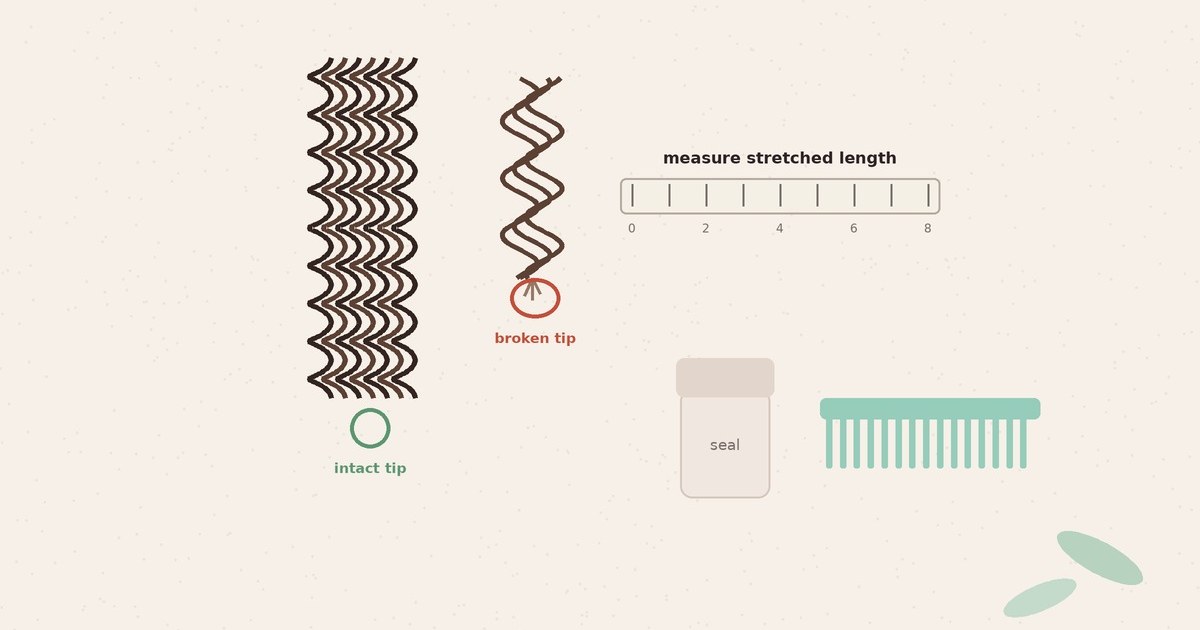
Length retention is how much of your new growth you actually keep. Curly hair grows at a steady rate, but breakage at the ends and shrinkage at the top hide that growth. So the length you see is roughly growth minus what snaps off, and most people who "can't grow" curls have a breakage problem, not a growth problem.
That's good news, because breakage is the part you control.
In this guide, you'll learn:
- How fast hair really grows, from the studies
- Why shrinkage makes growth look slower than it is
- How to tell shed hair from broken hair at home
- Why coils and tight curls break more
- A simple monthly retention score
- The habits that cut breakage the most
Quick answer
- Growth: scalp hair grows about 1 cm (roughly 0.4 inch) a month on average, and MedlinePlus puts it at about half an inch. (Dtsch Arztebl Int, MedlinePlus)
- Retention: visible length gained is about growth minus length lost to breakage and trims.
- Diagnose it: collect the hair you lose for a few days. Hairs with a small white bulb at one end were shed normally. Hairs with no bulb broke. (Practical Dermatology)
- Fix it: detangle only when damp with conditioner, ends first; reduce friction at night; go easy on heat and chemicals; trim splits before they travel. (AAD)
Start with a Curltine hair scan
How fast curly hair grows
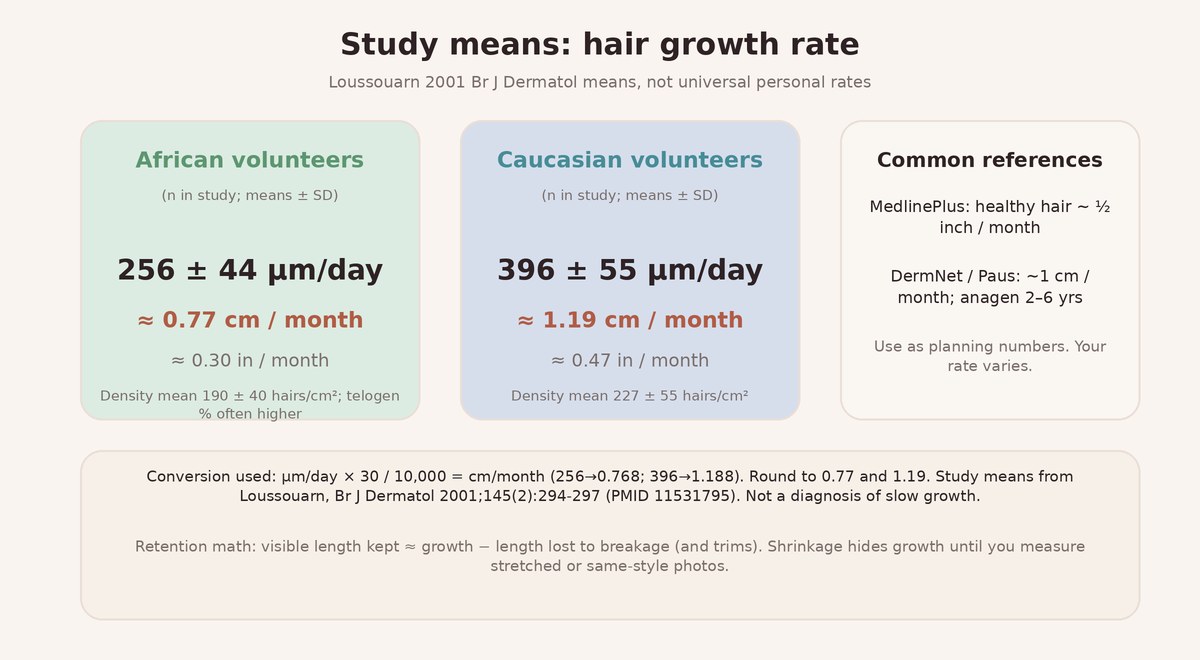
Hair grows during its active phase, called anagen, which lasts about 2 to 6 years on the scalp. During that time a hair grows about 0.3 mm a day, or about 1 cm a month. How long that phase lasts sets the maximum length a hair can reach. (Dtsch Arztebl Int, DermNet)
Growth rates do vary. In a phototrichogram study of 38 young adults born in central and western Africa, hair grew at a mean of 256 µm a day, compared with 396 µm a day in Caucasian volunteers from earlier work by the same group. The African group also had lower average density (190 vs. 227 hairs per cm²). (Loussouarn, 2001)
| Group (study means) | Per day | About per month |
|---|---|---|
| African volunteers | 256 µm | 0.77 cm (0.30 in) |
| Caucasian volunteers | 396 µm | 1.19 cm (0.47 in) |
| General reference | about 0.3 mm | about 1 cm; MedlinePlus says about half an inch |
Monthly figures are our conversion (µm per day × 30). They are group averages, not a prediction for any one person; individual rates in the African group ranged from 150 to 363 µm a day.
Here's why this matters for curls. If your hair grows a little slower, you have less margin for breakage. Losing a quarter inch a month to snapped ends costs a lot more when you're only growing about a third of an inch.
Shrinkage is not lost length
Curls and coils draw up as they dry, so a lot of real length is hidden in the spiral. That's why "my hair hasn't grown in a year" is often a measuring problem.
To track length honestly:
- Measure stretched, the same way each time. Gently stretch one damp section from the same spot (for example, the nape) against a ruler or tape measure.
- Or photograph the same style. Same section, same style, same angle, once a month. Comparing a wash-and-go to a blowout tells you nothing.
- Track the ends, not just the length. Thin, see-through ends mean you're losing length even if the top keeps growing.
Your density affects this too. Lower-density hair can look shorter and thinner at the ends even when it's growing normally.
Shed vs. broken hair check
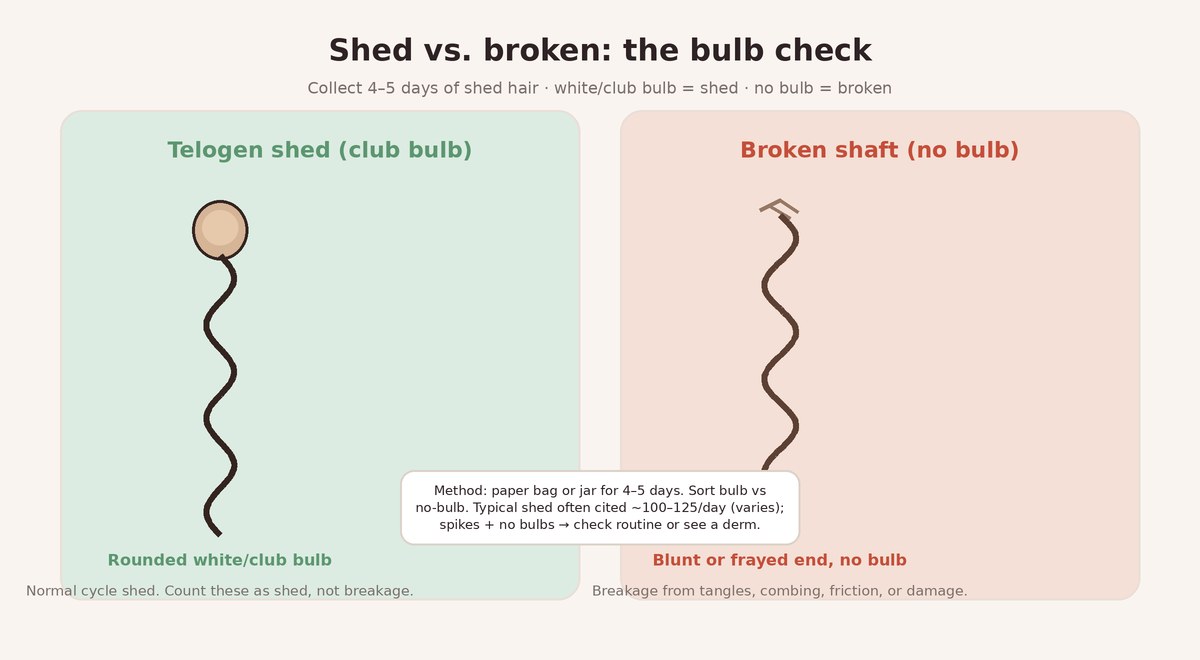
Not all hair in your comb is a problem. Every hair eventually rests and falls out, and that's normal. Dermatologists separate the two kinds of loss by looking at the end of each hair.
- Collect for 4 to 5 days. Put each day's hair from your comb, brush, sink, and shower drain in its own bag or envelope. Write the date and whether you washed that day. You'll lose more on wash days. (Practical Dermatology)
- Sort on a sheet of white paper. Stretch each hair out.
- Look at one end. A small rounded, teardrop, or white "club" bulb means the hair was shed at the end of its cycle. No bulb, with a blunt, frayed, or split end, means it broke. (DermNet, Practical Dermatology)
- Compare the piles. Broken pieces are your length retention problem. Short pieces of an inch or two usually come from the ends.
- Know when to see a dermatologist. The same article treats about 125 hairs a day as normal loss and says a medical work-up makes sense when shed (bulb) hairs are well above that. It also says that when broken hairs make up more than about 25% of what you lose, cosmetic changes to your routine can help. (Practical Dermatology) If you see thinning patches, a widening part, or scalp pain, book a board-certified dermatologist instead of changing products.
Why high-curl hair breaks more
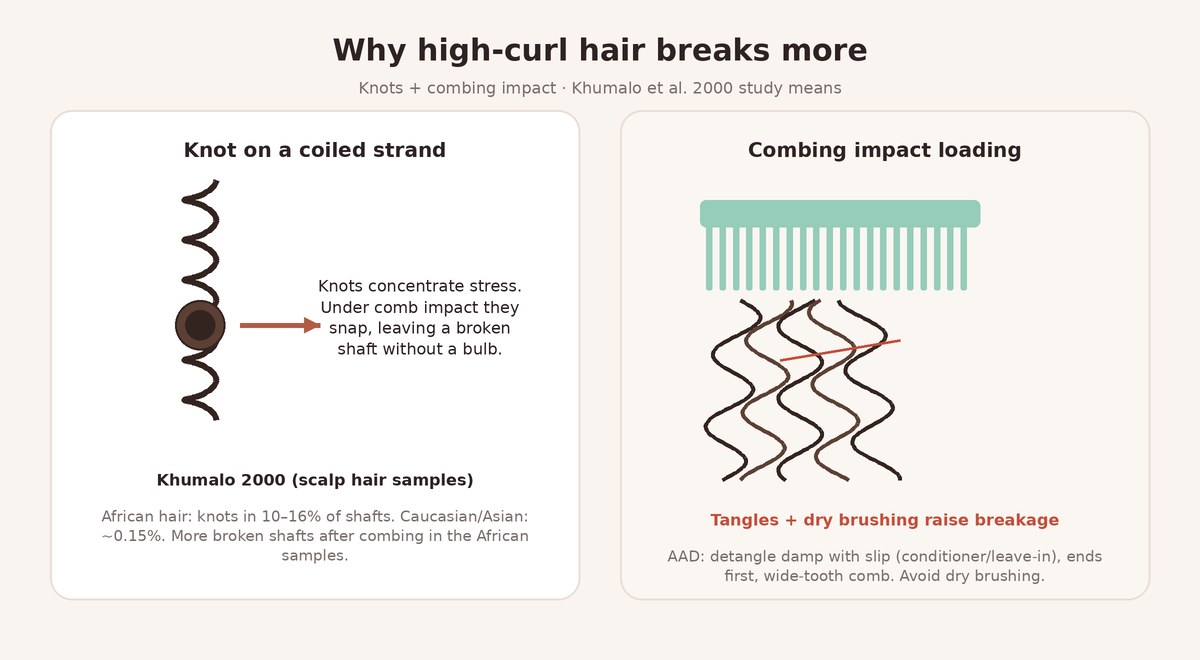
Tightly curled hair isn't weaker because of anything you did. Its shape creates weak points.
- Uneven thickness. In curly and coily hair, the shaft's thickness varies along its length. The narrow spots are less flexible, can crack, and break more easily when dry hair is pulled. (Society for Pediatric Dermatology)
- Knots. In a microscopy study of more than 2,000 hairs collected by combing, 10% to 16% of shafts from African volunteers had knots, compared with 0.15% in Caucasian and Asian samples, and the African hairs showed signs of repeated breaks. (Khumalo et al., 2000)
- Knots fail under a quick pull. In lab tests, hairs tied in a knot all broke on the first impact, while unknotted hairs didn't. Fast combing through a snag is that kind of impact. (Robbins, J Cosmet Sci)
Put together, this is why dry combing and rushing through tangles cost coily hair so much length. The fix isn't a product. It's how you handle the tangle.
Monthly retention score
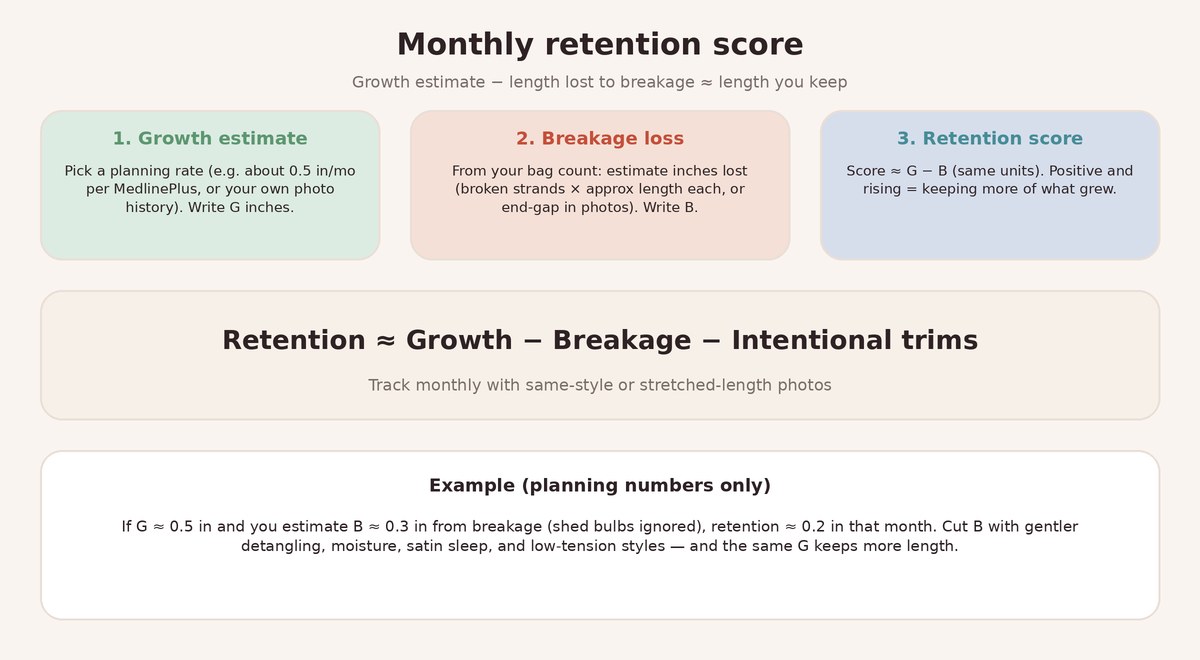
You don't need a lab to know if things are improving. Once a month:
- Growth (G): use about half an inch as a planning number, or your own number from last month's measurement.
- Breakage (B): from your measurement or photos, estimate how much length the ends lost. Your bag check tells you whether breakage is high or low.
- Trims (T): add anything you cut on purpose.
- Retention = G − B − T.
Example, with planning numbers only: if you grew about 0.5 inch, lost about 0.3 inch to breakage, and didn't trim, you kept about 0.2 inch that month. Cut breakage to 0.1 inch and the same growth keeps 0.4 inch. That's twice the visible progress with no change in how fast your hair grows.
This is rough math, and the point is the trend. If your score rises for three months in a row, your routine is working.
What actually improves retention
These habits target the breakage term in the math. They're ordered by how much they usually matter for curls.
- Detangle damp, with slip, ends first. Wet your hair, apply conditioner or leave-in, and work in sections with your fingers or a wide-tooth comb. Avoid brushing dry curly hair. (AAD, AAD stop-damage) Full method: how to detangle curly hair without breakage.
- Keep it moisturized. Condition all your hair, then follow with a leave-in or oil. (AAD) If your ends soak up water and dry fast, the high porosity routine helps. Not sure? Take the hair porosity test.
- Balance protein and moisture. Mushy, over-stretchy strands and stiff, snapping strands both break. See protein vs. moisture balance and when to use a protein treatment.
- Cut friction at night. A loose pineapple or braid reduces rubbing against the pillowcase. (AAD) More in how to sleep with curly hair.
- Wash on a schedule that suits you. Washing too often dries curly hair, but the AAD still advises a wash at least every 2 to 3 weeks. (AAD) See how often to wash curly hair and the wash day routine.
- Choose low-tension, low-manipulation styles. Styles that keep ends tucked mean less daily handling. Keep them loose at the hairline. If you work out often, gym curly hairstyles covers low-tension options.
- Go easy on heat and chemicals. Lightened or heat-styled ends are the first to snap. Read bleached curly hair care, bond repair for curly hair, and diffusing vs. air drying.
- Trim splits, not length. Split ends can travel up the strand. Trim when your ends look thin, frayed, or tangle constantly, not on a fixed calendar.
Where Curltine fits
Breakage levers depend on your hair. Coily, low-density, high-porosity hair needs a different detangling and moisture plan than loose waves. A Curltine scan estimates your curl pattern (2A to 4C), porosity, and density from a photo and builds a wash-day routine around them. The ingredient checker checks a product against your profile before you put it on fragile ends. The free plan includes one hair scan and one product scan (terms). Curltine is for ages 13 and up (16 and up in the EEA), and its results are cosmetic guidance, not a diagnosis.
If you're not sure of your pattern yet, start with the curl type chart or the curly hair routine guide.
Frequently asked questions
Why is my curly hair not growing? It almost certainly is growing, about 1 cm a month on average. When length seems stuck, the usual causes are breakage at the ends and shrinkage hiding growth at the top. Measure stretched length monthly and check your shed hair for broken pieces.
How do I know if my hair is shedding or breaking? Look at the end of each hair. A shed hair has a small rounded white bulb at one end. A broken hair has no bulb and usually a blunt or frayed end, and it's often shorter.
Does trimming make curly hair grow faster? No. Growth happens at the scalp. Trimming removes split ends that would otherwise tangle and break further up, so it helps you keep more length.
Does tightly coiled hair grow slower? In one study, hair from African volunteers grew at a mean of 256 µm a day versus 396 µm a day in Caucasian volunteers. Individual rates overlap a lot. Coily hair also breaks more at knots, so retention matters even more.
How long until I see length retention results? Track monthly. With about half an inch of growth a month, cutting breakage should show up in your measurements within two to three months.
Next step
Start the 4-to-5-day shed-vs-broken check this week and take one stretched-length photo of the same section. Next month, do your first retention score. If you want your detangling and moisture plan matched to your actual pattern, porosity, and density, start a Curltine scan. If you see patchy thinning or a widening part, see a board-certified dermatologist.
Curltine
Consigue tu rutina de rizos personalizada
Haz un escaneo IA de 60 segundos y recibe un plan de wash day según tu tipo de rizo, porosidad y densidad.
Empieza tu plan