How to Choose the Best Gel for Your Curl Type (2A–4C)
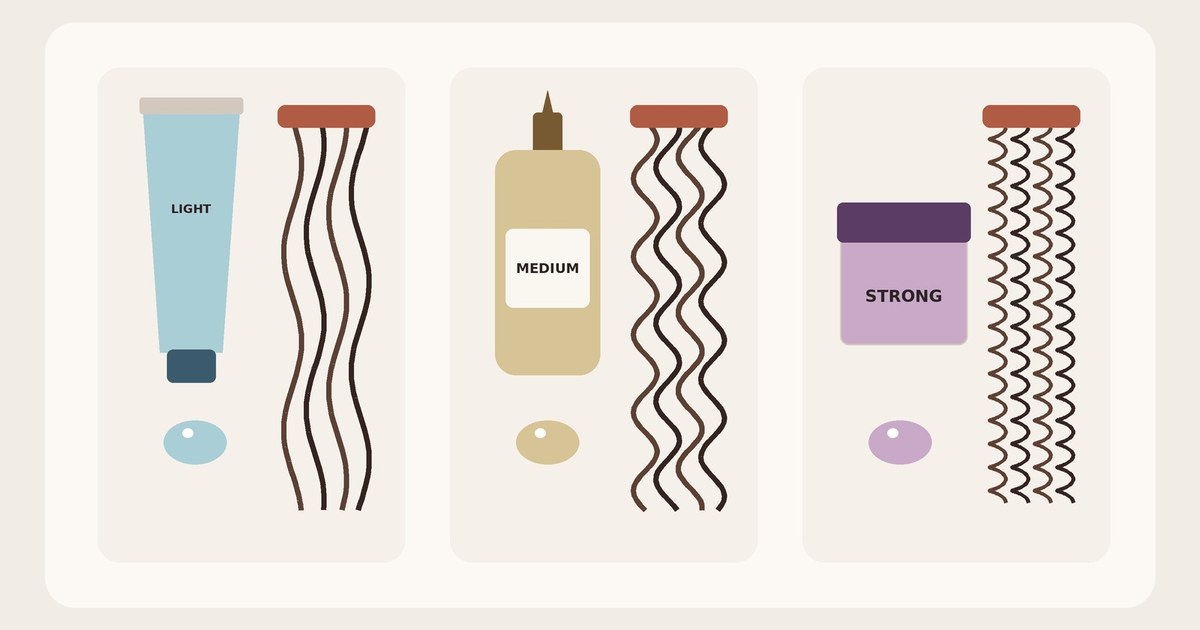
The best gel for your curl type is the lightest one that still holds your pattern in your weather. Waves usually want a thin, light-hold gel scrunched in. Curls do well with a medium-hold jelly. Coils usually need a thicker, stronger gel smoothed through small sections.
Curl type is only the starting point, though. Density, porosity, and dew point often decide whether a gel defines your curls or flakes, frizzes, or weighs them down. Brand rankings can't account for that. The ingredient list and the way you apply the gel can.
In this guide, you'll learn:
- Which gel texture and hold to start with for 2A–4C
- How to read the hold ingredients on a gel label
- How to apply gel for waves, curls, and coils
- How to fix flakes, frizz, crunch, and flat roots
Use the sections below as your playbook.
Gel chooser by curl type
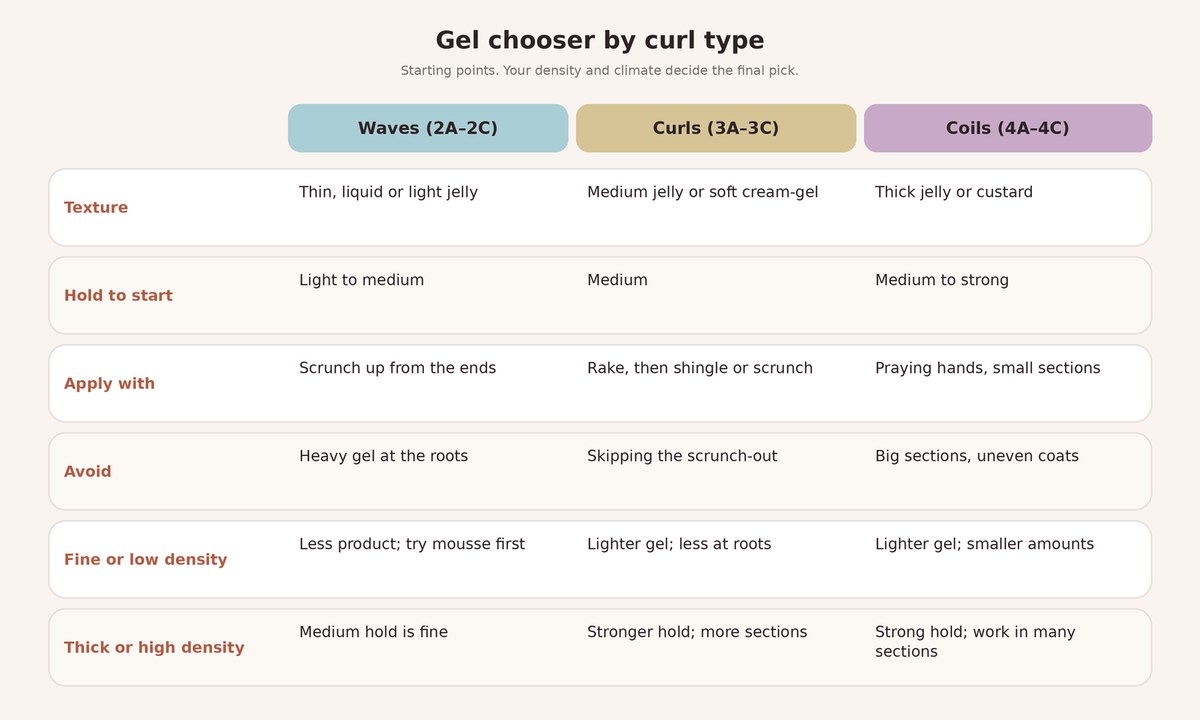
| Waves (2A–2C) | Curls (3A–3C) | Coils (4A–4C) | |
|---|---|---|---|
| Texture | Thin, liquid, or light jelly | Medium jelly or soft cream-gel | Thick jelly or custard |
| Hold to start | Light to medium | Medium | Medium to strong |
| Apply with | Scrunch up from the ends | Rake, then shingle or scrunch | Praying hands, small sections |
| Fine or low density | Less product; try mousse first | Lighter gel; less at the roots | Lighter gel; smaller amounts |
| Thick or high density | Medium hold is fine | Stronger hold; more sections | Strong hold; many sections |
This table is our starting point, not a lab result. It follows the pattern beauty editors and stylists describe: fine or looser curls do best with a lightweight formula, medium to thick curls with medium hold, and tight coils with stronger hold (Glamour UK). The application methods come from stylist guides (Curl Keeper, Aussie).
How to use it:
- Find your column. Not sure if you're 2C or 3A? Check the curl type chart or find your curl type at home. Many heads have two or three patterns, so pick by the section you style most.
- Adjust for density. Density, meaning how many strands you have, changes how much weight your hair can carry. A thick 2C head can take more hold than a fine 3B head. See what curl density is.
- Adjust for your climate. If your gel softens and frizzes on sticky days, you need a more humidity-resistant film (next section) or a second gel on top. Gel layering and the dew point guide cover that.
By type, in one line each:
- 2A–2C waves: a light gel scrunched into soaking-wet hair, little or none at the roots. Waves get weighed down quickly, so if gel flattens you, try a mousse first. See the 2A guide and the 2C guide.
- 3A–3C curls: a medium-hold jelly over a light leave-in, raked through, then shingled or scrunched into clumps. See the 3A guide and 3B vs 3C.
- 4A–4C coils: a thicker gel smoothed with praying hands through small sections, often over a moisturizing leave-in. Strong hold keeps coil definition when shrinkage and frizz fight it. See the 4C weekly routine.
Read the label: what actually holds your curls
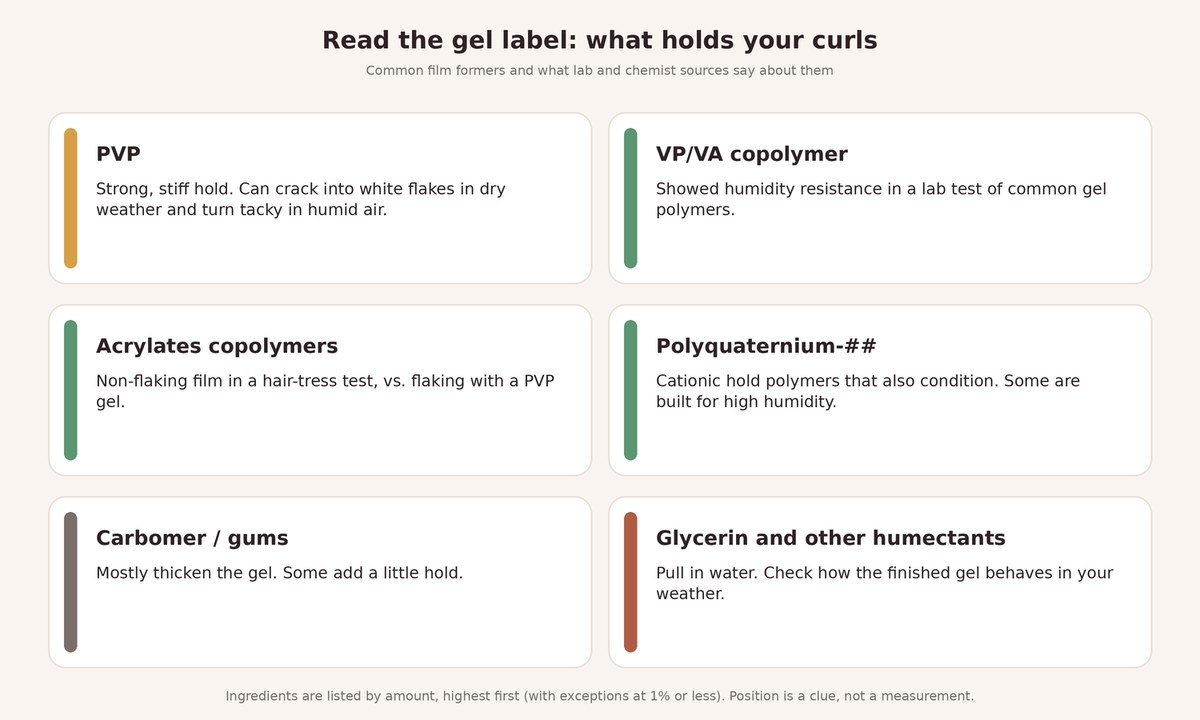
A gel holds because it leaves a thin film of polymer on each strand. As it dries, the film locks clumps in place. That's the "cast." Which polymer makes that film matters more than the brand name. When researchers surveyed 25 gels sold in Thailand, the most common hold ingredients were polyacrylic acid and PVP, then acrylates copolymer, VP/VA copolymer, and polyquaternium-86 (Thai fixative polymer study).
What to look for on the ingredient list:
- PVP gives strong, stiff hold and rinses out easily. It's also brittle and attracts water. Chemists note it can crack into white flakes when you touch your hair, especially in cold, dry weather, and turn tacky in humid air (CurlyNikki chemist explainer). In a hair-tress test, a PVP gel left visible flakes and residue on the comb (J Soc Cosmet Chem).
- VP/VA copolymer (also written PVP/VA) mixes a stiff part with a water-resistant part. In the Thai study, it held up to high humidity (Thai fixative polymer study).
- Acrylates copolymers (many names start with "acrylates/…") formed a continuous, non-flaking film in the same hair-tress test where the PVP gel flaked (J Soc Cosmet Chem).
- Polyquaterniums ("polyquaternium-" plus a number) are positively charged, so they cling to hair and condition as they hold. Some are made for humidity. In a manufacturer test at 80°F and 90% humidity, a polyquaternium-69 gel kept about 90% of its curl after 24 hours, while a PVP and VP/VA gel started failing within an hour (Tonya McKay, cosmetic chemist, NaturallyCurly; maker's data). That's one polymer maker's test, so treat it as a lead, not proof about a particular gel. Cationic polymers can also be hard to wash out (Gavazzoni Dias, 2015), so a periodic clarifying wash helps if your hair starts to feel coated (see how often to wash curly hair).
- Carbomer, gums, and similar thickeners mostly give the gel its body. They aren't the main source of hold.
- Glycerin and other humectants pull water toward the hair. Whether that means more definition or more frizz depends on the whole formula and your weather. Test the finished gel instead of banning the ingredient (glycerin in curly hair products; humectants vs anti-humectants).
Reading the order: US labels list ingredients from most to least, with exceptions for ingredients at 1% or less (FDA). Position is a clue, not a measurement. Our label-reading guide walks through the rest, and the ingredient checker can flag them for you.
How to apply gel by curl type
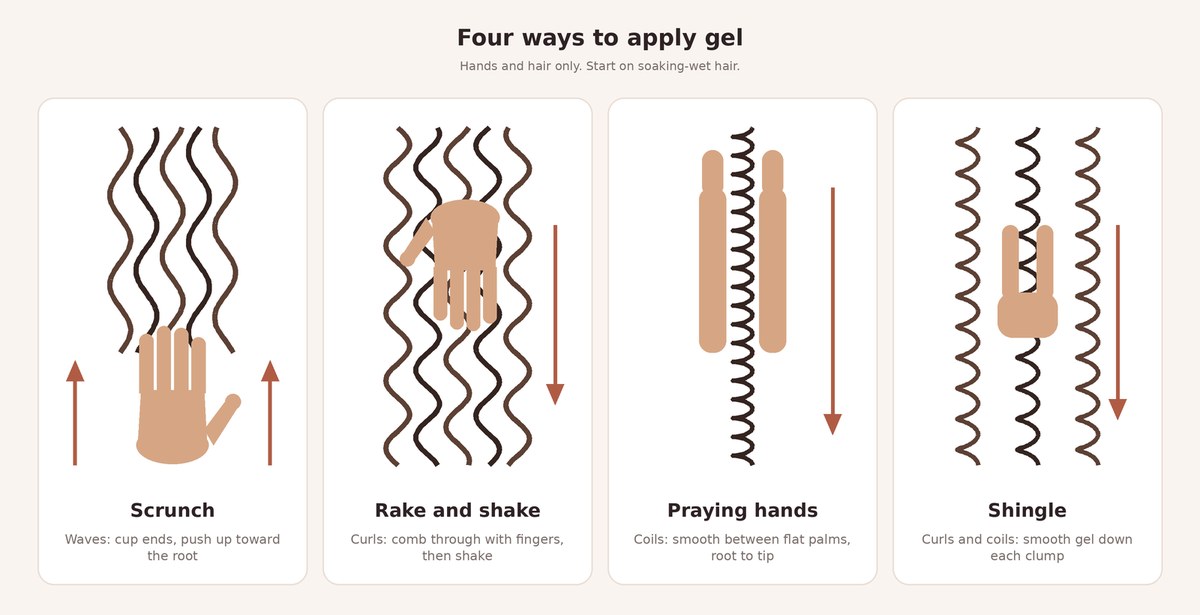
The same gel can look completely different depending on how you apply it. Follow these steps:
- Start soaking wet. Apply gel right after you rinse out conditioner, while your hair is still dripping. Gel on damp or half-dry hair tends to frizz and feel sticky (Curly Hair Society).
- Leave-in first, if you use one. A light leave-in under the gel adds slip and softness. Low porosity hair usually wants less; high porosity hair often wants more (hair porosity test).
- Emulsify. Rub the gel between your palms until it forms a thin, even layer. A blob in your palm becomes a blob in your hair (Curlsmith).
- Use the method that fits your pattern.
- Waves: scrunch. Cup the ends and push them up toward your scalp. Keep gel light at the roots so waves don't drop (Curl Keeper).
- Curls: rake, then shingle or scrunch. Rake gel through with your fingers, shake gently so curls clump, then smooth individual clumps if you want more definition (Curlsmith).
- Coils: praying hands, small sections. Sandwich each section between flat palms and slide down from root to tip. This spreads gel evenly and keeps the surface smooth (Aussie).
- Use enough. Your hair should feel slippery, almost like seaweed (Curly Hair Society). Start small and add more until it feels that way. If there's no cast at all once it dries, try a little more next time.
- Hands off until dry. Air dry or diffuse (diffusing vs air drying). Touching gel while it sets breaks up clumps and causes frizz.
- Scrunch out the crunch. Once your hair is 100% dry, scrunch upward with dry hands, or with a drop of oil on your palms. The cast breaks and leaves soft, defined curls (Curly Hair Society).
Be gentle as you go. Tightly curled hair is more prone to breakage when it's worked mechanically (Gavazzoni Dias, 2015), so glide and scrunch rather than tug.
Gel problems and how to fix them
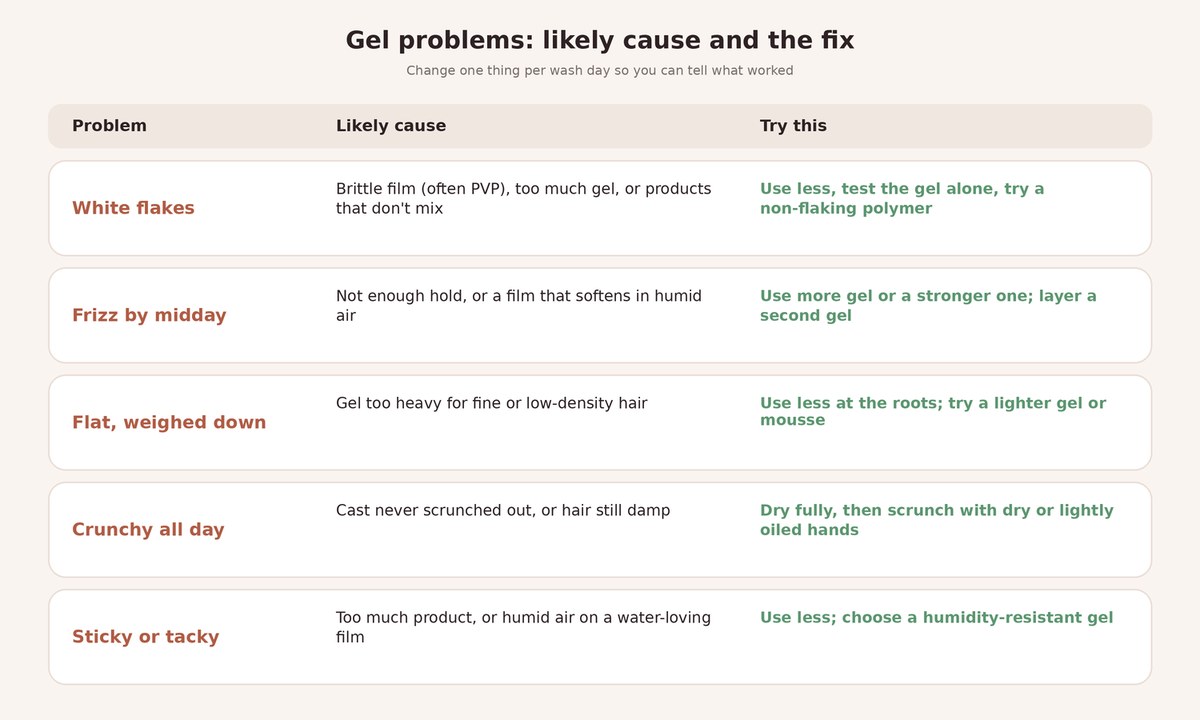
| Problem | Likely cause | Try this |
|---|---|---|
| White flakes | Brittle film (often PVP), too much gel, or products that don't mix well | Use less; try the gel on its own; switch to a non-flaking polymer such as an acrylates copolymer |
| Frizz by midday | Not enough hold, or a film that softens in humid air | Use more gel or a stronger one; layer a second gel |
| Flat, weighed down | Gel too heavy for fine or low-density hair | Less at the roots; try a lighter gel or mousse |
| Crunchy all day | Cast never scrunched out, or hair still damp inside | Dry fully, then scrunch with dry or lightly oiled hands |
| Sticky or tacky | Too much product, or humid air on a film that absorbs water | Use less; choose a humidity-resistant gel |
Change one thing per wash day. If you swap your gel, leave-in, and drying method all at once, you can't tell which one fixed it. Frizz has more causes than gel alone, so check why curly hair is always frizzy too. If every product seems to fail, read signs you're using the wrong products for your curl type.
Frequently asked questions
What is the best gel for curly hair?
The best gel for you depends on your curl type, density, and climate. As a starting point, use a light gel for waves, a medium-hold jelly for curls, and a thicker, stronger gel for coils. Then adjust based on whether your curls flake, frizz, or fall flat.
What gel is best for wavy hair?
A thin gel with light to medium hold, scrunched into soaking-wet hair and kept light at the roots. If even light gel weighs your waves down, try a mousse instead.
What gel is best for 4C hair?
Usually a thicker gel with medium to strong hold, smoothed through small sections with the praying hands method over a moisturizing leave-in. Stronger hold tends to keep coil definition longer, especially on humid days.
Why does my gel flake?
Usually because the dried film is brittle and cracks when you touch your hair. PVP-based gels are known for this, especially in cold, dry weather. Too much gel and layering it over a product it doesn't mix with can also cause flakes. Use less, test the gel alone, or switch to one built on a non-flaking polymer.
Should I put gel on wet or damp hair?
Soaking wet, right after you rinse out conditioner. Gel spreads more evenly and clumps curls better on wet hair. On damp hair it's more likely to frizz and feel sticky.
How do I get rid of the gel crunch?
Wait until your hair is completely dry, then scrunch upward with dry hands or a drop of oil on your palms. The cast breaks and leaves soft curls. If you scrunch while your hair is still damp, you'll get frizz.
Find the gel that fits your curls
A gel chart can only guess at your hair. A Curltine scan estimates your curl pattern, porosity, and density from a photo, and the ingredient checker shows you what's in a gel before you buy it. Start your free scan in the Curltine app, or build your styling step into a wash day in Curltine routines.
Curltine
احصلي على روتين تجعيدك المخصص
امسحي شعرك بالذكاء الاصطناعي خلال 60 ثانية واحصلي على خطة يوم غسيل تناسب نوع شعرك ومساميته وكثافته.
ابدئي خطتك