Deep Conditioner vs Hair Mask for Curly Hair: Same Thing? What to Use
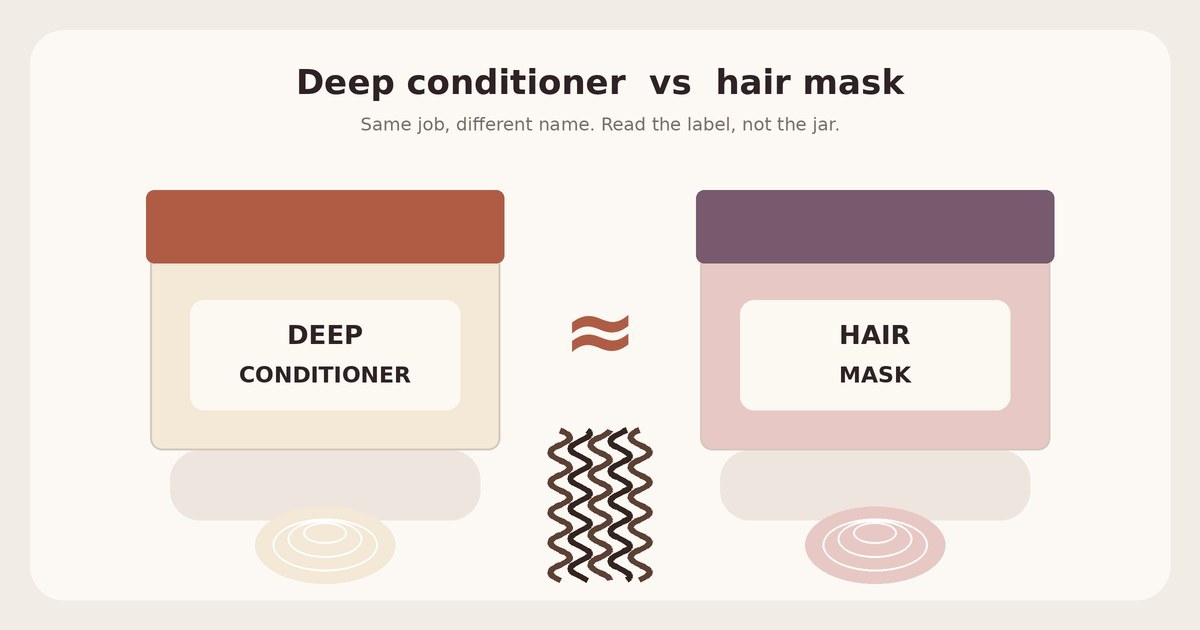
For curly hair, a deep conditioner and a hair mask are usually the same kind of product: a thicker, more concentrated rinse-out conditioner that you leave on longer than your everyday one. Some brands reserve "mask" for protein or bond-repair formulas, so check the ingredient list and how your hair is behaving to work out what a jar will do for you.
Key takeaways
- Deep conditioners are conditioners with "more concentrated ingredients or just more viscosity," according to a dermatology review of hair cosmetics (Gavazzoni Dias, 2015).
- Whether a product gets inside the hair depends on molecule size, not on whether it's called a mask. Small molecules can reach the cortex; larger ones act on the cuticle (same source).
- Pick by symptom: dry and rough means moisture, mushy and over-stretchy means protein, and bleached or relaxed lengths may call for a bond-repair formula.
- Follow the label time, which usually falls between 5 and 30 minutes, and deep condition about every one to two weeks to start.
So when you're standing in front of the shelf, ask what your hair is short on right now and whether the jar contains it. The rest of this guide covers how to deep condition curly hair, and how often, without flattening your curls.
Start with a Curltine hair scan to see your porosity and density before you choose a treatment.
Deep conditioner vs hair mask: the quick answer
Curly routines tend to mix up four conditioning products. Here's what each one is, how long it stays on and how often to use it.
| Regular conditioner | Deep conditioner / hair mask | Protein treatment | Leave-in | |
|---|---|---|---|---|
| What it is | Light rinse-out after every wash | Thicker, more concentrated rinse-out | Rinse-out with protein high on the list | Light conditioner you don't rinse |
| Typical time on hair | About 5 minutes | Label time, often 5 to 30 minutes | Label time | Stays in |
| Main job | Slip, detangling, less frizz | More softening and moisture for dry or damaged lengths | Temporary strength for mushy or over-stretchy hair | Slip and moisture for styling |
| How often | Every wash | Every 1 to 4 weeks (adjust by feel) | Only when hair shows protein need | Every wash day or refresh |
Sources: 2023 review in Polymers (deep conditioners are more concentrated than instant conditioners and usually stay on 20 to 30 minutes), L'Oréal Paris (masks 5 to 30 minutes), Gavazzoni Dias 2015.
Is a hair mask the same as a deep conditioner?
Usually, yes. The people who make and use these products don't agree on the terms, though:
- A stylist quoted by Byrdie says a mask is "more reparative," while a deep conditioner is thinner and coats the outside of the strand. In the same article, a salon founder says deep conditioners are a type of hair mask, the kind aimed at dryness.
- WIRED puts it the other way around: "A deep conditioner is a hair mask, but a hair mask is not necessarily a deep conditioner."
- L'Oréal Paris calls a hair mask "a type of deep conditioning treatment."
The cosmetic-science literature is blunter. Gavazzoni Dias writes that deep conditioners "contain more concentrated ingredients or just more viscosity" than ordinary rinse-out conditioners (Int J Trichology, 2015), which makes them the same base at a higher dose or in a thicker texture.
Does a mask go deeper than a deep conditioner? Not because of its name. The same review explains that how far a conditioning ingredient travels depends on its size: "Smaller molecules can reach the cortex. Larger ones act on the cuticle" (Gavazzoni Dias 2015). A jar labeled "mask" full of large film-forming polymers works on the surface. A jar labeled "deep conditioner" with small hydrolyzed proteins can get further in.
The name can still hint at something. Some brands use "mask" for protein or bond-repair formulas rather than plain moisture, and a NaturallyCurly piece notes that some masks are meant for dry hair before you shower, while others replace conditioner (NaturallyCurly (Beautycon)). Some "masks" aren't even rinsed out: K18 sells its "Leave-In Molecular Repair Hair Mask" as a leave-in treatment. Check the ingredient list and the directions on the back before you buy.
What does a deep conditioner do to your hair?
Conditioners work mostly through electric charge and lubrication. Washing leaves hair with a negative surface charge, and positively charged (cationic) conditioning ingredients are attracted to it. They smooth the cuticle, cut friction between strands, and make combing easier (Gavazzoni Dias 2015).
For curls, three findings stand out:
- Damaged hair grabs more. Bleached and chemically treated hair has more negative sites and is more porous, so it has a higher affinity for conditioning ingredients (Gavazzoni Dias 2015). That's why a mask can make a big difference on bleached ends and do little on virgin roots.
- Molecule size decides where it goes. In a lab study using TOF-SIMS imaging, a small cationic conditioner (cetyl trimethyl ammonium bromide, CETAB) was found inside cross-sections of treated hair, while the researchers found no trace of the larger polymer polyquaternium-10 inside the fiber, which they read as a lack of penetration (Ruetsch & Kamath, J Cosmet Sci 2005). The fibers soaked in each compound for six hours at body temperature, far longer than any wash day. The study shows what can get in under those conditions; it doesn't tell you what your mask does in 20 minutes.
- Curly hair starts out drier. Sebum travels poorly down a curly or coily strand, so the lengths get less natural lubrication (Gavazzoni Dias 2015). The American Academy of Dermatology says curly hair is drier than other hair types. It recommends conditioning all your hair, not just the ends, and applying a thick conditioner after washing (AAD).
A deep conditioner can't rebuild a broken strand. When a jar says it "repairs damage," read that as makes damaged hair feel and behave better until the next wash. For what bond-building products claim, see bond repair for curly hair.
How to read a deep conditioner or hair mask label
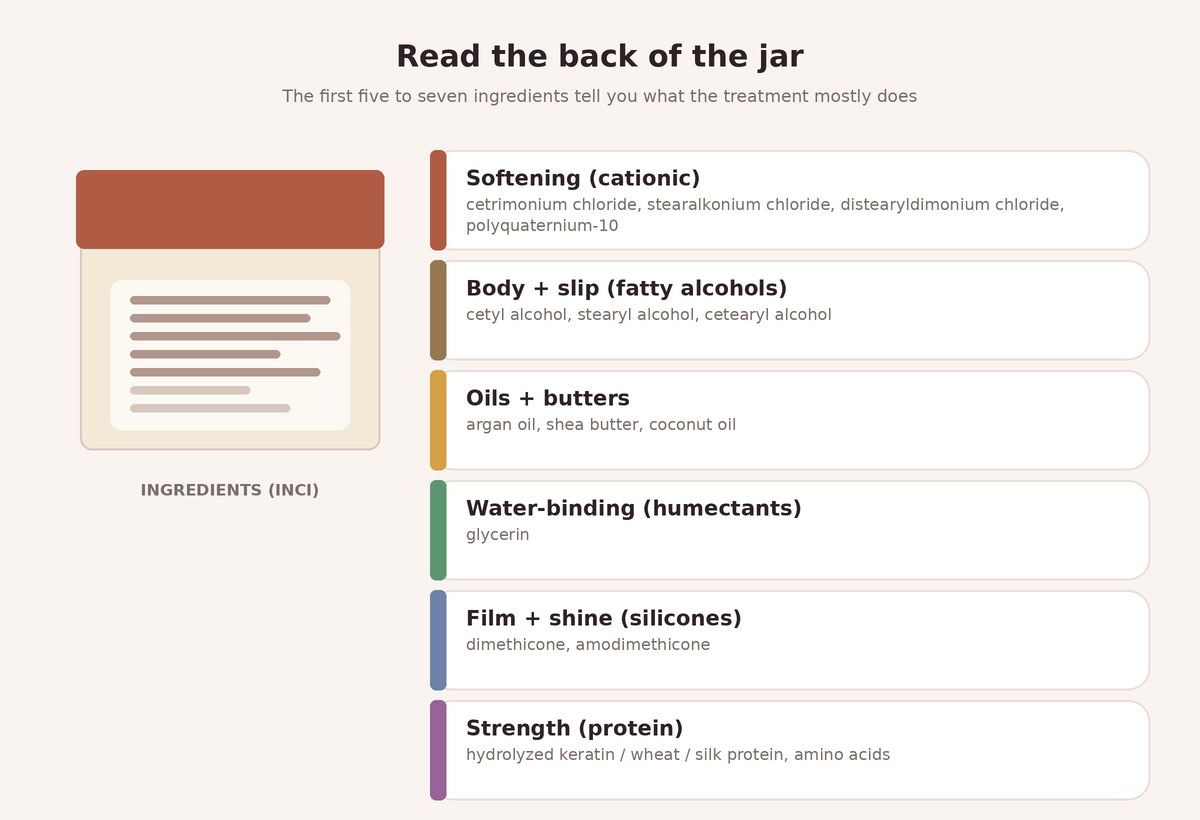
Ingredients are listed in descending order of concentration, so the first five to seven tell you what the product mostly is. These are the groups to look for:
| Ingredient group | Examples on the label | What it's for |
|---|---|---|
| Cationic conditioners | cetrimonium chloride, stearalkonium chloride, polyquaternium-10 | Softening, detangling, frizz control (Gavazzoni Dias) |
| Fatty alcohols | cetyl alcohol, stearyl alcohol, cetearyl alcohol | Thickness and slip. These are not drying alcohols. The AAD lists cetyl and stearyl alcohol as good conditioning ingredients for curly hair (AAD) |
| Oils and butters | argan oil, coconut oil, shea butter | Lubrication and softness. Coconut oil reduced protein loss in one study (Rele & Mohile 2003). See coconut oil and shea butter for curls |
| Humectants | glycerin | Draws water in (the AAD lists glycerin for curly hair). See is glycerin bad for curly hair? for how it behaves in humidity |
| Silicones | dimethicone, amodimethicone | Film, shine, friction reduction (Gavazzoni Dias). See silicones and curly hair |
| Proteins | hydrolyzed keratin, wheat or silk protein, amino acids | Temporary strength and less stretch. See protein ingredients in curly hair products |
A rule of thumb: if hydrolyzed protein sits in the top five, treat the jar as a protein treatment, whatever the front says. If the top of the list is water, cationic conditioners, fatty alcohols and oils, it's a moisture treatment. For a full walk-through, see how to read curly hair product labels, or scan the jar with the Curltine ingredient checker.
Hair mask vs deep conditioner for curly hair: which to use
Whatever the jar is called, choose the formula that matches what your curls are doing.
Moisture vs protein vs bond-repair masks
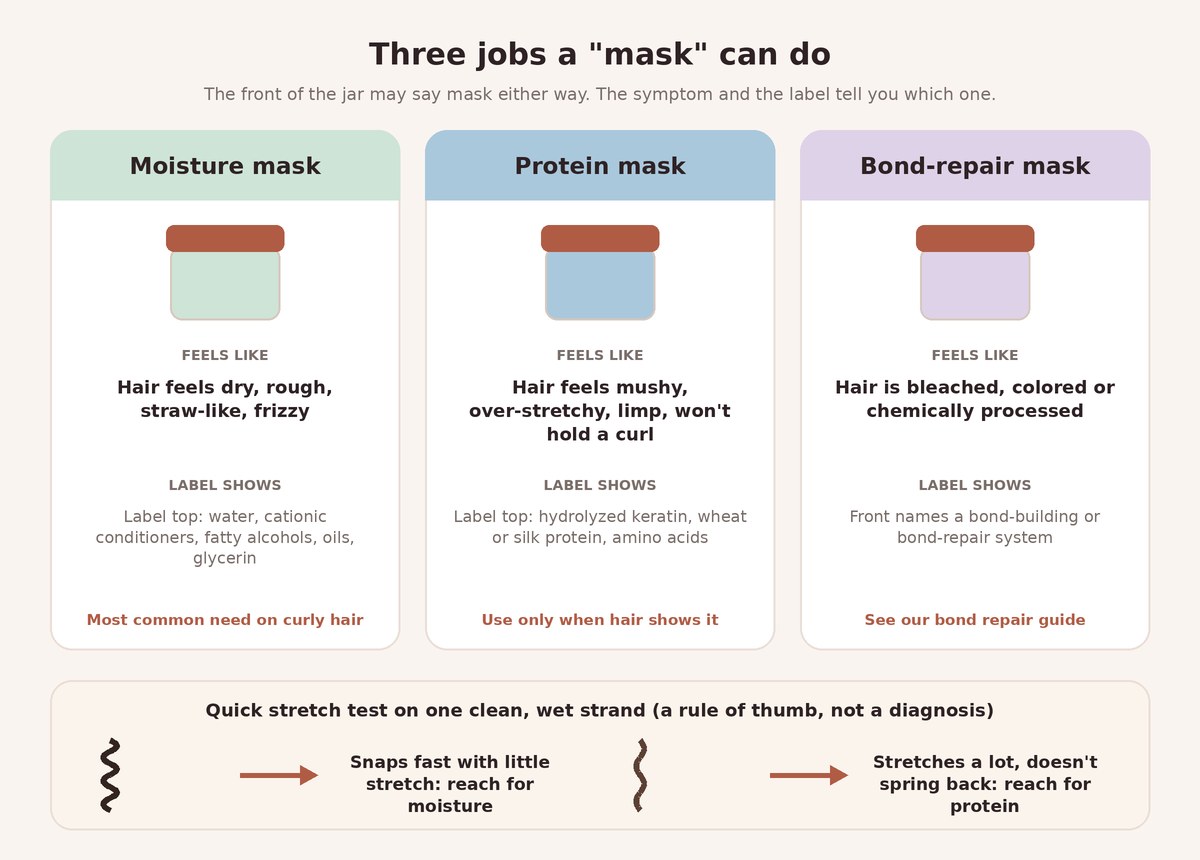
- Moisture mask. For dry, rough, straw-like, frizzy lengths. The top of the label is water, cationic conditioners, fatty alcohols, oils and glycerin. Pattern calls this the more frequent need for most coily hair (Pattern).
- Protein mask. For hair that feels mushy, over-stretchy or limp and won't hold a curl. Hydrolyzed protein or amino acids sit high on the list. Read protein overload vs moisture overload and when to use a protein treatment first.
- Bond-repair mask. Aimed at bleached, colored or chemically processed hair, and usually marketed around a bond-building system rather than moisture. See bond repair for curly hair for what those claims mean.
To check which one you need, Pattern Beauty suggests a stretch test: gently pull one wet strand. If it stretches a lot and doesn't return, it needs protein. If it snaps right away with little stretch, it needs moisture (Pattern). This is a rough guide rather than a lab test, so weigh it against how your hair feels and behaves over a few wash days. The protein and moisture balance guide walks through it.
Match the treatment to your hair
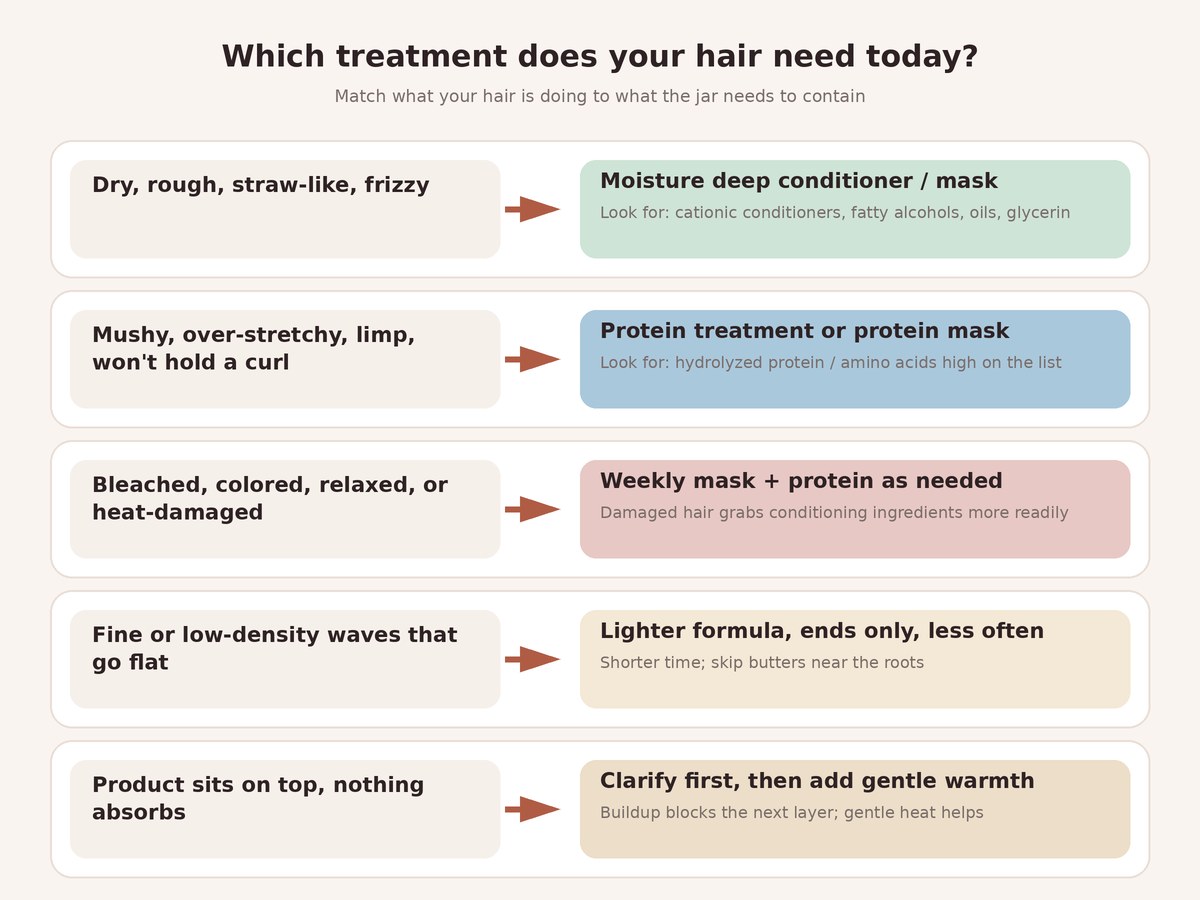
- Bleached, colored, relaxed or heat-damaged. These lengths take up conditioning ingredients more readily (Gavazzoni Dias) and usually do best on a regular schedule, with protein added only when the hair shows it. See bleached curly hair care and heat damage in curly hair.
- Fine or low-density waves that go flat. Choose a lighter formula, put it on mid-lengths to ends, rinse it well and use it less often. A Matrix colorist quoted by NaturallyCurly (Beautycon) says fine, thin or naturally oily hair usually does better with a lightweight conditioner than a heavy mask.
Porosity and 4c hair
- Low porosity (product sits on top and nothing absorbs). Clarify first so the treatment can reach the hair, then use gentle warmth under a cap. Pattern suggests deep conditioning low-porosity hair once every few weeks so it isn't weighed down (Pattern). See the low porosity routine and hair porosity test.
- High porosity (soaks up water fast, dries fast, frizzes). It tends to need a richer formula, used more often, with a sealing step afterward. Pattern's FAQ suggests weekly deep conditioning for high-porosity, chemically treated or heat-damaged hair (Pattern). The high porosity routine covers the order.
- 4c and tightly coiled hair. Sebum has a hard time traveling down tightly coiled strands, so the lengths tend to stay dry (Gavazzoni Dias 2015), and Pattern notes that moisture masks are the more frequent need for most coily hair (Pattern). A lot of 4c routines deep condition weekly, working in sections and detangling while the treatment is in. If you see buildup or limpness, shorten the time or clarify before you drop the step. See a weekly routine for 4c hair and type 4c curls.
How often to deep condition curly hair
No dermatology body sets a fixed schedule. The AAD's curly-hair advice is to keep hair moisturized and use a thick conditioner after washing, and it doesn't name a deep-conditioning frequency (AAD). Brand and editorial advice varies:
| Source | What they suggest |
|---|---|
| Pattern Beauty | Every other week, or weekly in dry climates. Every few weeks for low porosity. Weekly for high-porosity, chemically treated or heat-damaged hair |
| Davines | Curly hair: start once a week, go up to twice if still dry, and cut back if curls look limp. Its general advice is 15 to 30 minutes on the hair |
| Matrix colorist via NaturallyCurly (Beautycon) | Masks about once a week or every two weeks |
| Byrdie (stylist) | Intensive masks once or twice a month |
To start, deep condition every one to two weeks on the same wash day each time, then adjust:
- If hair is still dry two days after wash day, go weekly, or leave it on a little longer with gentle warmth.
- If it's limp, flat or greasy-feeling, or curls won't clump, go less often, switch to a lighter formula, or keep it off the roots.
- If it's mushy and over-stretchy, stop adding moisture and check protein (see above).
Your wash day routine and how often you wash matter here too. If you only wash every week or two, putting the treatment on every wash day can be enough.
How to deep condition curly hair (6 steps)
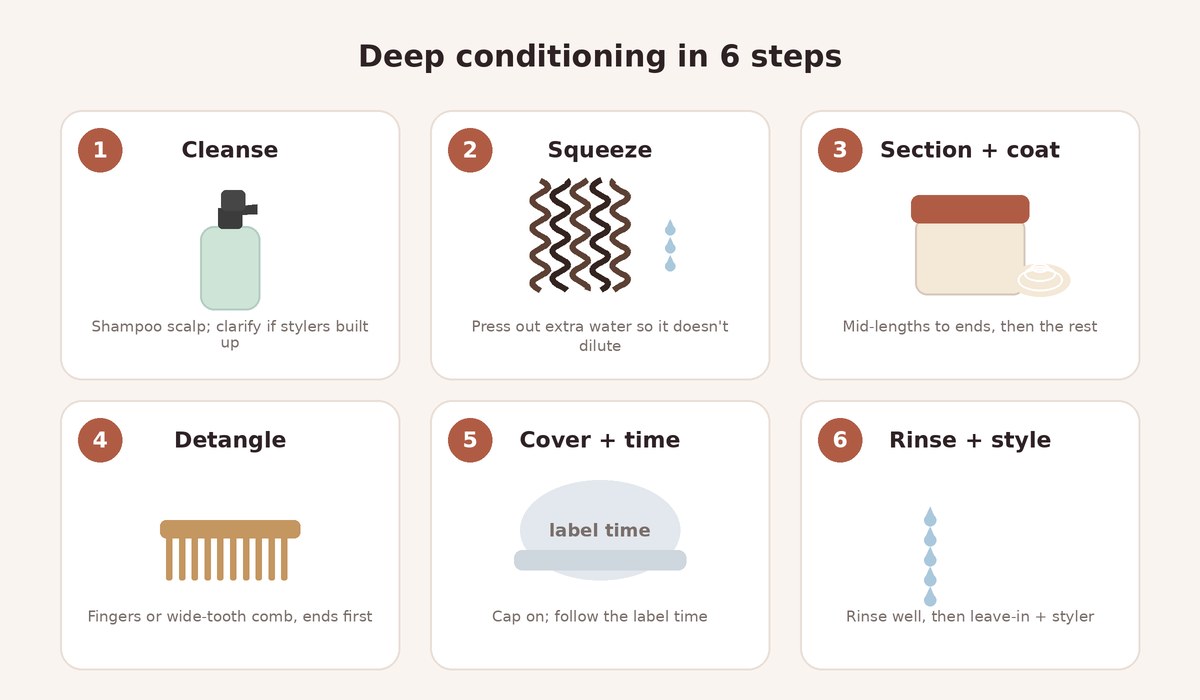
- Cleanse first. Shampoo the scalp. If you use a lot of gels, creams or oils, the AAD suggests a clarifying shampoo before your moisturizing shampoo (AAD). A treatment can't soak into hair that's coated in buildup. If you live in a hard-water area, read hard water and curly hair too.
- Squeeze out extra water. Dripping hair dilutes the product and makes it slide off.
- Section and coat. Start on mid-lengths and ends, where hair is oldest and driest, then work up the length. With curly hair, coat the whole length, as the AAD recommends for conditioner (AAD). Use more on thick or long hair and less on fine hair (Pattern).
- Detangle while it's in. The AAD says the best time to comb thick, curly hair is in the shower before you rinse out conditioner. Use a wide-tooth comb or fingers, and start at the ends (AAD healthy hair tips). More in how to detangle curly hair without breakage.
- Cover and time it. Put on a shower cap and follow the label time. Gentle warmth, such as a warm towel over the cap, can help. A 2023 review notes that heat lifts the cuticle and increases penetration of conditioning agents (Polymers review). Keep the warmth gentle, since the aim is to warm the hair rather than heat-style it.
- Rinse well, then style. If the mask is meant to be followed by conditioner, add a quick light one for slip (L'Oréal Paris). Then apply leave-in and styler as usual, for example with the LOC method or the LCO method.
Mistakes that make a good mask look bad
- Leaving it on overnight without checking the label. Sources disagree. Pattern's guide calls it "a major no-no" because over-moisturized curls lose their shape, yet the FAQ on the same page says overnight is "generally fine for moisture-based formulas but can cause protein overload with protein-heavy treatments" (Pattern). L'Oréal Paris says to sleep in a mask only if the product says so (L'Oréal Paris). Keep protein-heavy formulas to the label time, and if curls come out limp, do the same with moisture masks.
- Using a mask and a full conditioner every time. Some masks are meant to replace conditioner, and doubling up can weigh hair down (L'Oréal Paris).
- Treating protein need with more moisture. If hair is mushy and over-stretchy, another moisture mask makes it worse.
- Loading it onto the roots. The AAD's advice is about where conditioner goes on the hair: the full length for dry or curly hair, the ends for fine or straight hair (AAD). If your roots get oily, Pattern suggests starting about halfway down and rinsing thoroughly so the treatment doesn't build up on the scalp (Pattern). Persistent itching or flaking is a reason to see a dermatologist; see curly hair scalp care.
Where Curltine fits
A Curltine hair scan estimates your curl pattern, porosity and density from a photo, and the ingredient checker breaks down a product's ingredient list. Results are estimates to guide your routine, not a diagnosis.
Start with a Curltine hair scan. Curltine is available on the App Store and Google Play with a free plan.
Frequently asked questions
Does a hair mask replace conditioner?
Sometimes. L'Oréal Paris notes that some heavier masks are meant to replace your conditioner and that doubling up can weigh hair down. Others are meant to be followed by a light conditioner for slip. The label tells you which. If you use both, the mask usually goes first.
Which is better, a hair mask or a deep conditioner?
The name doesn't decide it. Pick the jar whose ingredients match what your hair is short on: moisture ingredients for dry, rough curls, protein for mushy, over-stretchy curls, and a bond-repair system for chemically processed hair.
How long should I leave a deep conditioner in?
Follow the label. Published guidance ranges from about 5 to 30 minutes (L'Oréal Paris), and Pattern Beauty's FAQ says 15 to 30 minutes for most deep conditioners. A shower cap and gentle warmth help more than extra time.
Do you deep condition before or after shampoo?
After, for most products. Shampooing first removes buildup so the treatment can reach the hair (Pattern, L'Oréal Paris). The exception is a mask labeled as a pre-shampoo treatment, which goes on before you wash.
Can you deep condition with a regular conditioner?
You can leave your regular conditioner on longer under a cap, but it won't match a deep conditioner, which has more concentrated ingredients or more viscosity (Gavazzoni Dias 2015). Wella recommends a mask for deep conditioning stressed hair (Wella).
Does deep conditioning help with hair growth?
There's no evidence that it makes hair grow. Hair grows from the follicle under the scalp, and conditioners work on the hair shaft. Hair cosmetics cut friction, which can help prevent breakage (Gavazzoni Dias 2015) and so help you keep the length you grow. If you notice sudden shedding or thinning, see a dermatologist.
Can you leave a deep conditioner in overnight?
Only if the label says so. Sources disagree, and protein-heavy formulas are the riskiest overnight (see "Mistakes" above).
Curltine
Consigue tu rutina de rizos personalizada
Haz un escaneo IA de 60 segundos y recibe un plan de wash day según tu tipo de rizo, porosidad y densidad.
Empieza tu plan