Clarifying Shampoo for Curly Hair: How Often by Buildup
Clarifying shampoo for curly hair is a stronger cleanse used to strip product, oil, and sweat film that everyday shampoo or co-wash leaves behind. It is not your daily wash. It is a reset when curls feel coated, dull, or stop responding to your usual products.
Most guides give one number for everyone. Your cadence should follow buildup signs, product load, water quality, and how dry your hair runs — not a calendar alone.
In this guide, you'll learn:
- What clarifying is vs regular shampoo vs chelating
- How often to clarify by buildup and lifestyle
- How porosity changes the feel
- Signs you need it — and when to skip
- A step-by-step clarify + remoisturize method
- Aftercare, sulfates/silicones, and co-wash
Use the sections below as your playbook.
Quick answer
Clarify when hair feels coated, dull, or product stops absorbing — not on a fixed schedule that ignores how your hair feels. As a starting range, many sulfate-free routines land around every 2–4 weeks or about every 4–5 washes. Heavy product use, hard water, or oily roots may need sooner. Dry, coily, color-treated, or fragile hair often needs more space.
Always follow with conditioner or a mask, then style as usual. If lengths feel rough or the scalp feels tight afterward, wait longer next time.
Not sure whether residue or porosity is the real issue? Check porosity, skim the ingredient checker, or scan and build a wash day in Curltine routines or the Curltine app.
Start with a Curltine hair scan
Clarifying vs regular shampoo vs chelating
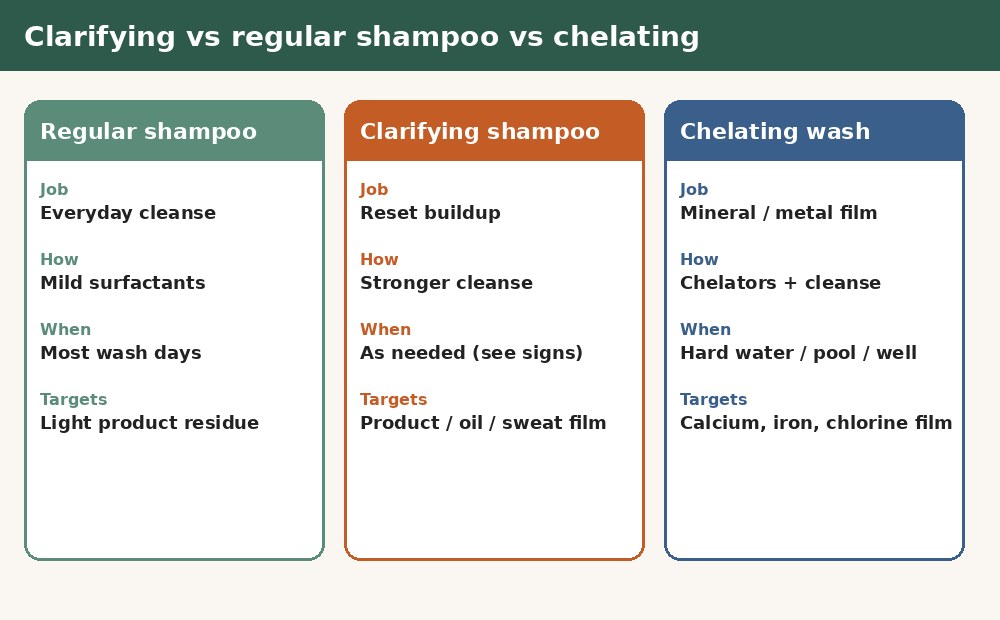
| Type | Job | Typical use | Best when |
|---|---|---|---|
| Regular shampoo | Everyday cleanse | Most wash days | Light residue; scalp needs a normal wash |
| Clarifying shampoo | Reset product / oil / sweat film | As needed | Hair feels coated; definition drops; products sit on top |
| Chelating wash | Mineral / metal film | Hard water, pool, well water | Hair feels crunchy or dull after swimming or hard-water washes |
Clarifying is about stronger cleansing. Chelating adds ingredients that bind minerals (calcium, iron, and similar deposits). Some formulas do both. Read the label: if your main problem is hard water or chlorine, a chelating product is usually the better match than a generic “detox” shampoo.
For everyday wash order, see the wash day routine.
How often to clarify (starting ranges, not rules)
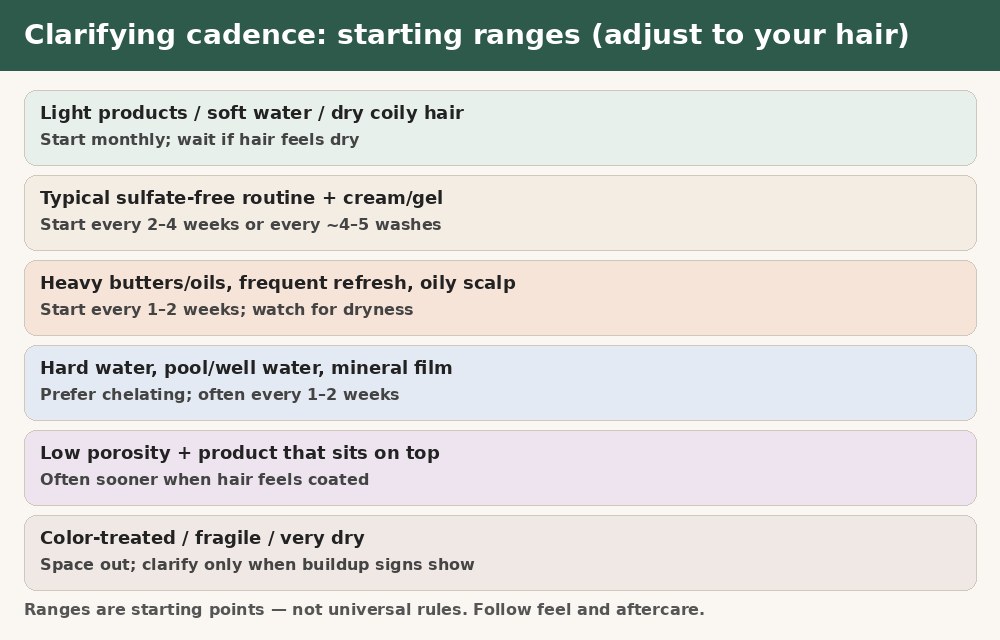
These are starting ranges. Brand pages often cite every 2–4 weeks or every 4–5 washes for sulfate-free routines. Treat that as a hypothesis you adjust:
| Situation | Start here | Then adjust if… |
|---|---|---|
| Light products, soft water, dry coily hair | About monthly | Hair feels dry/rough → wait longer |
| Typical cream + gel sulfate-free routine | Every 2–4 weeks / ~every 4–5 washes | Still coated mid-cycle → sooner |
| Heavy butters/oils, frequent refresh, oily scalp | Every 1–2 weeks | Dry or brittle → space out |
| Hard water, pool, well water | Prefer chelating; often every 1–2 weeks | Soft water returns → stretch the gap |
| Low porosity, products sit on top | When coated (often sooner than high porosity) | Over-stripped feel → less often |
| Color-treated, fragile, very dry | Only when buildup signs show | Default to moisture between resets |
Do not treat these intervals as a law. Curl pattern alone is a weak signal next to product load and water quality. Waves can need resets more often if they get oily; 4C coils often need more moisture between clarifies.
Porosity and clarifying
Porosity changes how buildup feels, not a magic schedule:
- Low porosity: products often sit on the cuticle. Hair can feel waxy or coated sooner. Clarify when that film shows, then keep layers lighter (protein–moisture balance matters after a reset).
- High porosity: products absorb more readily, but hair can dry out faster after a strong cleanse. Space clarifies and prioritize a rich conditioner or mask afterward.
- Medium: follow feel and lifestyle rows above.
A scan that estimates porosity can help you guess whether “coated” or “dry” is the more likely side effect — then you still judge by your own hair. Start in the Curltine app or routines.
Signs you need a clarifying wash
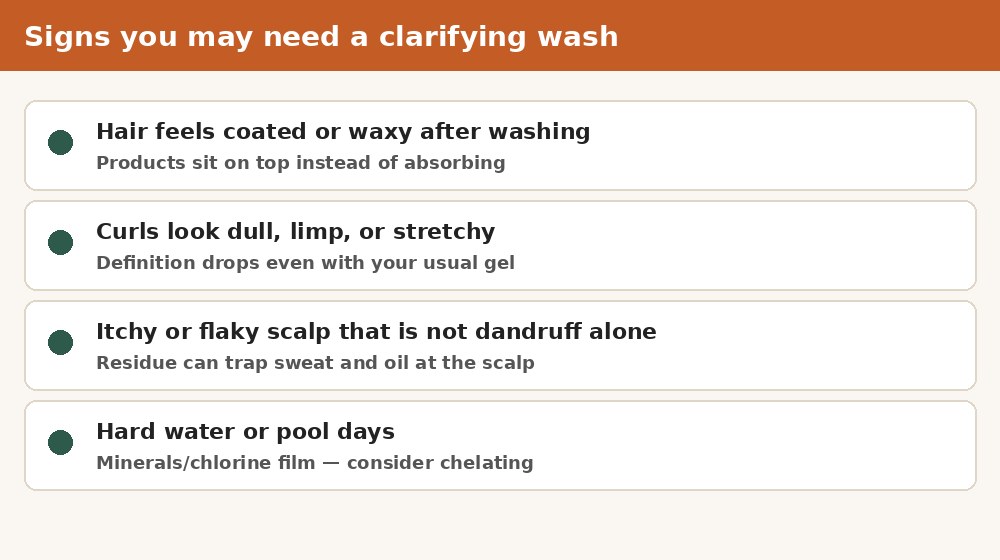
Clarify when you notice:
- Hair feels coated or waxy even after washing
- Curls look dull, limp, or stretchy; your usual gel stops working
- Scalp feels itchy or flaky in a way that tracks with product, not only dry skin
- You swim, use hard water, or notice a mineral film (consider chelating)
Also common: roots look greasy while lengths feel dry, or leave-in beads up instead of absorbing.
When not to clarify
Skip or postpone a clarifying wash if:
- Hair already feels rough, brittle, or squeaky-dry
- You just colored or chemically processed and the stylist said to wait
- Your scalp is irritated or broken (see a professional; clarifying is not medical care)
- You clarified recently and the only problem is frizz from humidity or a bad style day
Clarifying will not fix damage, grow hair, or replace a dermatologist for scalp disease.
How to clarify curly hair (step by step)
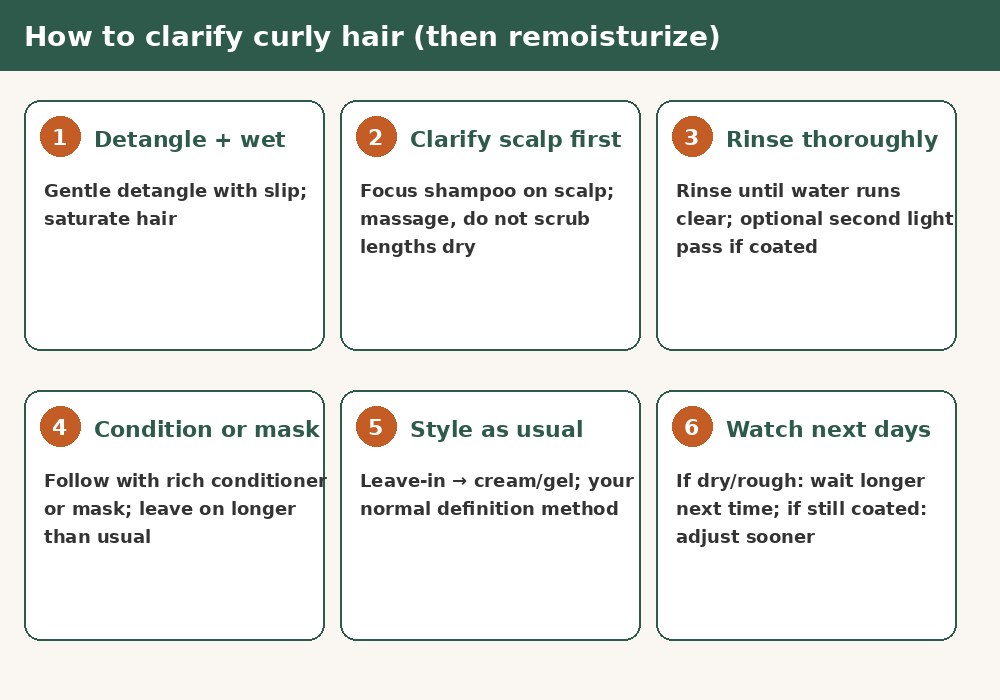
- Detangle and wet. Work in slip first so you are not ripping through dry knots. Saturate the hair.
- Clarify the scalp first. Apply clarifying shampoo to the scalp. Massage with pads of fingers. Let suds run through the lengths; do not scrub ends dry.
- Rinse thoroughly. Rinse until the water runs clear. If hair still feels coated, a light second pass is optional — then rinse again.
- Condition or mask. Follow with a rich conditioner or deep mask. Leave it on longer than a normal wash day.
- Style as usual. Leave-in, then cream and/or gel. Use your normal definition method for your curl pattern.
- Watch the next few days. Dry or rough → wait longer next time. Still coated mid-cycle → clarify a bit sooner or check silicones/hard water.
Aftercare and what to use next
After clarifying, moisture and seal matter more than on a normal wash:
- Conditioner or mask immediately after
- Leave-in before stylers
- Avoid stacking heavy oils right back on if low porosity caused the buildup
Sulfates and silicones
Clarifying formulas often use stronger surfactants, sometimes including sulfates. That does not mean every sulfate shampoo is a clarifier, or that every clarifier must be sulfated. Context: sulfates for curly hair.
Non-water-soluble silicones can contribute to the coated feel some people clarify to remove. Others tolerate certain silicones fine. Read labels with an ingredient overview or the ingredient checker, and see silicones for curly hair.
Co-wash relationship
Co-washing cleanses gently with conditioner. It can leave more residue over time. Many co-wash-heavy routines need clarifying (or a regular shampoo) more often than shampoo-only routines. Co-wash is not a substitute for a true reset when buildup is already there.
Pattern notes (directional, not measured)
- 2A–2C waves: often weighed down faster; watch oily roots and light products between clarifies.
- 3A–3C curls: follow product load; cream + gel routines usually fit the 2–4 week starting band.
- 4A–4C coils: tend to run drier; clarify for real buildup, then remoisturize thoroughly.
Use the curl type chart as a map, not a schedule.
Frequently asked questions
How often should I use clarifying shampoo on curly hair?
Start from feel, not a fixed rule. A common starting range for sulfate-free routines is every 2–4 weeks or about every 4–5 washes. Heavy product use or hard water may need sooner. Dry, coily, or color-treated hair may need more space. Adjust when hair feels coated versus dry.
Is clarifying shampoo the same as chelating shampoo?
No. Clarifying targets product and oil film with a stronger cleanse. Chelating targets mineral and metal deposits (hard water, pool). Some products combine both. Match the bottle to the film you actually have.
Can I clarify every wash day?
Usually no. Over-clarifying can leave curly hair dry, rough, or frizzy. Save clarifying for buildup signs, then return to your gentler cleanse.
Do I need clarifying shampoo if I only co-wash?
Often eventually yes. Co-wash is gentle and can leave residue. Many co-wash-heavy routines pair with periodic clarifying or a regular shampoo. See co-wash vs shampoo.
Should I deep condition after clarifying?
Yes, plan on it. Follow clarifying with conditioner or a mask, then leave-in before stylers. That remoisturizing step is part of the method, not optional.
Will clarifying remove color or damage curls?
Strong cleansers can fade color faster and leave hair feeling dry. They do not “damage” by definition, but overuse on fragile or freshly colored hair is a bad trade. Space clarifies and remoisturize. This is not medical advice.
Soft next step with Curltine
Buildup and porosity are easier to judge when you know your pattern and what is in your bottles. Scan once, check labels against your profile, and sketch a wash day in Curltine or in the Curltine app. Then clarify only when your hair asks for a reset.
Curltine
Consigue tu rutina de rizos personalizada
Haz un escaneo IA de 60 segundos y recibe un plan de wash day según tu tipo de rizo, porosidad y densidad.
Empieza tu plan