Plopping Curly Hair: When It Helps (and When It Flattens Waves)
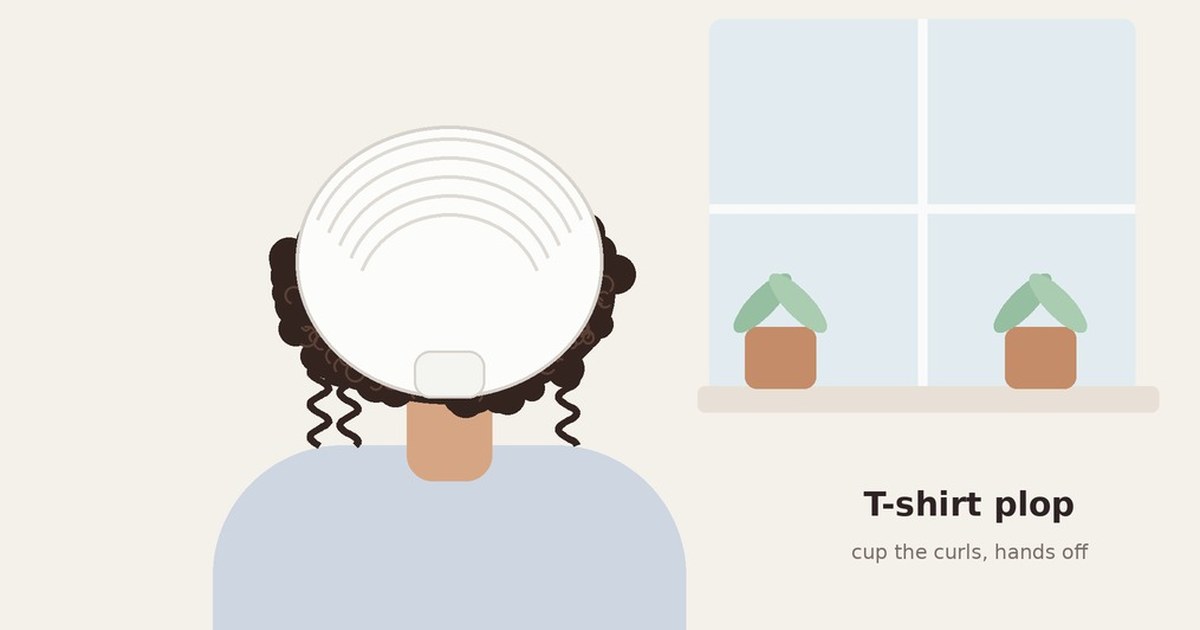
A cotton bath towel after wash day is the fastest way to rough up a curl clump. Plopping curly hair is the gentler alternative: you cup wet, product-coated curls into a T-shirt or microfiber wrap so water wicks out and the curl pattern stays stacked instead of stretched. Done for the right fabric and the right number of minutes, plopping often means less frizz and a faster dry. Done too long, on the wrong cloth, or on looser waves, it can squash volume at the root and leave a helmet.
This guide covers what plopping is (and is not), T-shirt vs microfiber vs terry, a simple step-by-step, how long to sit by porosity and density, when plopping flattens 2A–2C waves, and what to do instead on a rushed wash day.
Quick answer
Plopping is a short, no-rub dry: after leave-in and stylers go on soaking-wet hair, you flip forward, lower curls onto a cotton T-shirt or microfiber towel, wrap without twisting the hair itself, and sit 10–30 minutes (sometimes longer for dense, high-porosity hair). The wrap lifts water so you can diffuse or air-dry from damp, not dripping.
It often helps 3A–4C clumps and anyone who frizzes from terry towels. It often hurts looser waves if you leave it on until the hair is almost dry—roots pancake and the S-shape stretches. Start short. If the crown looks flatter than yesterday’s wash-and-go, cut the time in half or skip the wrap and scrunch with a T-shirt instead.
Match fabric and time to your porosity—or sketch wash-day order in Curltine routines or the Curltine app.
Start with a Curltine hair scan
What plopping is (and is not)
Plopping is not overnight pineapple, a bonnet, or a heat set. You are not “locking in” curls with the cloth. You are removing excess water so gel can form a cast on hair that is still damp, not soaking.
| Method | What it does | Typical window |
|---|---|---|
| Plop | Wicks water, holds clumps in a cup | 10–30 min after stylers (sometimes up to ~45) |
| Microfiber scrunch | Same fabric, no wrap | 1–3 minutes of gentle presses |
| Diffuse | Heat + airflow from damp | After a short plop or instead of one |
| Pineapple / satin | Overnight shape, not drying | Sleep—see how to sleep with curly hair |
If you wrap until the hair is fully dry, you often get a crease, a flattened crown, and a cast that cracked while you sat. Treat plopping as the first dry, then finish with air or a diffuser.
Fabric: T-shirt vs microfiber vs terry
Use
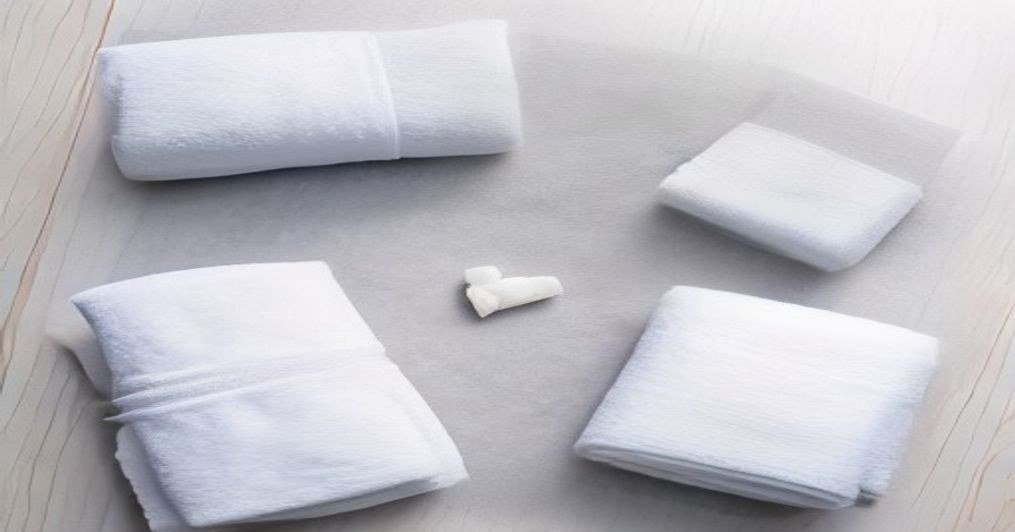
- Cotton T-shirt (smooth, not terry loops). Cheap, everywhere, gentle enough for most 2C–4C wash days.
- Microfiber hair towel or “plopping turban.” Faster wick; watch tightness at the nape so you do not stretch the hairline.
Skip for the plop itself
- Terry bath towels. Loops catch and rough the cuticle. If it is all you have, blot—do not wrap and twist.
- Paper towels. They shed and grip. Fine for a couple of scrunches in a pinch, not a 20-minute wrap.
Wash the cloth. Product buildup in a shirt makes the next plop greasy and slower to dry. A dedicated “hair shirt” in the laundry rotation is enough; you do not need a branded turban.
Step-by-step
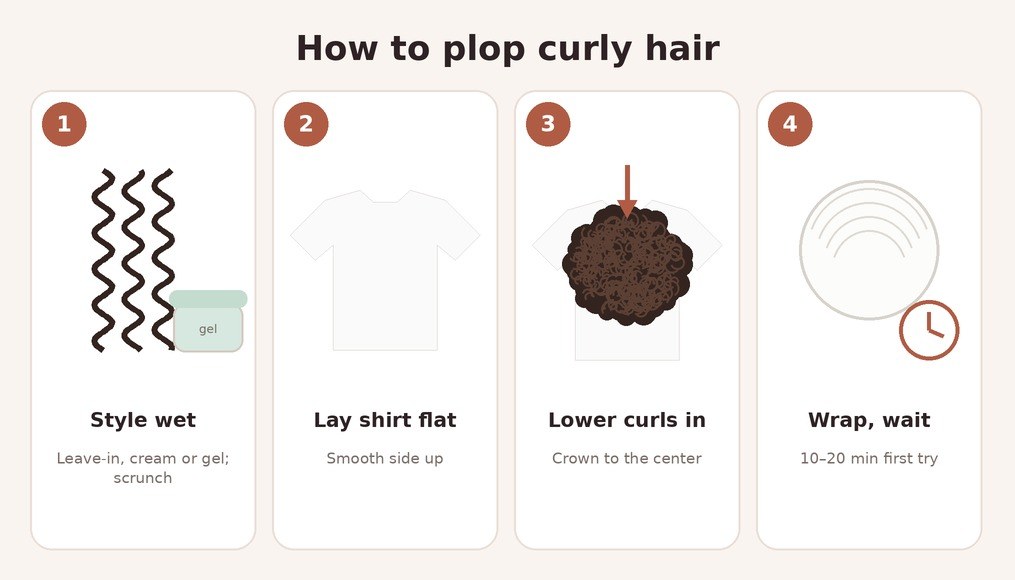
Do this after cleanse, condition, and stylers—not on soaking, product-free hair. Product needs to be in the clumps before you cup them. For the rest of wash-day order, see the wash day routine.
- Style on soaking-wet hair. Leave-in, then cream and/or gel as your density allows. Prayer-hands or scrunch so clumps form.
- Lay the T-shirt or microfiber on a bed or counter, inside of the shirt facing up (smoother side to hair).
- Flip forward so curls fall toward the center of the cloth. Do not pile them into a tight bun first—that stretches the root.
- Lower your head so the crown sits in the middle. Fold the bottom of the shirt up over the nape, then the sleeves toward the crown, and knot or tuck at the back. Hair stays in a bowl, not a twist.
- Sit 10–20 minutes for a first try (see times below). Hands off. Do not keep tightening.
- Unwrap gently. Flip back up. Scrunch out extra water with the same cloth if the ends are still dripping.
- Finish dry. Air-dry or diffuse on low. Hover first, then cup from the ends. Do not touch until the cast is dry if you used gel.
If you need definition on a few stubborn pieces after the wrap, finger-coil those sections while they are still damp—do not rake the whole head.
How long: porosity, density, pattern
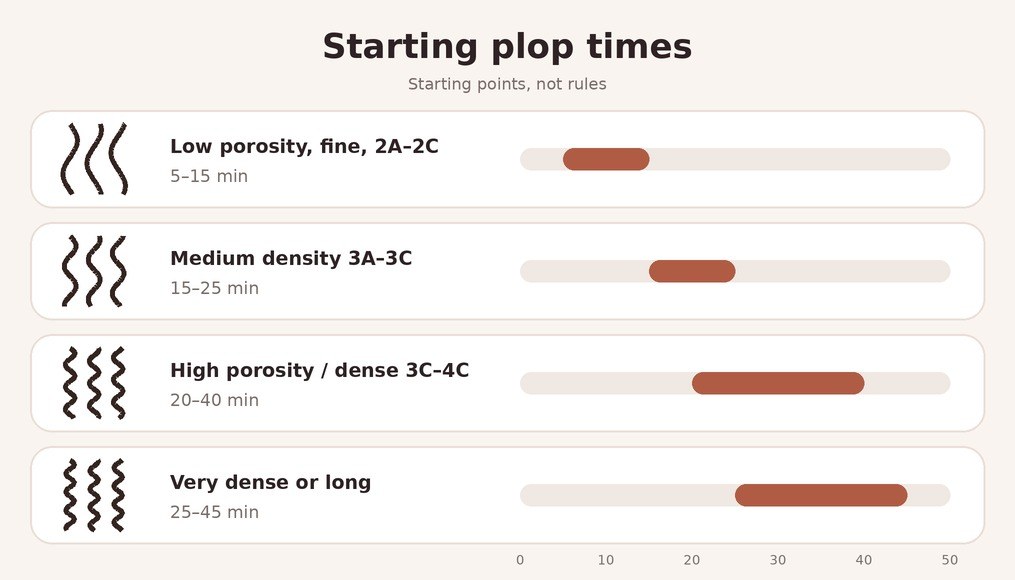
Times are starting points, not rules. Hair that still drips after 20 minutes can sit longer. Hair that already feels damp-dry at 10 should come out.
| Hair | First-try plop | Why |
|---|---|---|
| Low porosity, fine, or 2A–2C | 5–15 min, or skip and scrunch | Slow to dry; long wraps flatten the root and stretch the S |
| Medium density 3A–3C | 15–25 min | Enough wick for a cast without a crease |
| High porosity or dense 3C–4C | 20–40 min | Holds more water; a longer cup often helps clumps |
| Very dense / long | 25–45 min, then check | If the interior is still soaking, add time or microfiber |
Low porosity (routine notes): lighter layers, shorter plop, warmth from a hooded dryer or a short diffuse often does more than extra wrap time.
High porosity (routine notes): water leaves fast and frizz shows fast. A medium plop plus gel, then hands off, usually beats a two-hour wrap.
If humidity is high and your gel has glycerin, a long damp wrap can feel sticky—see glycerin and dew point. Cut the sit time and finish with airflow.
When plopping flattens waves (2A–2C)
Looser patterns need clump + root lift. A tight, long plop does the opposite: it presses the crown into a disc and lengthens the wave.
Signs the wrap is working against you:
- Roots look glued to the scalp when you unwrap
- Waves look longer and stringier than a T-shirt scrunch
- A horizontal crease sits where the knot was
- Volume is only at the ends
Fixes for waves
- Plop 5–10 minutes, then scrunch and clip the roots or diffuse with the head flipped.
- Or skip the wrap: press with a T-shirt in sections (sometimes called “micro-plopping”).
- Apply styler on soaking-wet hair; if you wait until hair is damp, 2A–2C often drops.
- For type-specific wash days, start at 2A, 2B, or 2C.
Coily hair can still pancake if the wrap is yanked tight at the nape. Loosen the knot, not the method.
Plop vs diffuse vs air-dry
Use plopping as a pre-step, not a religion.
- Short plop → diffuse: fastest defined dry for most 3x/4x wash days.
- Short plop → air-dry: quieter; expect more time. Pineapple only once hair is mostly dry if you need to sleep on it.
- No plop, just scrunch + diffuse: better for fine waves and anyone whose crown dies in a wrap.
- No plop, terry rub: the frizz you are trying to avoid.
Diffusing while hair is still pouring water just takes longer and blows clumps apart. That is the job the cloth is supposed to do first.
Common mistakes
Wrapping a terry towel. Loops = frizz. Switch fabric.
Plopping before stylers. You wick water and knock clumps apart, then try to restyle on damp hair. Product first.
Overnight plop on soaking hair. Creases, smell, a crushed root, and a broken cast. If you must sleep, get to damp first, then satin—not a wet T-shirt for eight hours.
Knot so tight the hairline aches. You are stretching the edges. Wrap snug, not tourniquet.
Touching the cast while it is still wet. Unwrapping is enough; do not fluff until dry, then scrunch the crunch if you used gel.
Same 40 minutes for every head. Fine 2B and dense 4C are not the same sponge.
Frequently asked questions
How long should I plop curly hair?
Start at 10–20 minutes. Fine or low-porosity waves often need less; dense or high-porosity coils can take 20–40. Unwrap when hair is damp, not dry.
Can I plop with a regular towel?
A smooth cotton T-shirt or microfiber, not a looped bath towel. If terry is all you have, blot and scrunch—do not twist-wrap.
Should wavy hair plop?
Short or not at all. Many 2A–2C wash days look better with T-shirt scrunches and root clips than a long cup. If you plop, keep it under ~15 minutes and check the crown.
Do I plop before or after gel?
After. Leave-in and stylers on soaking-wet hair, then the wrap. Plopping is drying, not cleansing.
Can I plop overnight?
Not on dripping hair. A wet overnight wrap is a crease machine. Dry to damp, then a satin bonnet or pineapple.
Is plopping part of the Curly Girl Method?
It is a popular CG-adjacent dry, not a required step. The Curly Girl Method is about ingredients and manipulation; plopping is optional technique.
Soft next step with Curltine
Plopping only works if the wash-day order under it matches your porosity and density. Scan and build a routine in Curltine or start in the Curltine app—then use this wrap (or skip it) on purpose, not by habit.
Curltine
Consigue tu rutina de rizos personalizada
Haz un escaneo IA de 60 segundos y recibe un plan de wash day según tu tipo de rizo, porosidad y densidad.
Empieza tu plan