LCO Method vs LOC: Which Order Fits Your Porosity
If classic LOC leaves your curls greasy at the roots, coated mid-shaft, or somehow still dry by day two, the problem may be order, not “moisture methods.” The LCO method—Liquid, Cream, Oil—flips the last two steps so cream can absorb before a light oil seals the outside.
This guide covers what LCO is, when it beats LOC (Liquid, Oil, Cream), how porosity and density tip the choice, and a wash-day sequence you can run without endless drop-count guessing.
Quick answer
LCO means apply Liquid (water or leave-in), then Cream, then Oil. Liquid hydrates, cream softens and defines while hair is wet, and a small oil seals last. LCO often suits low porosity and fine or easily weighed-down hair, because oil-under-cream (LOC) can sit on closed cuticles and feel muddy. High porosity or denser hair that sheds moisture fast may still prefer LOC—or LCO on roots and LOC on ends.
Match order to hair porosity and density first; curl pattern (2A–4C) matters more for definition than for which letter comes second. For scaffolding, see our wash day routine and curly hair routine—or personalize amounts in Curltine’s routine builder.
Start with a Curltine hair scan
What the LCO method is
LCO is a layering order, not a brand kit and not a promise that three products equal healthy hair.
| Letter | Role | Common examples |
|---|---|---|
| L – Liquid | Puts water back into the strand | Water mist, water-based leave-in, light hydrating spray |
| C – Cream | Softens, adds slip, helps define while wet | Curl cream, light lotion-cream, soft butter-cream (weight varies) |
| O – Oil | Seals the outside; slows moisture loss | Jojoba, argan, grapeseed, a drop of richer oil on ends only |
What LCO is not: a rule that you must oil every wash day; permission to skip water and “moisturize” with cream alone; or proof that LOC is “wrong.” Both orders solve different absorption problems.
Think of LCO as hydrate → let cream sink in → lightly seal. LOC is hydrate → oil to slow loss → cream to finish. Same roles; different timing for oil.
LCO vs LOC: the real difference
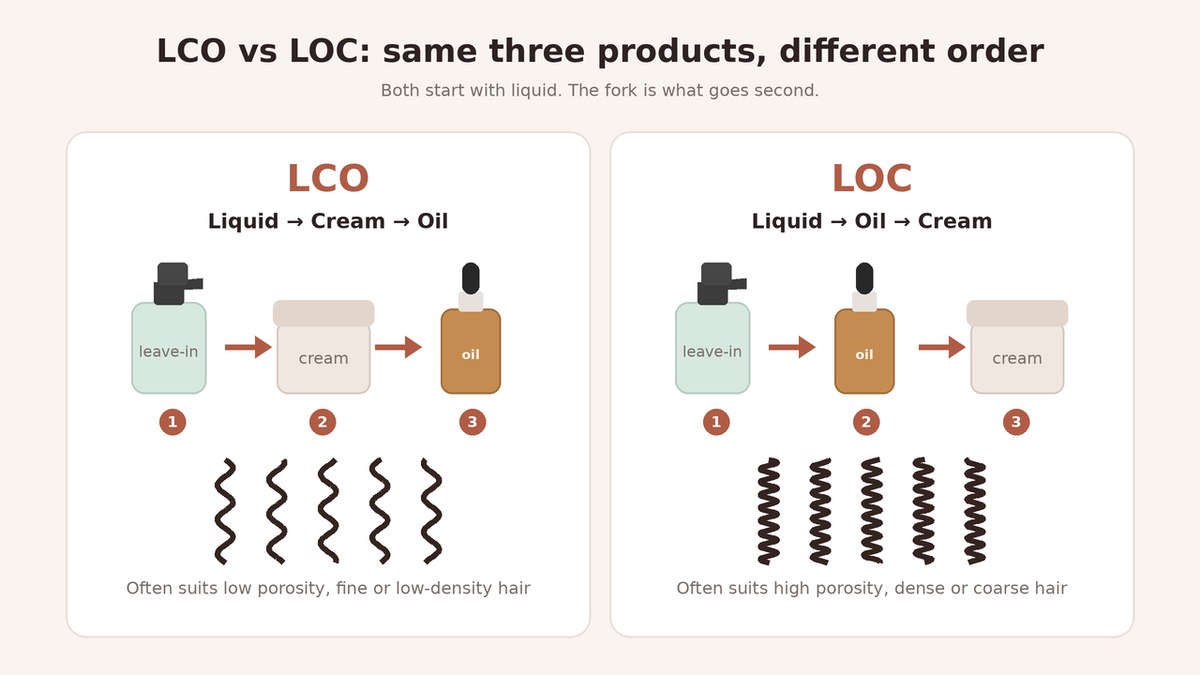
Both start with Liquid. The fork is whether oil or cream comes next.
| LCO (Liquid → Cream → Oil) | LOC (Liquid → Oil → Cream) | |
|---|---|---|
| Best when | Oil before cream feels greasy or coats low-porosity hair | Hair loses moisture fast; cream alone doesn’t hold |
| Feel | Cream absorbs first; oil seals the surface | Oil helps hold liquid; cream softens and defines last |
| Common fit | Low / some medium porosity; finer or low-density hair | High / some medium porosity; denser or coarser textures |
| Watch-out | Too much oil on top = shiny, slippery cast | Too much oil under cream = white cast, limp roots, mud |
Practical rule: If products sit on top and hair feels heavy but thirsty, try LCO with less oil—or cream with no oil some weeks. If hair feels soft after washing then brittle or frizzy by evening, you may need more sealing (classic LOC) or a better leave-in, not heavier cream alone. Hybrids work too: LCO near the scalp, more oil (or LOC) on weathered ends.
Why low porosity and fine density often prefer LCO
Low porosity
Low-porosity cuticles lie flatter. Water and product enter slowly; heavy oils and rich creams applied too early sit on the surface. Oil before cream (LOC) can create a slick barrier that blocks cream—especially on damp-dry hair.
LCO lets cream emulsify with water first. Oil comes last as a thin seal, not a middle layer cream has to fight. Warm water, steam, or thorough wetting still helps. Fuller plan: low porosity routine.
Fine density / easily weighed-down hair
Fine strands hold up butter-heavy stacks poorly. Oil under cream often means flat roots. Cream-first (LCO) with 1–3 drops of oil on ends only usually feels lighter than a full LOC palmful.
Medium porosity
Many medium-porosity curls rotate: LOC in dry winter air or after clarifying; LCO (or liquid + cream) in humidity. Ends may need oil; roots often do not.
High porosity
High-porosity hair often absorbs fast and loses moisture fast. Classic LOC remains a strong default for many. LCO can still work with a richer cream and intentional oil seal—or when fine high-porosity hair gets weighed down by oil-under-cream. See high porosity routine and confirm with a hair porosity test.
Curl pattern shapes clumping and styling; porosity and density decide whether cream-before-oil feels hydrating or coated.
Step-by-step: LCO on wash day
Do this on clean, conditioned hair. Clarify when layers bead up, feel sticky, or never fully rinse clean.
1. Start soaking wet or very damp
Squeeze out excess water—but do not towel to nearly dry. LCO fails on damp-dry hair the same way LOC does: cream pills and oil sits. Section into 4–8 parts if density is high; work one section at a time.
2. L — Liquid
Apply a water-based leave-in or mist until hair feels evenly damp and slippery. Prefer leave-ins with water first on the list. Focus on driest zones (often ends and crown). On refresh days, water (sometimes with a little leave-in) is your L.
3. C — Cream
Warm a modest amount of curl cream between palms. Rake, shingle, or pray-hands through each wet section. Start with less than you think. If cream pills or turns white/gray, add water and retry, or check for buildup.
Optional: gel or mousse after cream (before or after oil). If oil makes the cast slippery, use a tiny end oil after gel sets—or skip oil that day.
4. O — Oil
Emulsify a small amount. Start with 1–4 drops total, ends-heavy; near roots only if scalp and density allow. Prefer lighter oils (jojoba, grapeseed, argan) for fine or low-porosity hair; richer oils for coarse ends.
Gloss on the outer strand is the goal. Grease on your fingers minutes later usually means too much oil—or cream on hair that was not wet enough.
5. Dry with intention
Air-dry, diffuse on low/medium heat, or plop briefly if that suits your pattern. Minimize touching until mostly dry. Use the wash day routine as the broader scaffold.
Amount cheat sheet (starting points)
| Hair profile | Leave-in (L) | Cream (C) | Oil (O) |
|---|---|---|---|
| Fine, low porosity, shoulder-length | Light mist / thin leave-in | Pea-size total | 1 drop on ends or skip |
| Medium porosity, mid-back | Palm of leave-in, sectioned | Nickel per section | 2–3 drops, ends-heavy |
| Dense coils, low–medium porosity | Generous leave-in on soaking hair | Quarter per section | 3–5 drops; richer oil on ends OK |
| High porosity, dense (often LOC-first) | Generous leave-in | Richer cream | LCO: 4–6 drops seal—or switch to LOC |
Log amounts for two washes. “Greasy but dry” is usually a recipe issue, not LCO failing.
Common LCO mistakes (and quick fixes)
Treating oil as optional forever when ends are parched
Skipping oil can be right for fine, low-porosity hair in humidity. Chronically dry ends may still need a micro-seal.
Fix: Keep LCO order; add one drop to ends only for two washes and compare day-two feel.
Applying cream on hair that is too dry
Fix: Re-wet the section. LCO is still a wet-styling method.
Heavy cream + heavy oil “just to be safe”
Fix: Cut both in half. Low-porosity and fine hair improve more from water and light cream than from more sealant.
Using LOC amounts with LCO order
Do not pour the same oil volume on top of cream that you used under cream in LOC.
Fix: Drop oil volume first when you flip to LCO.
Ignoring porosity and copying a dense-coil stack
Fix: Run a basic porosity test, then choose order. Curltine’s AI hair scan estimates curl pattern (2A–4C), porosity, and density so your routine is not based on one viral video.
Oiling every refresh
Day-two frizz often wants water + a touch of leave-in or cream, not another oil layer.
Fix: Save full LCO for wash day unless ends are crispy. Clarify on a schedule that matches your product load.
Confusing “coated” with “moisturized”
Shiny, slippery hair that feels straw-like inside usually had too much oil or cream relative to liquid.
Fix: More water-based leave-in, less oil, lighter cream—same LCO order.
Choosing LCO or LOC without overthinking it
Use a two-wash experiment:
- Wash A — LCO with light oil on ends only. Note root lift, mid-day frizz, and whether hair feels soft inside.
- Wash B — LOC with the same leave-in and cream if possible; change only order and keep oil drops low.
Pick the order that wins on day two, not only wet-hair shine. Dry heat and winter air often justify more sealing (LOC or richer LCO oil); humid summers often want cream-gel finishes and less oil.
Explore low porosity routine, high porosity routine, and the porosity overview. For oil-before-cream detail, see the LOC method guide.
Building a simple LCO shelf
Keep the shelf small: one leave-in (L), one cream that spreads on wet hair (C), one oil you understand by drop count (O), plus optional gel. Change one variable per wash day. If cream fights your oil (pilling, white cast), check ingredients—or use Curltine’s product ingredient checker before the next purchase. You need amounts and order that match porosity, density, and weather—not a different oil for every season.
Frequently asked questions
Is LCO only for low porosity hair?
No. It is common for low porosity and fine density, but medium-porosity and some fine high-porosity hair use it too. Dense high-porosity hair often still leans LOC. Order follows how your hair behaves.
Can I skip oil in LCO?
Yes. Liquid + cream (LC) is a valid light stack—especially in humidity or on fine hair. Add oil back when ends feel dry by day two.
What if LCO still feels greasy?
Use less oil, keep oil off roots, apply on wetter hair, switch to a lighter cream, or clarify. Grease after LCO usually means volume, not the letter order alone.
Do I put gel before or after the oil?
Both exist. Cream → gel → tiny end oil is popular when you want cast first. Cream → oil → gel can work if oil is tiny. If gel slides off, you used too much oil too early.
Is water alone enough for the Liquid step?
Yes—especially for refreshes. On wash day, a leave-in often adds slip that helps cream spread before oil.
Should I LCO every day?
Usually no. Full LCO is a wash-day or deep-refresh method. Between washes, mist and add the smallest cream or gel you need.
How is LCO different from “cream and seal”?
Same idea with clearer letters: water first, oil as a seal—not the moisturizer.
Soft next step with Curltine
If you are flipping between LOC and LCO based on whoever posted last, start with signals that match your head:
- AI hair scan estimates curl pattern (2A–4C), porosity, and density
- Wash-day routine builder turns that into a stepwise plan
- Product ingredient checker flags creams or oils likely to sit heavy before they hit your cart
Curltine is available on the App Store and Google Play, with a free plan. Build or tweak a plan in Routines—then keep LCO or switch to LOC based on day-two feel, not a single tutorial.
LCO is not magic. It is a clear order: hydrate, soften with cream, seal lightly with oil. Get porosity, density, and amounts right, and “greasy but dry” usually clears within a wash or two.
Curltine
Consigue tu rutina de rizos personalizada
Haz un escaneo IA de 60 segundos y recibe un plan de wash day según tu tipo de rizo, porosidad y densidad.
Empieza tu plan