Swimming With Curly Hair: Protect Your Curls From Chlorine (and Fix Them After)
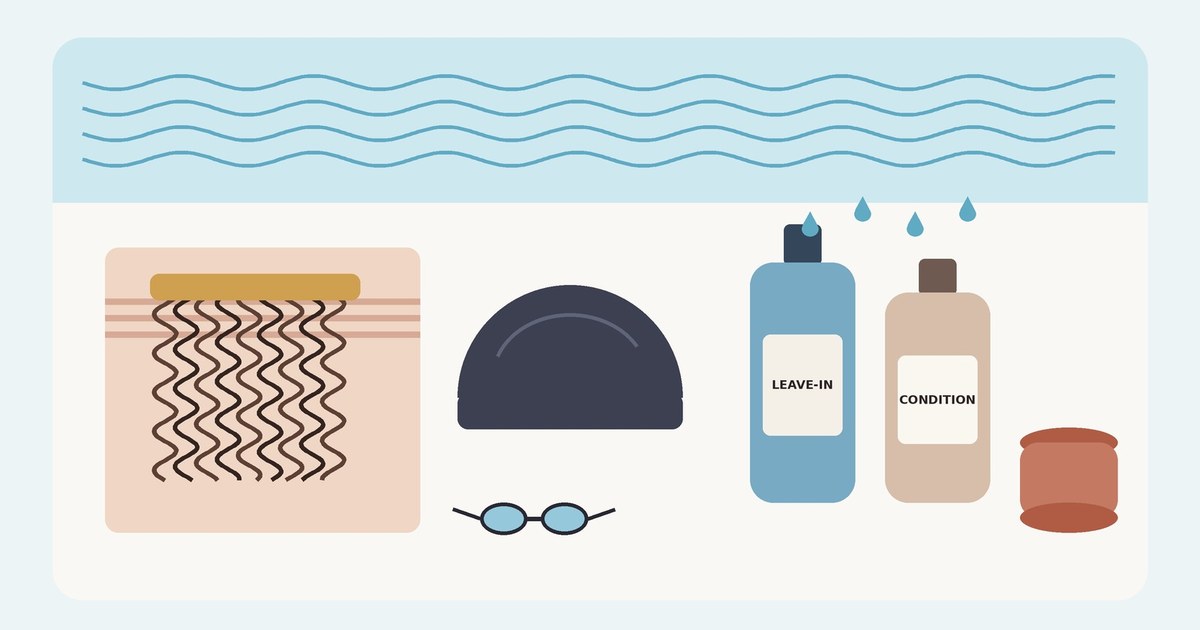
You don't have to choose between swimming and your curls. Chlorine strips the oils that coat your hair and roughens the cuticle, so curls come out dry, tangly, and frizzy. A few minutes before and after the pool prevents most of that: wet your hair with clean water, add a leave-in, tuck it under a cap, and rinse as soon as you get out.
This guide covers what pool, copper, and salt water actually do to curly hair, then gives you a swim-day routine, a cap and style chooser, and a post-swim plan based on how often you swim.
In this guide:
- What pool water does to curly hair
- Why hair turns green (it's not the chlorine)
- Swim-day routine, step by step
- Choosing a cap and style
- Post-swim care by how often you swim
- Ocean and salt water
- Already damaged? How to recover
What pool water does to curly hair
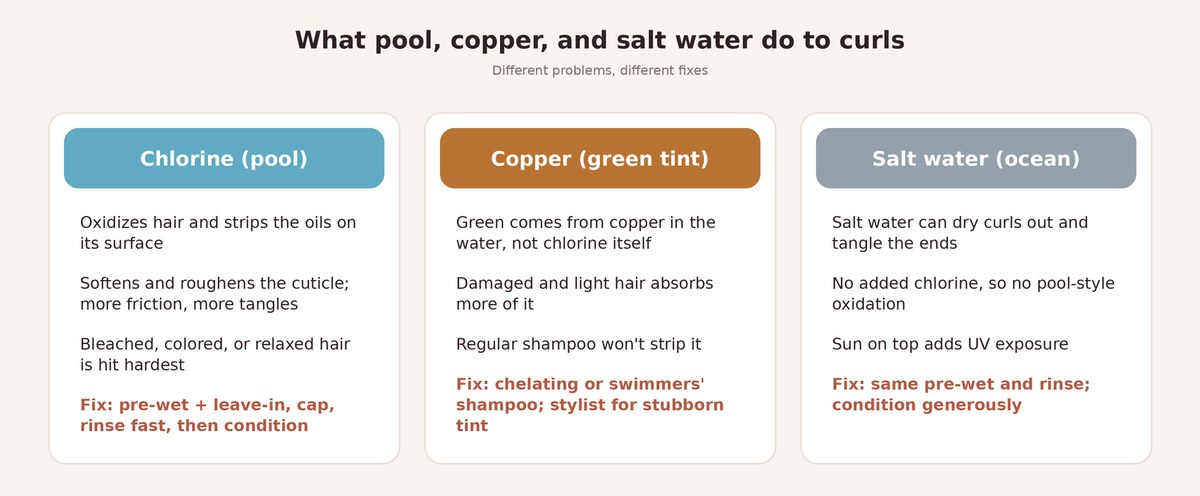
Pools are chlorinated to kill germs; the CDC's typical range is 1–4 ppm (CDC). That's good for your health and hard on your hair:
- It strips your hair's protective oils. Dermatologists at the AAD say chlorine dissolves hair lipids, the fats that coat the strand, and can break down protein bonds, which means more split ends and breakage (AAD).
- It roughens the cuticle. In lab tests, chlorinated water softened the cuticle surface and raised friction between strands. The effect built up with repeated exposure (J Soc Cosmet Chem study). For curls, more friction means more tangles and frizz.
- Heavy swimmers show it. In a study of 67 elite Japanese swimmers, 61% had discolored hair, compared with none of the controls. Their discolored hair had lost its cuticle completely (J Dermatol, 2000). That's training-level exposure, not a weekend at the pool.
Curly hair has less margin to begin with. The AAD notes that voluminous curly and tightly coiled hair is prone to breakage from chlorine and repeated wetting (AAD letter to FINA). Bleached, colored, permed, or relaxed curls take the biggest hit, so if that's you, read bleached curly hair care too.
The good news: most people won't see real damage from an occasional swim. It's frequent swimmers who need a routine (Cleveland Clinic).
Why hair turns green after swimming
Green hair is a copper problem, not a chlorine problem. Copper gets into pool water from pipes and some algaecides. In a 1979 lab study, blond hair turned green from copper alone, without chlorine. Oxidized (damaged) hair absorbed more copper, and regular shampoo didn't remove the tint (Bhat et al., 1979).
A dermatology case review lists the usual risk factors: previous damage from bleaching, dyeing, perms, or sun, frequent chlorinated water, and alkaline shampoos. One of the treatments it describes is an EDTA (chelating) shampoo (Mascaró et al., 1995).
What that means for you:
- Dark curls rarely look green, but they can still hold copper and other minerals that make them feel rough.
- A chelating or swimmers' shampoo is the right tool. Regular and clarifying shampoos aren't built to remove metals. Look for a chelator such as disodium EDTA in the ingredients and a mineral or swim claim on the bottle.
- Stubborn tint on light or color-treated curls is a job for your colorist.
Swim-day routine for curly hair, step by step
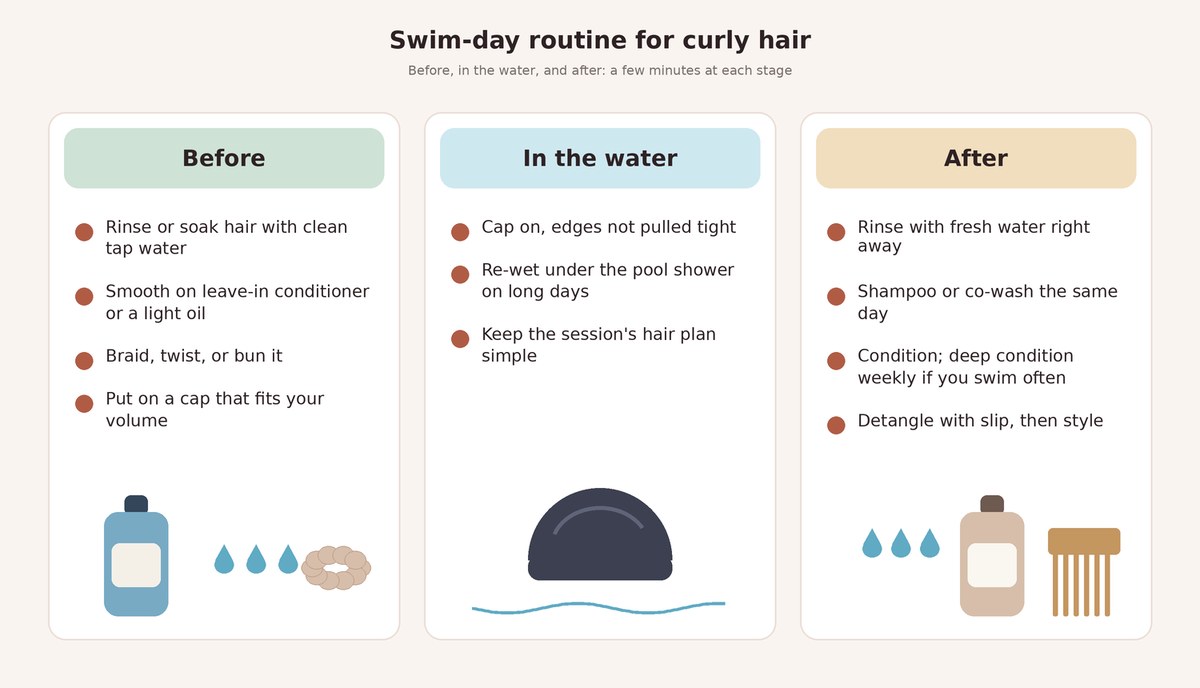
Before you swim
- Soak your hair with clean water. Hair that's already full of tap water takes up less pool water (Cleveland Clinic). The CDC also asks swimmers to shower for a minute before getting in, so this step is free (CDC).
- Add a leave-in conditioner or a light oil. Dermatologists describe it as a physical barrier between your hair and the chlorine (AAD). Conditioner also helps with copper: in the green-hair study, conditioner-type ingredients cut copper uptake (Bhat et al., 1979).
- Put it in a low-tension style. One big braid, two braids, twists, or a loose bun keeps curls from tangling in the water (Baylor College of Medicine).
- Cap on. Use a cap that fits your hair's volume and doesn't pull at your edges (more below).
In the water
- Don't fight the cap. No cap is fully watertight. Its job is to cut down how much pool water reaches your hair. If you're there for hours, re-wet and re-condition at the pool shower halfway through.
After you swim
- Rinse with fresh water right away. The longer chlorine sits in your hair, the more it does (Cleveland Clinic).
- Wash the same day. Dermatologists suggest shampooing within a few hours of swimming. For curly and coily hair, they suggest a moisturizing, sulfate-free, or chlorine-specific shampoo instead of a clarifier every time (Baylor College of Medicine). Swimming most days? A cleansing conditioner can stand in for some of those washes (Swim England; see co-wash vs shampoo).
- Condition, detangle, style. Use plenty of conditioner, then detangle while hair is wet and slippery, using a wide-tooth comb or your fingers (AAD). Our detangling guide walks through it. Then style as you normally would on wash day.
About swimmers' shampoos: they're made to remove chlorine and/or minerals. Check the label for a chelator (for example, disodium EDTA) or a chlorine neutralizer (sodium thiosulfate is a common one), plus a claim on the front like "swim" or "chlorine removal." They can be drying, so follow them with conditioner.
Choosing a swim cap and style for curly hair
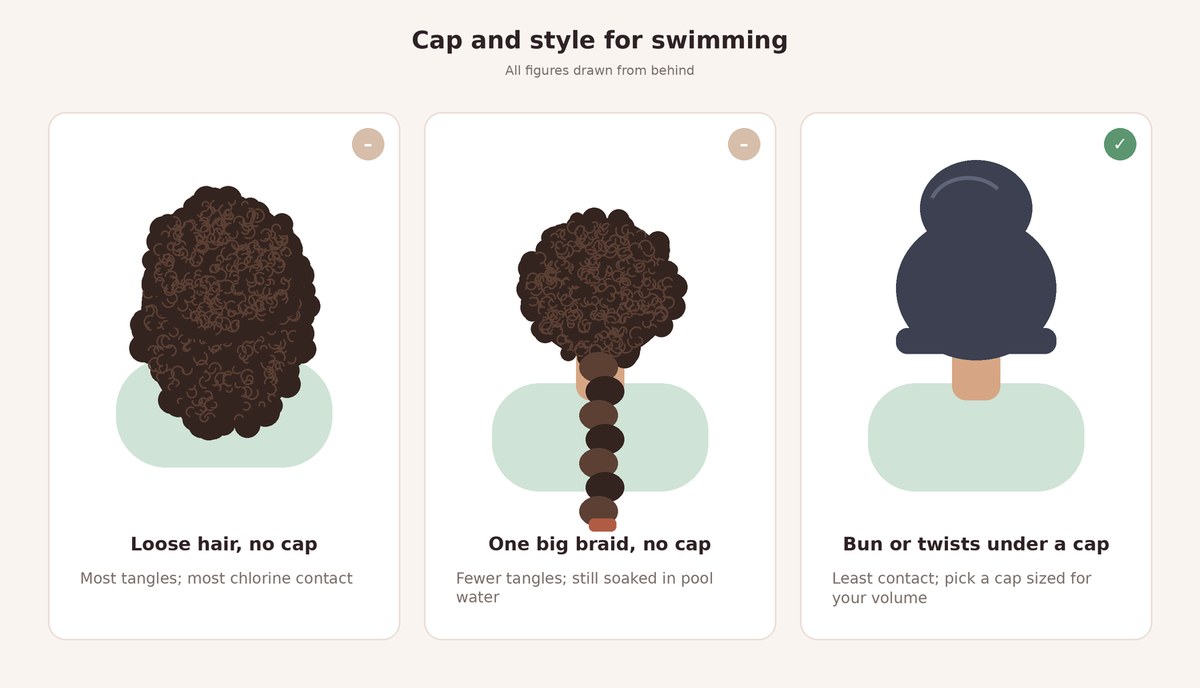
| Setup | Tangles | Pool-water contact | Best for |
|---|---|---|---|
| Loose hair, no cap | Most | Most | Quick dips only, with a rinse after |
| One big braid or two braids, no cap | Fewer | High | Casual swims, kids' pool days |
| Bun, twists, or braids under a cap | Fewest | Least | Laps, swim lessons, long pool days |
Getting the cap right:
- Size for volume. Standard caps are made for short, flat hair. If yours won't stretch over your curls without squeezing, get a cap made for long or voluminous hair. After a public dispute over the Tokyo Olympics, swimming's governing body added Soul Cap, a cap designed for thick, curly, and braided hair, to its approved list in September 2022 (NPR). Larger caps now come from several brands.
- Protect your edges. A cap that's too tight at the hairline adds tension right where hair is most fragile (Baylor College of Medicine).
- Silicone vs fabric. Silicone keeps out more water. Lycra or fabric caps are comfier but let water through, so you still need the leave-in.
Swimming right after the gym? Our gym hairstyles guide covers styles that work for both.
Post-swim care by how often you swim
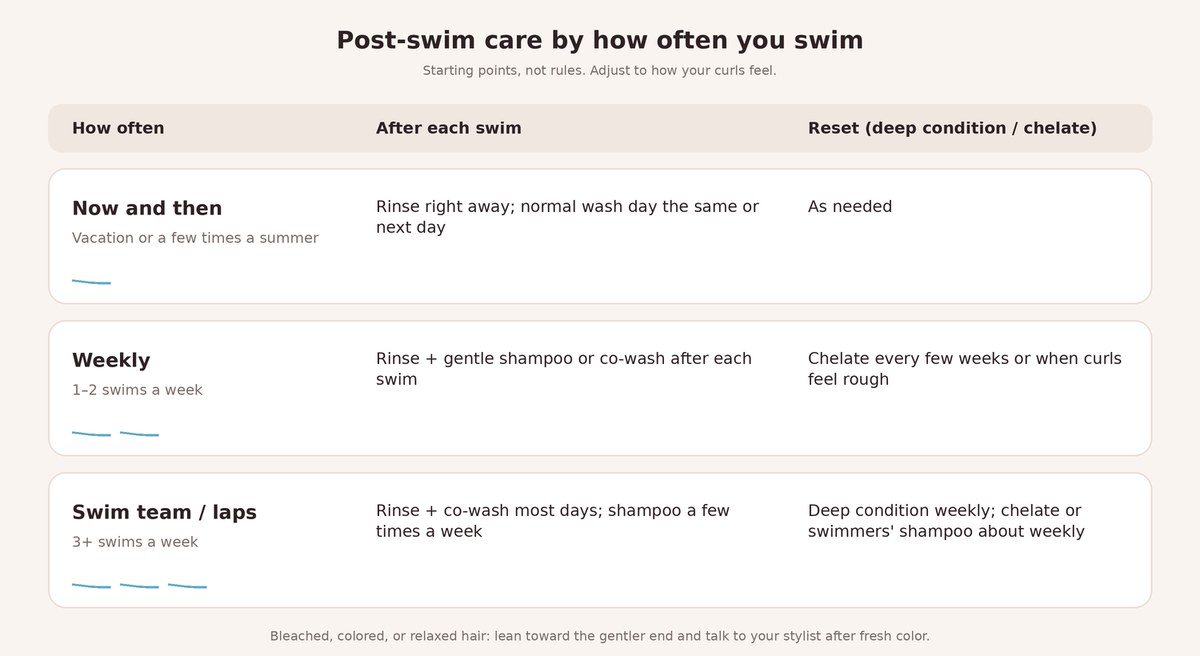
| How often you swim | After each swim | Reset |
|---|---|---|
| Now and then (vacation, a few times a summer) | Rinse right away; normal wash day the same or next day | As needed |
| Weekly (1–2 swims) | Rinse, then gentle shampoo or co-wash | Chelating or swimmers' shampoo every few weeks, or when curls feel rough |
| Swim team or laps (3+ a week) | Rinse, co-wash most days, shampoo a few times a week | Deep condition weekly; chelating or swimmers' shampoo about weekly |
This table is our starting point, based on dermatologist guidance: deep condition weekly if you swim often (Cleveland Clinic), don't clarify after every swim (Baylor College of Medicine), and co-wash instead of shampooing every time (Swim England). Adjust it to how your hair feels. If it feels rougher after a reset, space the resets out.
Chemically treated hair: after a relaxer, follow your stylist's wait time before getting your hair wet. Swim England cites up to 48 hours (Swim England). Planning a pool vacation? The AAD suggests not going blond right before, because bleached hair is more vulnerable to chlorine (AAD).
Ocean and salt water
Salt water doesn't have pool chlorine, but it's still drying, and dermatologists say it can lead to breakage if you don't take care of your hair (Baylor College of Medicine). Use the same routine: soak with fresh water, add a leave-in, braid it, and rinse as soon as you can. On beach days, cover your hair with a hat or cover-up between swims, too (AAD). For the rest of the season, see summer curly hair care.
How to fix chlorine-damaged curly hair
Signs your swim routine isn't keeping up: curls feel straw-like or gummy when wet, ends snag and split, definition fades, or color looks brassy or green.
- Reset once. Use a chelating or swimmers' shampoo to remove built-up chlorine and copper, then a long deep-conditioning session.
- Balance moisture and protein. Damaged cuticles often need both. Use our protein-moisture balance guide to tell which one your hair needs.
- Treat it as high porosity for now. Chlorine-roughened hair takes in water fast and loses it fast. Our high porosity routine works well during swim season.
- Cut back on other damage. Hold off on heat and new chemical services while you're swimming a lot (Cleveland Clinic). If you've had bleach or color, bond repair treatments may help.
- Trim what's split. Split ends don't fuse back together, so trim the frayed ends rather than chasing them with products.
If your hair is falling out from the root, not breaking along the strand, or your scalp is irritated, see a dermatologist.
Frequently asked questions
Is chlorine bad for curly hair?
Over time, yes. Chlorine strips the oils that coat your hair and roughens the cuticle, so curls get drier, frizzier, and more tangled. An occasional swim won't do much, but frequent swimmers, and anyone with bleached or colored curls, should protect their hair before and after.
Should I wet my curly hair before swimming?
Yes. Hair that's already soaked with clean water takes up less pool water. Add a leave-in conditioner or a light oil on top as a barrier, then put on a cap.
Do swim caps keep curly hair dry?
Not completely. Even a well-fitted silicone cap lets some water in. A cap still cuts down how much chlorine reaches your hair, especially with a leave-in underneath. Choose one made for long or voluminous hair so it doesn't squeeze your curls or pull at your edges.
Why did my hair turn green from the pool?
Copper in the pool water, not chlorine. Light, bleached, or damaged hair absorbs copper most easily, and regular shampoo won't take it out. A chelating or swimmers' shampoo can help. See a colorist for stubborn tint.
Should I wash my curly hair after every swim?
Rinse after every swim, and wash the same day if you can. If you swim most days, use a gentle shampoo or a cleansing conditioner most of the time. Save chelating or clarifying shampoos for about once a week so your curls don't dry out.
Is salt water better for curly hair than chlorine?
It has no pool chlorine, but it's still drying and can tangle curls. Use the same routine: soak first, leave-in, braid, and rinse with fresh water as soon as you can.
Build a swim-season routine for your curls
Every swimmer's hair reacts differently, depending on curl pattern, porosity, and past color. A Curltine scan estimates your curl pattern, porosity, and density, and the ingredient checker tells you whether a "swim" shampoo actually chelates. Start your free scan in the Curltine app, or build a swim-week wash day in Curltine routines.
Curltine
Consigue tu rutina de rizos personalizada
Haz un escaneo IA de 60 segundos y recibe un plan de wash day según tu tipo de rizo, porosidad y densidad.
Empieza tu plan