Dandruff vs Dry Scalp vs Buildup: How to Tell on Curly Hair
Dandruff is skin shedding linked to oil and yeast. Dry scalp is skin that has lost moisture. Buildup is product residue sitting on top of the skin. On curls, all three look like white flakes. The fastest way to tell them apart is how your scalp feels, where the flakes sit, and what one clarifying wash does.
Quick answer
- Oily scalp, flakes that cling to the skin, itch that keeps coming back: think dandruff. Use a dandruff shampoo on the scalp only.
- Tight, dry scalp, small dusty flakes, dry skin elsewhere too: think dry scalp. Switch to a gentler, non-medicated shampoo.
- Waxy film, heavy roots, flakes that smear and vanish after one clarifying wash: think buildup. Clarify, then use less product at the roots.
- Red, painful, swollen or patchy scalp: skip the guessing and see a doctor.
In this guide:
- A three-way decision table you can check in the mirror
- Why curly routines make flakes so confusing
- Three at-home tests, including a four-day clarify-and-watch test
- How to use dandruff shampoo on curls without drying your lengths
- How to remove scalp buildup, step by step
- When to see a dermatologist
Start with the table, then run the test that fits.
This guide is general information, not medical advice. It can't diagnose a scalp condition. If your symptoms are severe, painful or don't improve, talk to a doctor or a board-certified dermatologist.
Dandruff vs dry scalp vs buildup: the decision table
Check on day two or three after a wash, in good light. Rub a flake between your fingers.
| Clue | Dandruff | Dry scalp | Product buildup |
|---|---|---|---|
| Flake size and color | Often bigger, off-white flakes; can look oily | Small, fine, white flakes | Waxy or chalky bits, or a film you can see at the roots |
| Oily vs tight feel | Scalp feels oily or greasy | Scalp feels tight and dry; other skin may be dry too | Roots feel coated, heavy or sticky |
| Where it sits | Clings to the scalp skin | On the skin and drifts onto shoulders | On the skin and the first inch of hair |
| Smears vs dusts off | Sticks; may feel slightly greasy | Dusts off easily | Smears or rolls between fingers |
| After one clarifying wash | Comes back within a few days | Can feel tighter and flakier | Usually clears and stays clear longer |
| Try first | Dandruff shampoo, scalp only | Gentle, non-medicated shampoo; less stripping | Clarify, then lighten root products |
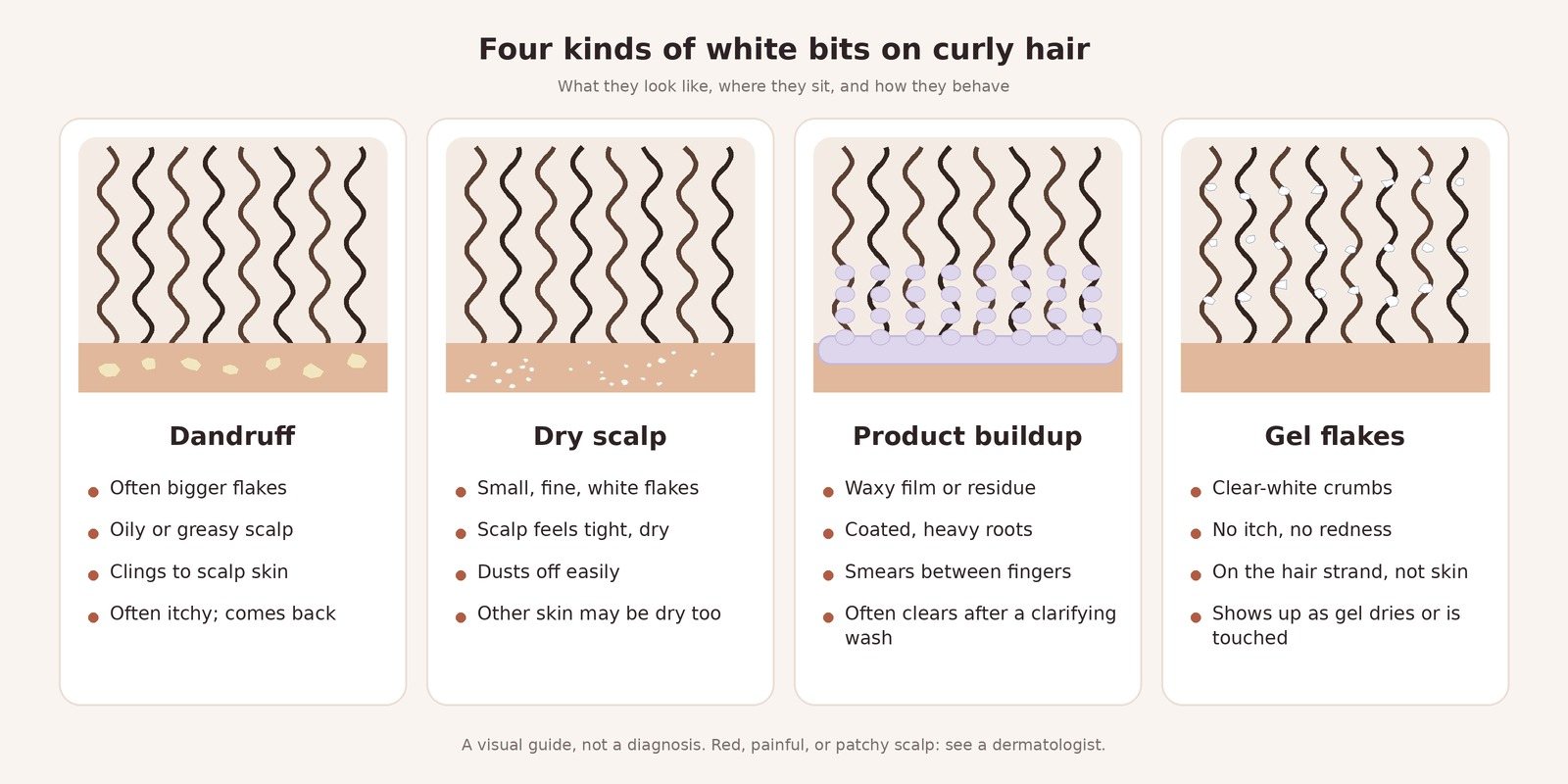
There's a fourth look-alike: gel flakes. They sit on the strand, not the skin, and don't itch.
Is dandruff the same as dry scalp?
No, even though they look alike. Cleveland Clinic puts it simply: excess oil causes dandruff, and loss of moisture causes dry scalp. With dandruff, skin cells build up on an oily scalp and flake off. Cleveland Clinic says seborrheic dermatitis is the main cause of dandruff.
The NHS adds that dandruff may be caused by a yeast that naturally lives on your skin, and by skin conditions such as eczema. Stress and cold weather may make it worse. Your scalp can also feel dry and itchy with dandruff, which is exactly why people mix the two up.
Dry scalp is different. Cleveland Clinic notes that if your scalp is dry, the rest of your body may feel dry too. Harsh products, low humidity, cold weather and age can all play a part.
So the key question isn't "Do I have flakes?" It's "Is my scalp oily or tight?"
Why curly routines make this confusing
Habits that protect curly lengths can also make scalp flakes harder to read.
- Low wash frequency. Many curly routines stretch washes to protect moisture. The American Academy of Dermatology (AAD) says that going a long time between washes can lead to dandruff from oil overproduction. It also says to wash at least every 2 to 3 weeks for scalp and hair health. See how often to wash curly hair for a cadence that works.
- Butters and oils. Rich products meant for ends drift to the roots and leave a film.
- Root gel. Gel applied right at the part can dry into white crumbs. That's not your skin at all. Our gel layering guide helps you keep hold where you need it.
- Co-washing. Cleansing conditioners are gentle but may not lift heavy product or oil. See co-wash vs shampoo.
- Protective styles. Braids, twists and wigs make the scalp hard to wash, so residue collects along the parts. Our protective styles guide covers scalp care.
None of this means your routine is wrong. It means buildup is often the first suspect.
How to tell if you have dandruff or dry scalp: three at-home tests
These help you pick what to try first. They aren't a diagnosis.
1. The overnight moisture test
On a non-wash night, part your hair and smooth a small amount of a light, fragrance-free moisturizer or a few drops of a light oil onto one small patch of scalp. Leave the rest alone. Check both areas in the morning.
- The patch feels calmer and the fine flakes have softened: dryness is the likely cause.
- No change, or the patch looks greasier and flakier: oil isn't the fix. Think dandruff or buildup.
If the patch stings or turns red, wash it off.
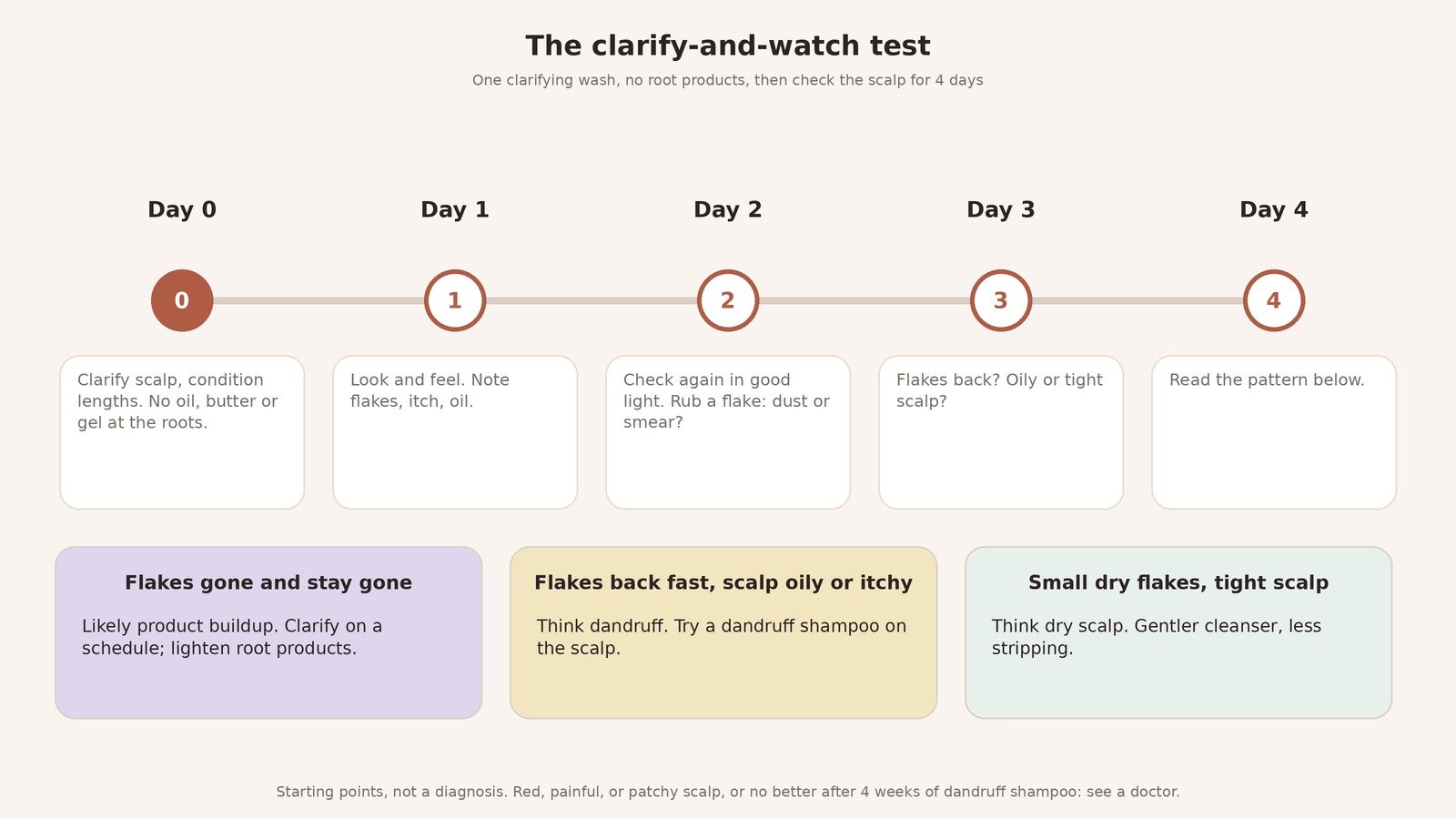
2. The clarify-and-watch test
Start here if you use a lot of styling product at the roots.
- Day 0: Wash your scalp with a clarifying shampoo. Condition your lengths. Put no oil, butter or gel at the roots.
- Day 1: Look and feel. Note any flakes, itch or oil.
- Day 2: Check again in good light. Rub a flake between your fingers. Does it dust off or smear?
- Days 3 and 4: Are flakes back? Is the scalp oily or tight?
How to read the result:
- Flakes gone and they stay gone: product buildup is the likely cause. Follow the buildup steps below.
- Flakes back quickly, with an oily or itchy scalp: think dandruff.
- Small dry flakes and a tight scalp, maybe worse after clarifying: think dry scalp.
3. The gel-flake check
Flakes only on styling days? Check the strands first.
- Look at where the white bits sit. Gel flakes cling to the hair shaft, often mid-length, not the scalp.
- Rub one between your fingers. Gel flakes crumble or feel slightly plastic.
- Note the timing. They appear as your cast dries or after you scrunch.
If so, your scalp may be fine. Apply gel to soaking wet hair, use less at the roots, and don't touch it until it's dry.
What to do for each one
If it looks like dandruff
- Use a dandruff shampoo on the scalp. The section below shows how to use it on curls.
- Wash often enough that oil doesn't sit for weeks.
- Don't add more oil to "moisturize" the flakes.
If it looks like dry scalp
- Switch to a gentle, non-medicated shampoo. Both Cleveland Clinic and the AAD list this as a first step.
- Rinse shampoo out well. Cleveland Clinic notes that shampoo left behind can irritate the scalp.
- Cut back on clarifying for a few weeks. Stop any product that seems to sting or itch.
If it looks like buildup
- Clarify, then rebalance your routine: lighter products near the roots and heavier ones on the ends.
- If you have hard water, add a chelating wash on a schedule.
- Follow the steps in the buildup section below.
Dandruff shampoo for curly hair: how to use it
Dandruff shampoos work, but their actives can dry curly lengths. The AAD's advice on treating dandruff is written with hair texture in mind. If you have curly or coily hair, it suggests using dandruff shampoo about once a week, if tolerated, and applying it only to your scalp.
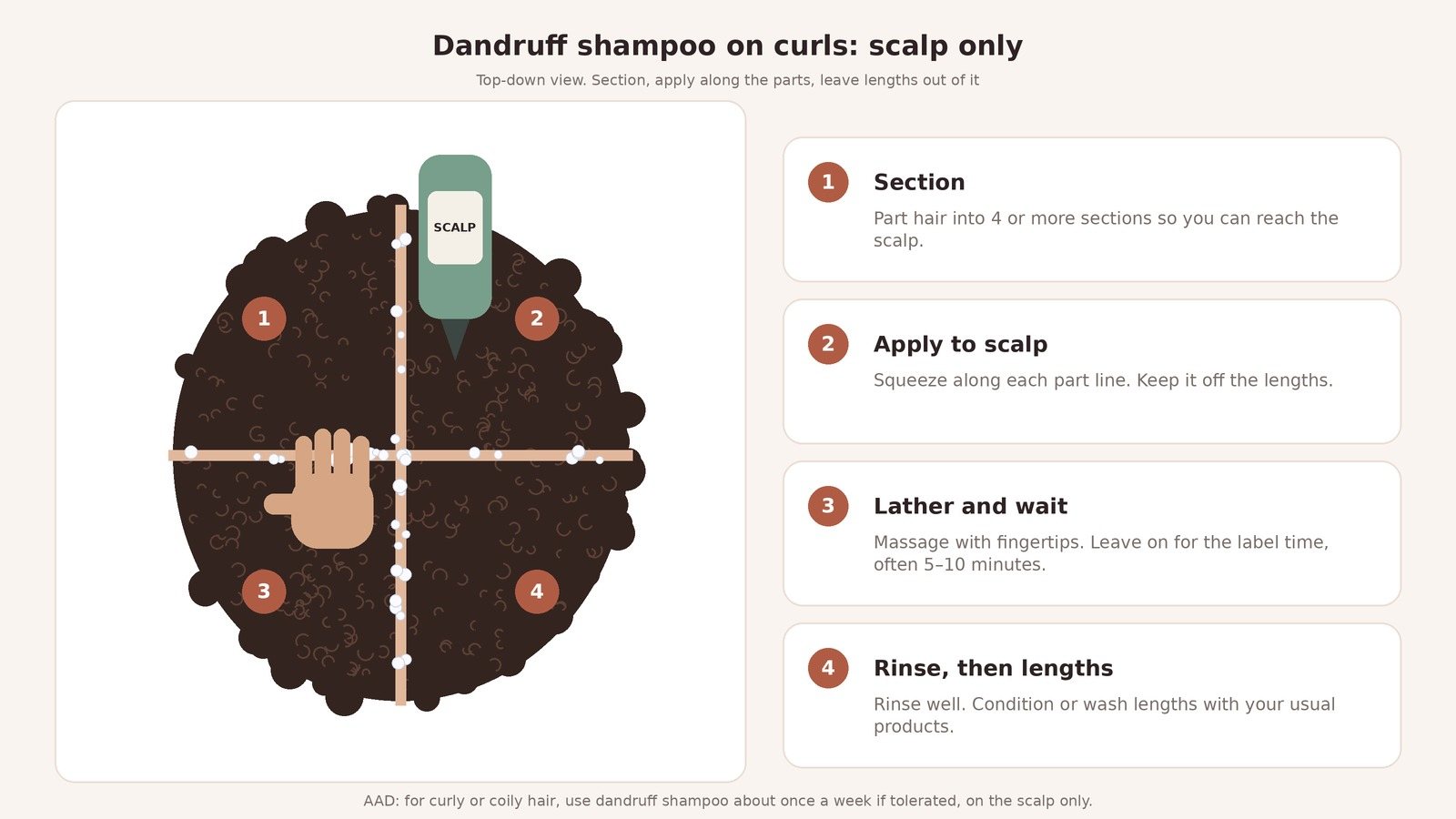
- Section your hair. Four or more sections let you reach the skin.
- Apply along the parts. Squeeze the shampoo onto the scalp along each part line.
- Lather and wait. Massage with your fingertips, not your nails. Leave it on for the time on the label. The AAD notes that some need 5 to 10 minutes.
- Rinse well. Let the water run through the lengths without scrubbing them.
- Take care of the lengths. The AAD says you can shampoo and condition with your normal products afterward. Its curly hair care tips suggest a moisturizing shampoo on the rest of your hair.
A few more points from the AAD:
- Rotate actives if one doesn't work. Common dandruff shampoo ingredients include zinc pyrithione, salicylic acid, sulfur, selenium sulfide, ketoconazole and coal tar. If one shampoo doesn't help, the AAD suggests alternating with one that has a different active ingredient.
- Watch coal tar on light hair. The AAD's seborrheic dermatitis self-care page warns that tar shampoos can discolor light-colored, bleached or tinted hair.
- Protect your scalp from the sun. Coal tar shampoos can make the scalp more sensitive to UV, the AAD says.
Give it time. The NHS suggests up to 4 weeks to see if an anti-dandruff shampoo helps.
How to remove scalp buildup
If the clarify-and-watch test pointed to buildup, here's a simple reset. The AAD's curly hair tips say that if you style with gels, oils, creams or pomades, you can use a clarifying shampoo before your moisturizing shampoo.
- Detangle first. Finger-detangle with conditioner in sections, so clarifying doesn't create knots.
- Wet the scalp thoroughly. Soak it so the shampoo can spread along the parts.
- Clarify the scalp in sections. Apply clarifying shampoo along the parts and massage with your fingertips for a minute or two.
- Rinse, then repeat if needed. Heavy butter or gel buildup can take two rounds.
- Chelate if your water is hard. Minerals cling in a different way from product. A chelating shampoo binds them so they rinse off.
- Condition well. Clarifying can leave lengths feeling dry, so follow with a rich conditioner or mask.
- Restyle lighter at the roots. Put your heavy creams and butters on mid-lengths and ends. Keep gel a little away from the part.
Clarifying vs chelating, in short: clarifying removes product, oil and sweat film. Chelating removes calcium, magnesium and other minerals from hard water. Many "detox" shampoos do some of both, so read the label. Our clarifying shampoo guide covers how often to clarify. The hard water guide helps you work out if you need to chelate.
To stop buildup coming back, wash on a steady schedule, and use your LOC method layers on the lengths, not the scalp.
Can you have more than one at once?
Yes, and it's common on curly hair. A dandruff-prone scalp can also carry product film, and a dry scalp can sit under root gel. Treat only one, and it can look like nothing works.
If you suspect a mix, take it in order:
- Clear the buildup first with one clarifying wash, so you can see the skin.
- Watch for 3 to 4 days. Oily flakes that return point to dandruff. Tight, dusty flakes point to dryness.
- Treat what's left, one change at a time, so you know what helped.
When to see a dermatologist
Some signs need a professional look, not a new shampoo. See a doctor or board-certified dermatologist if:
- Your symptoms haven't improved after about 4 weeks of anti-dandruff shampoo (NHS)
- Your scalp is red, swollen, warm or painful to the touch, or the itching is constant (Cleveland Clinic)
- You have scaly patches with patchy hair loss or broken hairs. This can be a sign of tinea capitis (scalp ringworm), which needs prescription antifungal medicine (AAD)
- Your flakes have a silvery sheen, or sit on raised, reddish patches. The AAD describes this as a sign of scalp psoriasis
- You have flaky, itchy patches on your face or other parts of your body, such as the eyebrows or behind the ears (NHS)
- Your scalp is sore or irritated under braids, a weave or other tight styles. The AAD advises removing weaves that cause pain or irritate the scalp and making sure cornrows aren't tight (AAD)
Frequently asked questions
What's the difference between dandruff and dry scalp?
Dandruff is linked to oil and a yeast that lives on the skin, so the scalp often looks oily and the flakes cling. Dry scalp happens when the skin loses moisture, so the scalp feels tight and the flakes are small and dusty. Both can itch.
How to tell if you have dandruff or dry scalp?
Check how your scalp feels a day or two after washing. Oily roots with flakes that stick to the skin point to dandruff. A tight, dry scalp with fine flakes that brush off points to dry scalp. If flakes vanish after one clarifying wash and stay gone, buildup is more likely.
How to get rid of buildup on scalp?
Use a clarifying shampoo on the scalp, massage with your fingertips, rinse well, and condition your lengths. If you have hard water, a chelating shampoo removes minerals that clarifying alone may leave. Then use less heavy product at the roots.
What causes scalp build up?
Product residue from butters, oils, creams, gels and dry shampoo, plus sebum and sweat, collects at the roots when there's a long gap between washes. Hard-water minerals can add to the film.
How to get rid of dandruff for curly hair?
The American Academy of Dermatology suggests using dandruff shampoo about once a week if your hair tolerates it, on the scalp only, left on for the time on the label. Then shampoo or condition your lengths as usual. If one active ingredient doesn't help, try another.
Is dandruff caused by poor hygiene?
No. The NHS says dandruff is not caused by poor hygiene, though it may be more obvious if you don't wash your hair regularly.
Build a routine that's kind to your scalp
The next step is a wash day that keeps flakes from coming back. Curltine can't diagnose scalp conditions, and it won't tell you which one you have. What it can do is estimate your curl pattern, porosity and density from a scan. Its ingredient checker shows what's in the products you're putting near your roots. Curltine is on the App Store and Google Play, with a free plan. For more on serums, scrubs and product order, read our scalp-first curly routine.
Curltine
Consigue tu rutina de rizos personalizada
Haz un escaneo IA de 60 segundos y recibe un plan de wash day según tu tipo de rizo, porosidad y densidad.
Empieza tu plan