# Hard Water and Curly Hair: When to Use a Chelating Shampoo
> Hard water leaves calcium and magnesium on curls that can feel rough and dull. Check your water hardness, pick a real chelating shampoo, and set a cadence.
Canonical: https://curlyhair.app/ar/blog/hard-water-curly-hair
Last updated: 2026-10-22
**Hard water leaves calcium and magnesium on your curls, and a regular or clarifying shampoo isn't built to lift them off.** A chelating shampoo is: it carries ingredients that bind those mineral ions so they rinse away. If your curls feel rough, dull, or tangly no matter what you put on them, check how hard your water is before you change your whole routine.
Here's how to find your water's hardness, tell a real chelating shampoo from a "detox" label, set a starting cadence, and know when minerals aren't actually the problem.
**In this guide:**
- How to tell if hard water is the problem
- How hard is your water?
- Chelating vs clarifying shampoo
- Does your shampoo actually chelate?
- How often to chelate
- Step-by-step chelating wash
- Shower filters, softeners, and rinses
## Signs hard water is the problem
Minerals tend to show up as a *texture* problem, not a *weight* problem. Common signs:
- Curls feel **rough, straw-like, or stiff** even right after conditioner
- **Dullness** that doesn't improve with lighter products
- **More tangles** than usual, or ends that snag
- Leave-in and gel seem to **stop working** at the same time
- White crust on your faucet and shower head (a sign about the water, not proof about your hair)
If your hair feels **coated, waxy, or greasy-heavy** instead, that's more often product buildup, which is a [clarifying job](https://curlyhair.app/ar/blog/clarifying-shampoo-curly-hair). If it feels **dry but soft** and drinks up conditioner, it may be a moisture issue; see [frizz vs dehydration](https://curlyhair.app/ar/blog/frizz-vs-dehydration-guide).
### What the research says (and doesn't)
The lab evidence is real but modest:
- Hair picks up calcium and magnesium from tap water, and those metals collect mainly in the **cuticle**. In one study, that made fibers **stiffer** ([Evans et al., 2011](https://doi.org/10.1111/j.1468-2494.2011.00659.x)).
- The biggest factor wasn't how hard the water was. It was **how damaged the hair was**. Chemically damaged hair soaked up notable amounts of metals **even from soft water** ([Evans et al., 2011](https://pubmed.ncbi.nlm.nih.gov/21982353/)).
- A small three-week study found more **magnesium** on hard-water-washed hair, but no significant calcium difference and no visible surface damage under the microscope ([Srinivasan et al.](https://pubmed.ncbi.nlm.nih.gov/28799530/)).
- A 2025 review of nine studies found more mineral deposits and slightly lower tensile strength with hard water, but rated most of the evidence as low certainty ([Int J Trichology, 2025](https://doi.org/10.4103/ijt.ijt_86_25)).
The practical takeaway: **if your curls are bleached, colored, or heat-damaged, minerals matter more for you, even if your water isn't very hard.** See [bleached curly hair care](https://curlyhair.app/ar/blog/bleached-curly-hair-care) and [bond repair](https://curlyhair.app/ar/blog/bond-repair-curly-hair).
## How hard is your water?
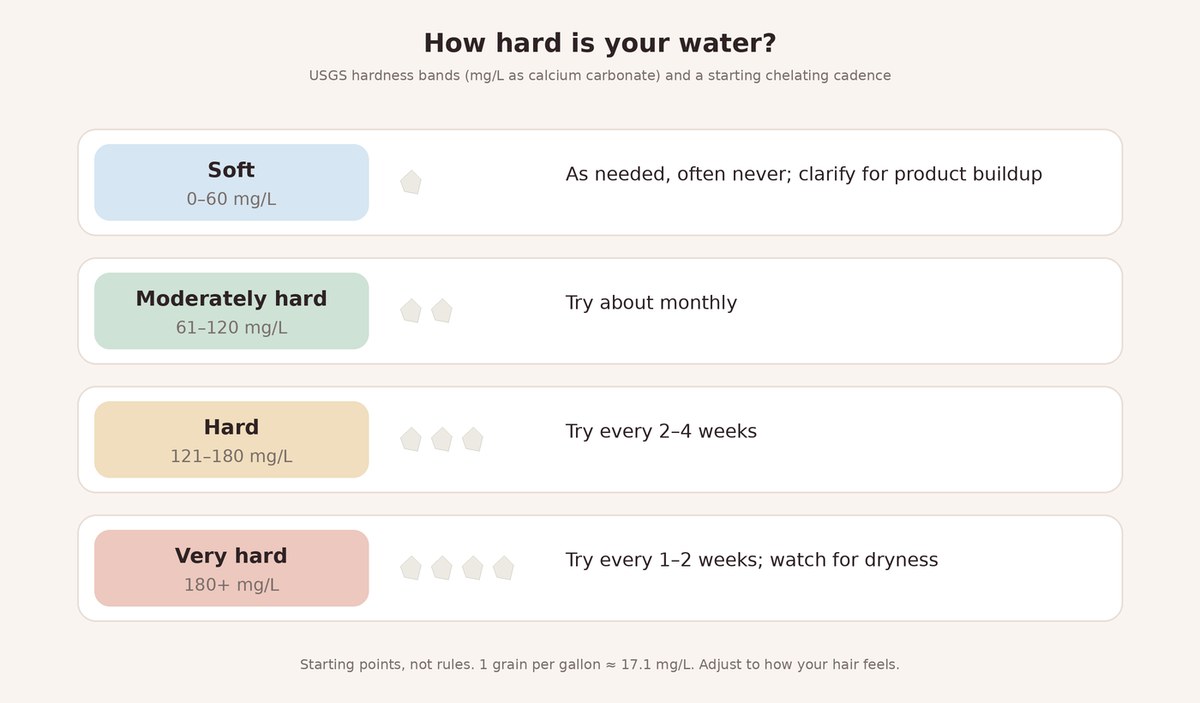 Don't guess from your zip code. Look it up:
1. **Find your water report.** In the US, community water systems publish an annual Consumer Confidence Report. Search [EPA's CCR tools](https://www.epa.gov/ccr/ccr-information-consumers) or ask your utility. Hardness isn't federally regulated, so some reports leave it out; if yours does, call the utility and ask.
2. **On a well?** Your report won't cover it. Use a hardness test strip or a lab test.
3. **Read the number.** Hardness is usually given in mg/L (same as ppm) as calcium carbonate, or in grains per gallon. One grain per gallon is about 17.1 mg/L ([Maryland Geological Survey](https://mgs.md.gov/groundwater/hardness.html)).
| USGS band | mg/L as CaCO₃ | Starting chelating cadence |
| --- | --- | --- |
| Soft | 0–60 | As needed (often not at all) |
| Moderately hard | 61–120 | About monthly |
| Hard | 121–180 | Every 2–4 weeks |
| Very hard | over 180 | Every 1–2 weeks |
The bands are from the [USGS](https://www.usgs.gov/water-science-school/science/hardness-water). The cadence column is our starting point, built from the ranges curl brands publish (from every 4–5 washes to weekly). It's a place to start, not a rule.
## Chelating vs clarifying shampoo
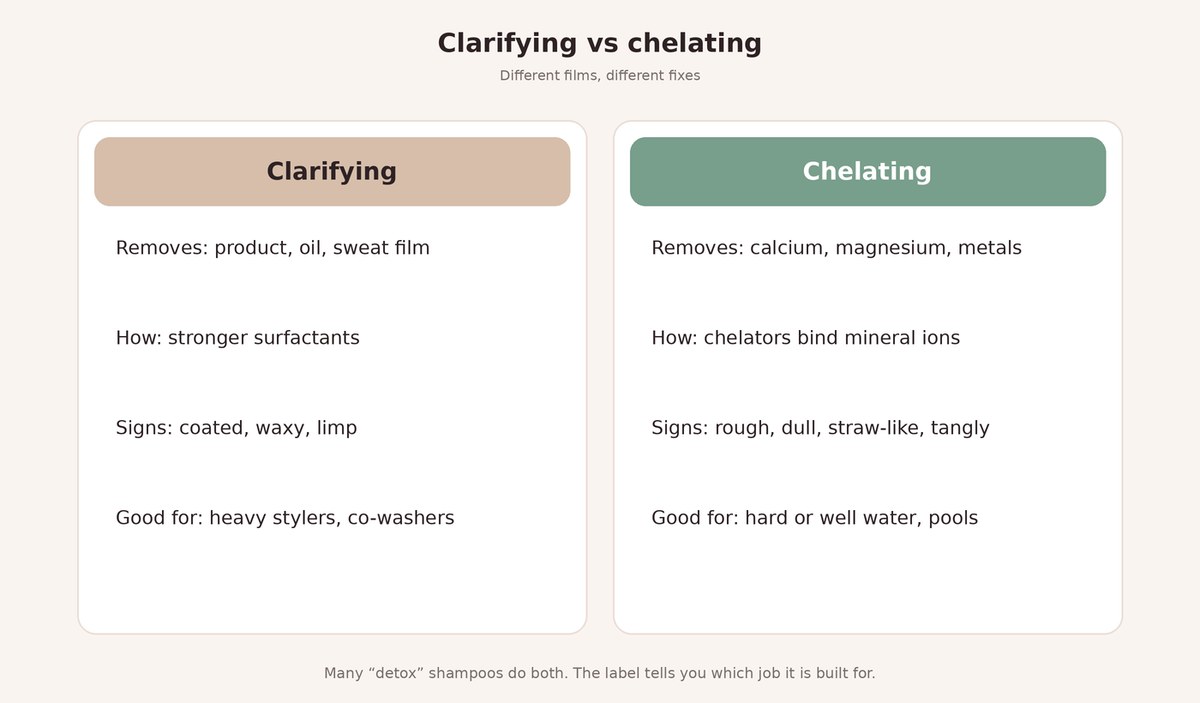 | | Clarifying | Chelating |
| --- | --- | --- |
| Removes | Product, oil, sweat film | Calcium, magnesium, other metals |
| How | Stronger surfactants | Chelators bind mineral ions so they rinse off |
| Hair feels | Coated, waxy, limp | Rough, dull, stiff, tangly |
| Best for | Heavy stylers, [co-wash](https://curlyhair.app/ar/blog/co-wash-vs-shampoo) routines | Hard or well water, frequent swimming |
Many "detox" or "reset" shampoos do both jobs. If your problem is product buildup on soft water, a clarifier is enough. If you're on hard water, pick one that names minerals on the label. For everyday cleansing, see [sulfates and curly hair](https://curlyhair.app/ar/blog/sulfates-curly-hair).
## Does your shampoo actually chelate?
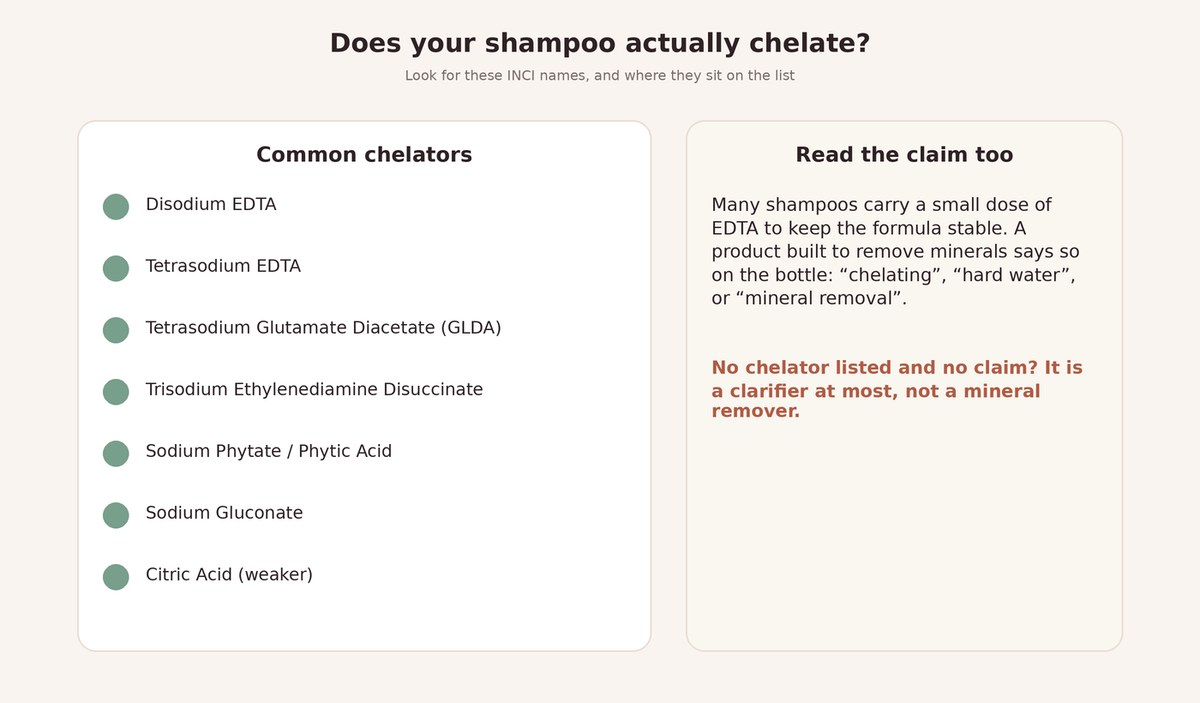 Chelating agents are standard shampoo ingredients. Dermatology reviews describe them binding calcium and magnesium that would otherwise form insoluble "scum" on the scalp and hair ([Gavazzoni Dias, 2015](https://pmc.ncbi.nlm.nih.gov/articles/PMC4458934/)). That means a chelator on the label alone doesn't tell you much. Many formulas use a small amount just to keep the product stable.
Look for both:
1. **A chelator in the ingredients.** Common INCI names: disodium EDTA, tetrasodium EDTA, tetrasodium glutamate diacetate (GLDA), trisodium ethylenediamine disuccinate, sodium phytate or phytic acid, sodium gluconate. Citric acid has some chelating action, but it's often there to adjust pH.
2. **A claim on the bottle.** A product built for mineral removal says "chelating," "hard water," or "mineral" on the front or in the directions.
No chelator and no claim means it's a clarifier at most. Not sure how to read the list? Use our [guide to reading product labels](https://curlyhair.app/ar/blog/read-product-labels), or paste the ingredients into the [Curltine ingredient checker](https://curlyhair.app/ar/blog/ingredient-checker).
## How often to use a chelating shampoo
Start from your water band above, then adjust to your hair:
- **Rougher or drier after a chelating wash?** Wait longer next time, and spend more time on conditioner.
- **Softer and more defined for a few washes, then rough again?** That gap is roughly your cadence.
- **Bleached, colored, or heat-damaged hair?** It holds more minerals (see above), but it's also fragile. Chelate when the signs show, not on autopilot, and follow your colorist's wait time after a fresh color.
- **You swim a lot?** Pool water adds its own load; chelate after swim-heavy weeks.
Use your regular gentle shampoo or co-wash on every other wash day. Chelating isn't an every-wash product.
## How to do a chelating wash (step by step)
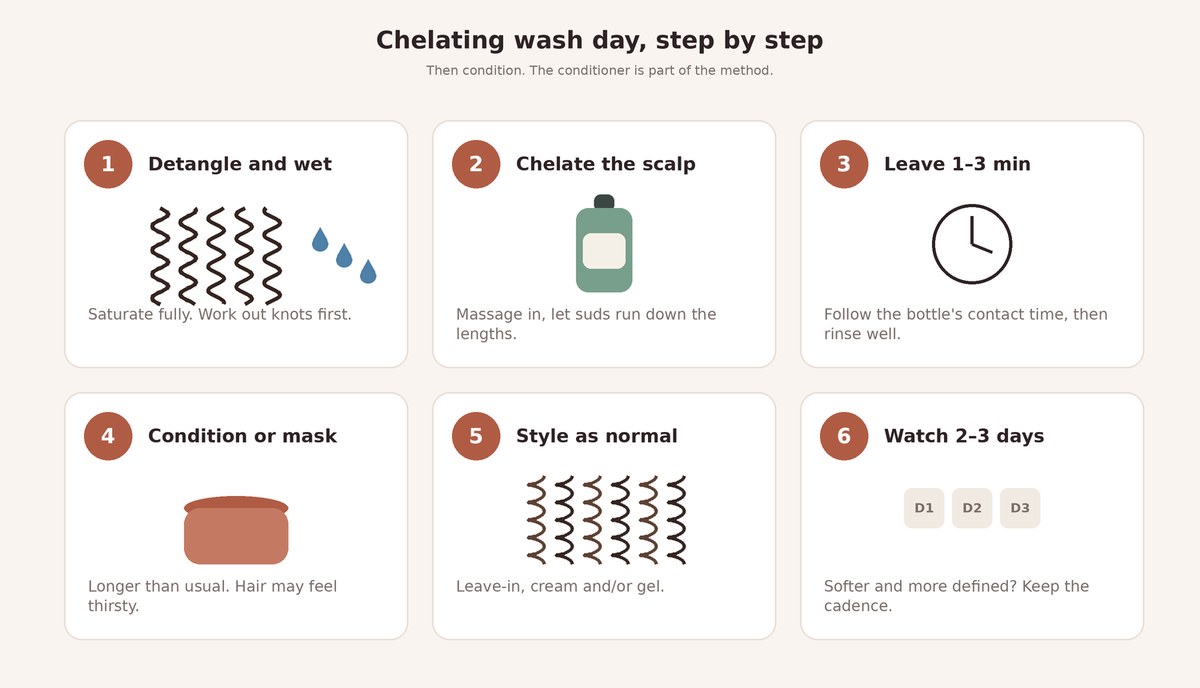 1. **[Detangle](https://curlyhair.app/ar/blog/detangle-curly-hair-without-breakage) and wet.** Work out knots with slip first, then saturate your hair fully.
2. **Chelate the scalp.** Massage the shampoo into your scalp with your fingertips. Let the suds run down the lengths instead of scrubbing the ends.
3. **Give it contact time.** Follow the bottle's directions (often 1–3 minutes), then rinse until the water runs clear.
4. **Condition or mask.** Leave it on longer than usual. Hair often feels thirsty right after.
5. **Style as normal.** Leave-in, then cream and/or gel. Your [wash day routine](https://curlyhair.app/ar/blog/wash-day-routine) doesn't change.
6. **Watch the next 2–3 days.** Softer, shinier, easier to detangle? Minerals were part of the problem. No change? Look at product buildup, moisture, or [protein balance](https://curlyhair.app/ar/blog/protein-moisture-balance) instead.
## Shower filters, softeners, and rinses
- **Shower filters mostly don't soften water.** Most shower-head cartridges (carbon, KDF) target chlorine, not calcium and magnesium. When researchers tested five showerhead filters sold online, most didn't meet the sellers' claims, and some even changed hardness the wrong way ([Dach et al., 2023](https://doi.org/10.1089/ees.2023.0099)). A filter may help with chlorine smell; don't count on it for minerals.
- **Softening means ion exchange.** A water softener is what actually removes hardness minerals. It's a house-level fix (and a renter-unfriendly one), so for most people a periodic chelating wash is the practical answer.
- **Acidic rinses.** Diluted apple cider vinegar or citric rinses are popular, and a lower pH is gentler on the cuticle. Treat them as a finishing rinse, not a replacement for a chelating shampoo; we didn't find good evidence that they remove mineral deposits on their own.
Scalp itchy or flaky? Hard-water scum can make a scalp feel worse, but persistent flaking or itching deserves a look from a dermatologist. Our [scalp care guide](https://curlyhair.app/ar/blog/curly-hair-scalp-care) covers the basics.
## Frequently asked questions
### Is hard water bad for curly hair?
It can make curls feel rougher, duller, and more tangly because calcium and magnesium collect in the cuticle. Lab studies show more mineral deposits and stiffer fibers, but the evidence that hard water causes serious damage is limited. Damaged or bleached hair is affected most.
### What's the difference between chelating and clarifying shampoo?
Clarifying shampoo uses stronger cleansers to remove product, oil, and sweat buildup. Chelating shampoo adds ingredients that bind minerals like calcium and magnesium so they rinse away. Many products do both; the label tells you which job it's built for.
### How often should I use a chelating shampoo on curly hair?
Start with your water hardness: about monthly for moderately hard water, every 2–4 weeks for hard, every 1–2 weeks for very hard. Then stretch the gap if your hair feels dry afterward, or shorten it if roughness comes back quickly.
### Do I need a chelating shampoo if I have soft water?
Usually not on a schedule. Use a clarifier for product buildup. One exception: chemically damaged hair can pick up minerals even from soft water, so an occasional chelating wash may still help if your hair feels rough.
### Will a shower filter fix hard water hair?
Probably not. Most shower filters are designed for chlorine, not calcium and magnesium, and independent testing has found many don't meet their claims. Softening water takes an ion-exchange softener.
### Is EDTA in my regular shampoo enough?
Not necessarily. Many shampoos include a small amount of EDTA to keep the formula stable. A shampoo made to remove minerals says so on the label.
## Know what your hair is reacting to
Rough curls can come from minerals, buildup, [porosity](https://curlyhair.app/ar/blog/hair-porosity-test), or damage, and they all look similar in the mirror. A Curltine scan estimates your curl pattern, porosity, and density, and the ingredient checker tells you what's in your bottles. Start in the Curltine app or build a wash day in [Curltine routines](https://curlyhair.app/ar/routines).
[Start with a Curltine hair scan](https://curltine.com/open?utm_source=curlyhair&utm_medium=blog&utm_campaign=hard-water-curly-hair)
## FAQ
### Is hard water bad for curly hair?
It can make curls feel rougher, duller, and more tangly because calcium and magnesium collect in the cuticle. Lab studies show more mineral deposits and stiffer fibers, but the evidence that hard water causes serious damage is limited. Damaged or bleached hair is affected most.
### What's the difference between chelating and clarifying shampoo?
Clarifying shampoo uses stronger cleansers to remove product, oil, and sweat buildup. Chelating shampoo adds ingredients that bind minerals like calcium and magnesium so they rinse away. Many products do both; the label tells you which job it's built for.
### How often should I use a chelating shampoo on curly hair?
Start with your water hardness: about monthly for moderately hard water, every 2–4 weeks for hard, every 1–2 weeks for very hard. Then stretch the gap if your hair feels dry afterward, or shorten it if roughness comes back quickly.
### Do I need a chelating shampoo if I have soft water?
Usually not on a schedule. Use a clarifier for product buildup. One exception: chemically damaged hair can pick up minerals even from soft water, so an occasional chelating wash may still help if your hair feels rough.
### Will a shower filter fix hard water hair?
Probably not. Most shower filters are designed for chlorine, not calcium and magnesium, and independent testing has found many don't meet their claims. Softening water takes an ion-exchange softener.
### Is EDTA in my regular shampoo enough?
Not necessarily. Many shampoos include a small amount of EDTA to keep the formula stable. A shampoo made to remove minerals says so on the label.
## Related
- [Curl Journal](https://curlyhair.app/ar/blog)
- [Home](https://curlyhair.app/ar)